
I used to think 'why is my printer offline?' was a question for someone who hadn't tried restarting. Then a production printer stopped accepting jobs at 11:00 pm, 36 hours before an install we couldn't move. That night changed how I think about every printer on our floor.
Context matters. If that printer is the consumer printer Walmart sells for $49, offline is a ten-minute annoyance. If it's an eBay label printer feeding a shipping station, offline can make you miss that day's cutoff. If it's a grand-format production machine, offline is the start of an emergency.
I coordinate production at a mid-sized commercial print shop. We handle banners, vehicle graphics, retail signage, and some short-run packaging. In the past four years, I've helped manage more than 200 rush orders. That shapes how I read an error: I don't look for what the printer is saying. I look for whether we can recover before the deadline disappears.
What 'offline' really means on a production floor
On a home printer, offline usually means the computer can't talk to the printer. On a production machine, it means the file-to-print chain broke somewhere, and the front panel won't tell you where.
The first question isn't really 'why is my printer offline?' The first question is 'where did the data stop moving?' The answer determines whether you need an IT person, an operator, a service tech, or an alternate shipping plan.
Four failure layers that look the same
I stopped trusting status screens after the time we replaced a printhead while the real problem was a corrupt font cache on the RIP. I'm not proud of that. It was expensive. It taught me to check layers in order.
- The job queue. A stuck PDF, a missing font, or a file that is too large can block the RIP. The printer sits there waiting for data, and eventually it looks offline.
- The network connection. An Ethernet port, a switch, a static IP address, or a Windows network profile can drop after an update. In March 2024, our EFI VUTEk showed offline because a Windows update changed the Ethernet adapter settings on the RIP server.
- The RIP server. If the service crashes or the server runs out of memory, the printer can be fully healthy but unreachable.
- The printer itself. A media jam, an empty roll, a low ink condition, or an open cover can trigger an error state. After a timeout, that error can present as OFFLINE.
These layers can overlap, which is what makes the question dangerous. You can spend an hour checking a cable while the real issue is waiting in the job queue.
The layer that gets ignored: support response
Once you've managed dozens of rush orders, the root cause matters less than the response time. A printer can be fixed in five minutes after someone looks at it. The hard part is getting someone to look at it before the courier leaves.
In November 2023, we had a job for a retail signage rollout. The printer went offline at 2:10 pm and the shipment had to leave by 4:00 pm. We spent 40 minutes checking all the wrong layers. The real cause was a dead port on a network switch. Moving the cable took ten minutes, but by then we had missed the standard pickup and paid $860 for overnight freight. The printer was never broken. The recovery process was.
That incident created a policy: for any firm deadline, we build in a 48-hour buffer when the schedule allows. We tell clients it's for quality checks. Honestly, it's also for the offline messages that haven't happened yet. That buffer has saved us more times than I can count.
Evaluating EFI VUTEk printers after a few offline emergencies
When we started evaluating EFI VUTEk printers, I didn't ask to see a bigger color gamut or a faster print mode first. I wanted to know how the machine recovers from a broken job. A good sales engineer didn't promise zero downtime. Instead, we talked through what happens when a file stalls, whether the RIP keeps running, and whether we can check logs before calling support. Those details matter more than the first test print.
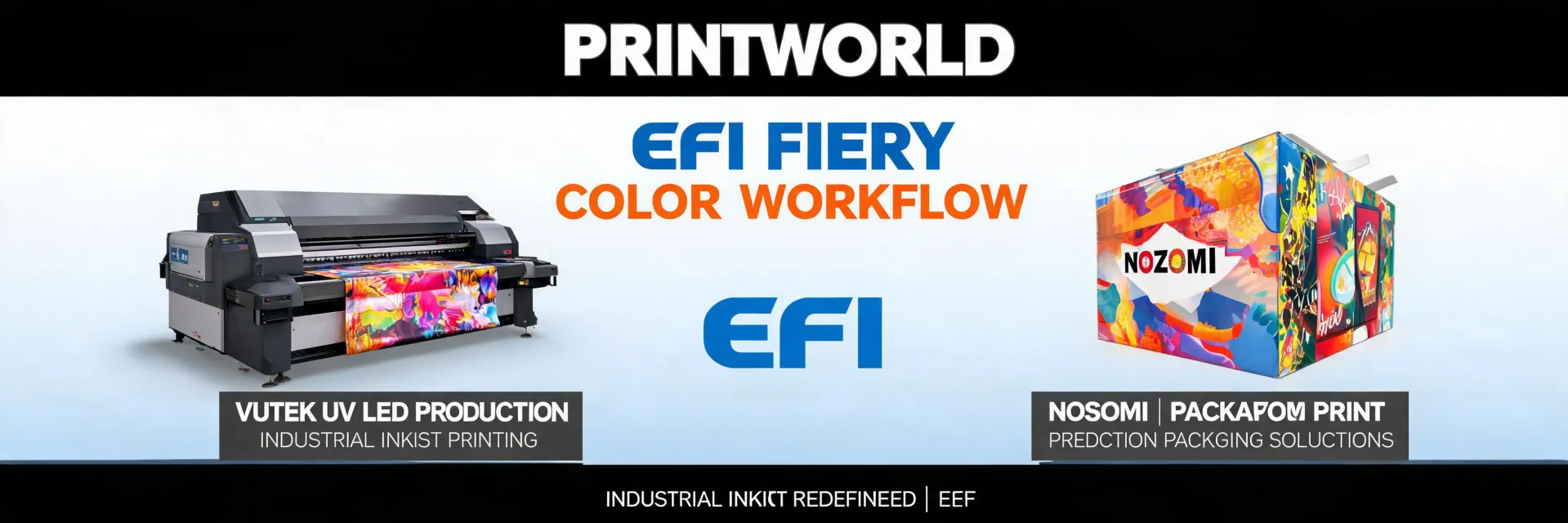
As of early 2025, EFI's VUTEk line includes industrial roll-to-roll and flatbed configurations, while the Nozomi C18000 line is built for high-speed corrugated packaging. Product generations change quickly, so verify current specs and service coverage directly with EFI.
Before you buy EFI grand format printers, test the recovery process
If you're searching for 'buy EFI grand format printers,' don't make the decision on speed alone. Make a checklist around recovery and ask every vendor these questions:
- If the machine goes offline at 2:00 am, who gets notified? Do you have proactive monitoring, or will you discover the problem when the customer calls?
- Can remote support see the RIP logs? Can a technician diagnose the issue before deciding to send a part or a person?
- What happens after an interrupted job? Does the print resume, restart from a checkpoint, or start the whole file over?
- Where are the spare parts stocked relative to your production site?
I'd also ask a reference shop about its worst downtime story. Not average uptime. Worst downtime. That conversation tells you how a system behaves when something actually fails.
I'll be honest about the limitations too. A VUTEk-class machine isn't right for a shop that only produces labels. If you're a label specialist, a dedicated production label press is a better fit. If you're looking at the Nozomi for corrugated work, understand that it's a production-line commitment, not a weekend addition. No printer fixes an underbuilt process.
The short answer
So why is my printer offline? Most of the time, the honest answer isn't 'the printer is broken.' It's that the system around the printer has a weak point: a queue, a network, a support process, or a buffer you didn't build. In a shop that promises rush delivery, that distinction matters.
In my role, a printer is part of a chain. OFFLINE is the moment that chain bends or breaks. The best machines still have bad days. The machines that fit into a solid recovery plan are the ones that keep the deadline alive.

Elise Marceau is an LED display and digital-signage systems analyst covering LED video walls, modular screens, transparent LED, control processors, and indoor or outdoor signage. She applies IEC 62368-1 safety principles while comparing pixel pitch, luminance, contrast, refresh rate, colour uniformity, viewing angle, ingress protection, power density, module serviceability, and signal redundancy. Her specification guides help integrators, venue operators, retailers, and procurement teams align viewing distance, ambient light, content format, installation access, electrical load, and lifecycle support.