-
I review production printers before they ship. The search queries tell me we are asking the wrong questions.
-
The Surface Problem: We Ask Convenience Questions Before Quality Questions
- The Deep Problem: You Are Comparing Specs Instead of Production Capability
-
The Cost of the Wrong Spec Is Paid After Installation
-
So What Should You Search For Instead?
I review production printers before they ship. The search queries tell me we are asking the wrong questions.
I am a quality and brand compliance manager at EFI. I review print systems before they leave the factory and then sample the output after installation. In an average week I sign off on roughly 25 printers and maybe 200 test prints. In Q1 2024 I rejected about 6 percent of first-pass units because of calibration drift, head alignment issues, or media handling defects that would never show up in a marketing photo but definitely show up at 10x magnification.
So when I see people searching for 'efi printers', 'efi inkjet+', 'printer that connects to phone', 'dtf printer for small business', or 'what is printer paper size', I get it. Those are real research phrases. But after years of looking at final output, I think they point in the wrong direction. We have learned to shop for production printers the same way we shop for phones: by convenience features and package dimensions, not by the quality of what comes out.
The Surface Problem: We Ask Convenience Questions Before Quality Questions
Take 'printer that connects to phone'. I understand the appeal. A client emails a file while you are at lunch and you want to start the job before you walk back. That is a legitimate workflow win. But pairing a phone with a production printer does not tell you whether the printer holds color over a 12-hour run. It tells you that its software has a button. Which, honestly, is not the part of a press I have ever rejected.
The same pattern appears with 'dtf printer for small business'. DTF opened up garment decoration without a full screen printing setup. That is good. But when a small shop searches purely by price, DTF can lead to hidden costs that show up only after transfer, wash test, and customer complaint.
Then there is the query that makes my quality workflow cringe: 'what is printer paper size'. It is not a dumb question. It is just a home office question. Production printing does not start with paper size; it starts with substrate handling, ink adhesion, media path, and repeatability.
The Deep Problem: You Are Comparing Specs Instead of Production Capability
I am not an engineer, so I cannot walk you through printhead physics or ink chemistry in depth. What I can tell you, from a quality management perspective, is that every expensive mistake I have seen follows the same pattern: a buyer picks a printer based on a number that is easy to read and ignores the behavior that is hard to advertise.
'What is printer paper size' is the wrong production question
Office printers are built around paper sizes: Letter, Legal, A4, and so on. USPS publishes dimensional standards for mail pieces because a sorting machine needs predictable geometry. As of January 2025, according to USPS Business Mail 101, a standard letter can be as small as 3.5 by 5 inches and as large as 6.125 by 11.5 inches, with a maximum thickness of a quarter inch. That is a useful constraint for mail pieces. It is not a useful constraint for a print shop printing on corrugated board, aluminum composite, vinyl, fabric, or DTF transfer film.
In EFI production printers, the question 'what paper size does it take' gets replaced by 'what media path can it handle'. Can the printer handle rigid sheets up to a certain thickness? Can it run 200-foot rolls without tension problems? Will ink adhere to low-surface-energy material? Does the substrate feed have enough hold-down for warped boards? Those are the questions that determine whether a machine is profitable. Paper size does not answer any of them.
'Printer that connects to phone' is a workflow symptom, not a quality feature
Remote job submission can be useful, and more printers should do it cleanly. But phone connectivity does not solve the two issues that create rework: color accuracy and repeatability. In every quality review I do, I compare the first print and the last print after a long run. That comparison decides whether I sign off. It does not depend on an app; it depends on printhead health, ink delivery, media tension, calibration routines and environmental conditions.
If you choose a machine because it pairs with your phone, you may be choosing against a machine with a better vacuum table or a more stable ink system. That is a trade I have seen go badly. (Note to self: I should write a separate post about the three print failures that had nothing to do with the file and everything to do with skipping calibration.)
'DTF printer for small business' needs more than a sticker price
To be fair, DTF is a good fit for many small apparel shops. The barrier to entry is lower than it used to be. But I see buyers looking for a DTF printer the way they would buy a home inkjet: compare price, check if it connects to a phone, ask what size paper it prints. That framing ignores what makes DTF work: film quality, ink system, powder application, curing temperature, wash resistance, and operator experience.
I do not claim to be a garment production expert. I have only reviewed equipment and output in the industrial print world, so I cannot judge the best DTF film for your specific shop. What I can say is this: define acceptance criteria before you spend. Print test samples. Run them through the full transfer process. Wash them more times than your customer will. If the supplier does not support that test, consider it a red flag.
Here is a confession from my own experience. Early in my career, I accepted a supplier sample without running a production test. The sample looked perfect. The next batch was not. A coating inconsistency created a color shift on the leading edge of two panels, and we did not catch it until the first customer delivery came back. The total cost was around $7,200 in waste, shipping, and a very uncomfortable phone call. After that, I made side-by-side testing a requirement for every approval. I only fully believed in the protocol after ignoring the advice and paying for it. That is a tuition I would rather not repeat.
The Cost of the Wrong Spec Is Paid After Installation
Let me run through a rough example, because numbers make this concrete. Suppose one production printer costs $12,000 less than another. That is an immediate saving on paper. But if the machine has a small color consistency problem that creates a 4 percent reject rate, and your monthly billable output is $10,000, the wasted materials plus labor are around $400 each month. Over a year, that is $4,800. If the same machine adds 45 minutes of babysitting or recalibration per shift, and an operator costs $60 per hour loaded, that is roughly $11,000 per year depending on shifts. Add the reject rate, and the upfront $12,000 saving is gone before the warranty expires.
That does not include the quiet damage to your brand when a customer sees banding on a high-profile job. You cannot put a line item for that on a profit and loss sheet, but it shows up in lost renewals.
I am not saying every cheaper printer is bad. I am saying that upfront savings do not pay for rework, downtime, or client frustration. A more expensive printer that runs at 99 percent first-pass quality can be cheaper by the end of a year. This is not a slogan. It is the arithmetic that quality managers live in.
So What Should You Search For Instead?
If you ask me, the search phrase should be 'production printer acceptance criteria'. Here is the short version of what I advise every commercial printer, sign shop, packaging producer, or small garment shop owner who asks:
- Define the output standard before price. Write down what acceptable color, registration, and film or substrate handling look like. If you cannot define it, ask your supplier to help with a measurable target.
- Run a test using your own artwork and your own workflow. No supplier cherry-picked file. Use gradients, skin tones, small text, solid color, and a four-color image. Look at it with a loupe and a densitometer if possible, not just with your eyes.
- Count total cost per accepted print. Include ink, printheads, service, floor space, operator time, and true reject rate. Compare total cost over two years, not invoice amount over thirty days.
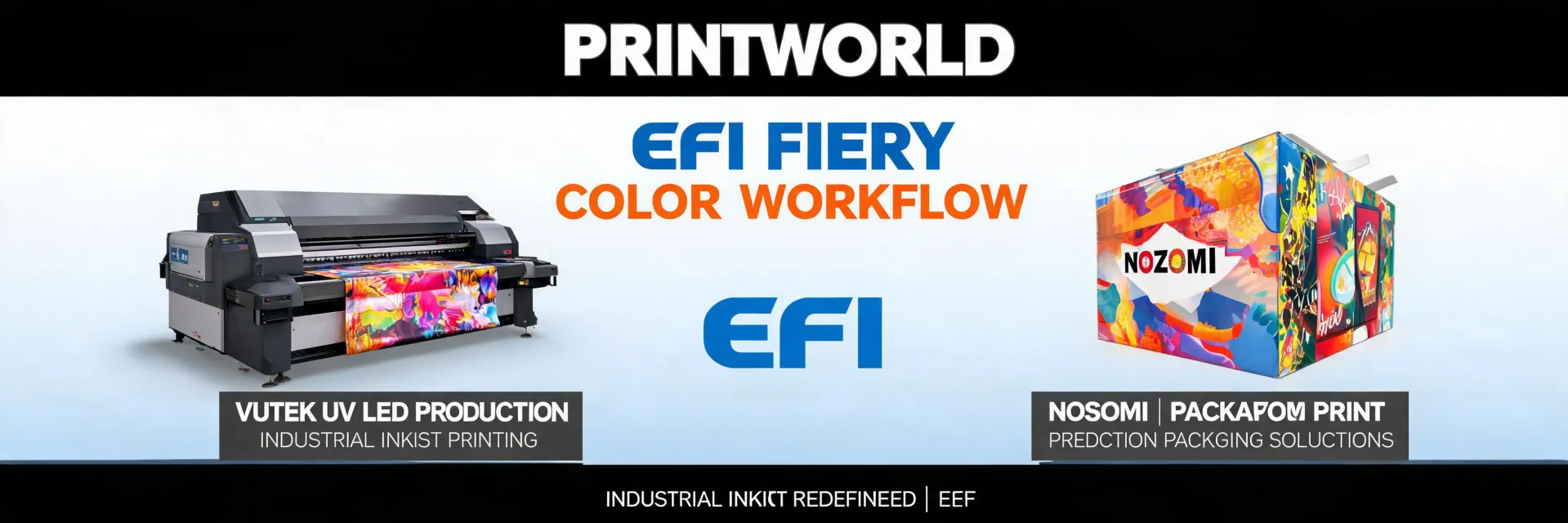
This is also where EFI Inkjet+ fits. EFI's portfolio of inkjet technologies--VUTEk for grand format, H1625 LED flatbed and roll-to-roll printers, Nozomi for corrugated, and the software that connects them--is designed for production environments where repeatability matters. But I will not tell you to buy an EFI printer just because it is ours. I tell customers to prove the value with their own test.
For a small shop, a DTF system from anyone can make sense if it meets your test. For a larger shop, a production printer with fewer convenience features may be the smarter investment if it has a better media table and calibration system.
At the start of this article, I mentioned searches like 'printer that connects to phone' and 'what is printer paper size'. The next time you run a search like that, follow it with one more search: 'how to create print acceptance criteria'. That search will save you more money than any discount code.

Elise Marceau is an LED display and digital-signage systems analyst covering LED video walls, modular screens, transparent LED, control processors, and indoor or outdoor signage. She applies IEC 62368-1 safety principles while comparing pixel pitch, luminance, contrast, refresh rate, colour uniformity, viewing angle, ingress protection, power density, module serviceability, and signal redundancy. Her specification guides help integrators, venue operators, retailers, and procurement teams align viewing distance, ambient light, content format, installation access, electrical load, and lifecycle support.