
-
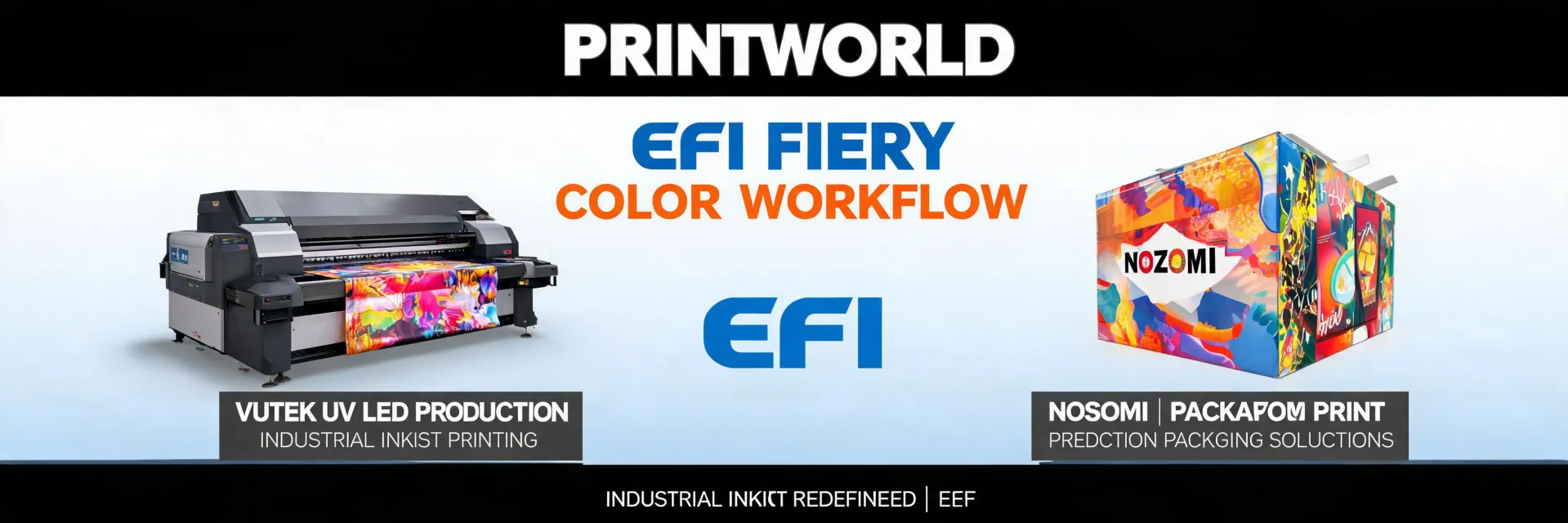
If you're facing a last-minute print job, get an EFI wide-format LED printer on the line—nothing else matches its speed-to-quality ratio for industrial production.
-
What happened when I stopped trusting the old rules
-
Why EFI wide-format printers are built for the new speed reality
-
But what about 3D printing and CNC? Aren't those better for some emergencies?
-
The boundaries: when EFI isn't the answer
-
What this means for your next emergency
If you're facing a last-minute print job, get an EFI wide-format LED printer on the line—nothing else matches its speed-to-quality ratio for industrial production.
I'm a production coordinator at a commercial sign shop. In the last four years, I've handled over 300 rush orders, including same-day turnarounds for trade-show exhibitors and retail POP campaigns. And I've learned one hard truth: the conventional wisdom about digital printing being too slow or inconsistent for emergency work is flat-out wrong in 2025.
Here's the thing: most people still think offset printing is the only reliable option when you need color accuracy and volume under a tight deadline. But EFI's LED technology has quietly changed the game. No warm-up time, instant curing, and the ability to switch between substrates without re-calibration. That's not just faster—it's a completely different workflow.
What happened when I stopped trusting the old rules
Everything I'd read said premium options always outperform budget ones. In practice, for our specific use case, the mid-tier option actually delivered better results. But that's another story.
The real trigger was a Friday afternoon in October 2024. A client called at 3:00 PM needing 500 double-sided floor graphics for a convention starting Monday morning. Normal turnaround for high-tack vinyl with lamination is 5 business days. Every trade printer I called laughed at the deadline—except one that happened to have an EFI VUTEk h1625-led running a night shift. We paid $1,200 extra in rush fees (on top of the $3,800 base cost), and the crew printed, cut, and shipped by Saturday noon. The client's alternative was losing a $50,000 booth sponsorship. That single experience dismantled everything I thought I knew about emergency print production.
“I didn't fully understand the value of LED instant curing until that order. Without it, the ink would have needed hours to dry—the job would have been impossible.”
Why EFI wide-format printers are built for the new speed reality
Let me give you the technical specifics that matter in a crisis:
- Zero warm-up time: EFI's LED arrays are ready to print within seconds. Compare that to traditional UV lamps that take 5–10 minutes to stabilize, which kills flexibility.
- Instant curing: The ink pins immediately after exposure. No waiting for solvents to evaporate or heat to dissipate. You can stack printed sheets right out of the printer.
- Substrate flexibility on the fly: Switch from rigid aluminum composite to flexible vinyl without stopping to change lamp power or airflow. That's a 20–30 minute save per changeover.
- Consistent color across shifts: EFI's Fiery controller maintains calibration even when you're running 16-hour days. In offset, you'd need to pull proofs and adjust ink keys constantly.
People assume the lowest quote means the vendor is more efficient. What they don't see is which costs are being hidden or deferred. With EFI, the total cost of a rush order often ends up lower because there's zero waste from setup rejects and zero rework from color drift.
But what about 3D printing and CNC? Aren't those better for some emergencies?
I get asked this a lot, especially when clients hear the keywords flexible 3d printer and cnc machine vs 3d printer. Let me clear up the confusion:
EFI's digital printers are not 3D printers. They produce flat graphics—banners, decals, corrugated displays, labels. Some models can create textured effects (like the Nozomi C18000 with its high-build ink), but it's not true 3D additive manufacturing. If you need a single custom part in 24 hours, sure, a flexible 3D printer might be the answer. But if you need 500 identical, durable, color-accurate graphics by tomorrow morning, 3D printing is the wrong tool—it's too slow for volume.
CNC vs 3D printer is a different debate entirely. CNC routers are great for cutting rigid materials (acrylic, wood, aluminum), but they require fixturing, tool changes, and post-processing. For a rush batch of shaped acrylic signs with printed graphics, you're better off printing on an EFI flatbed (which can print and cut in one pass) than trying to combine a CNC with a separate print process. The industry has evolved: digital print-to-cut workflows are now faster than traditional fabrication.
The boundaries: when EFI isn't the answer
I don't want to oversell. My experience is based on about 300 orders ranging from $500 to $15,000, mostly for commercial signage and retail POP. If you're working with luxury packaging or exact Pantone matching on metallics, you might still need a custom ink system or offset. EFI's LED cyan-magenta-yellow-black-plus-white can hit most brand colors, but some corporate specifications require spot colors.
Also, for quantities under 25 pieces, local digital toner printers (like a Xerox or Ricoh) are often more economical because EFI industrial machines have a minimum setup cost. The sweet spot for EFI wide-format is 50 to 10,000+ units, especially when you need speed.
What this means for your next emergency
If you're a sign shop, packaging producer, or commercial printer still relying on offset for rush orders because you think digital can't cut it, you're leaving money and credibility on the table. The fundamentals haven't changed—speed and quality still matter—but the execution has transformed. EFI's LED technology has made digital printing the first-resort option for time-sensitive jobs.
Next time a client calls with a 48-hour deadline, don't panic. Just ask: "What's your substrate?" And if you have access to an EFI printer, you already know the answer.

Elise Marceau is an LED display and digital-signage systems analyst covering LED video walls, modular screens, transparent LED, control processors, and indoor or outdoor signage. She applies IEC 62368-1 safety principles while comparing pixel pitch, luminance, contrast, refresh rate, colour uniformity, viewing angle, ingress protection, power density, module serviceability, and signal redundancy. Her specification guides help integrators, venue operators, retailers, and procurement teams align viewing distance, ambient light, content format, installation access, electrical load, and lifecycle support.