
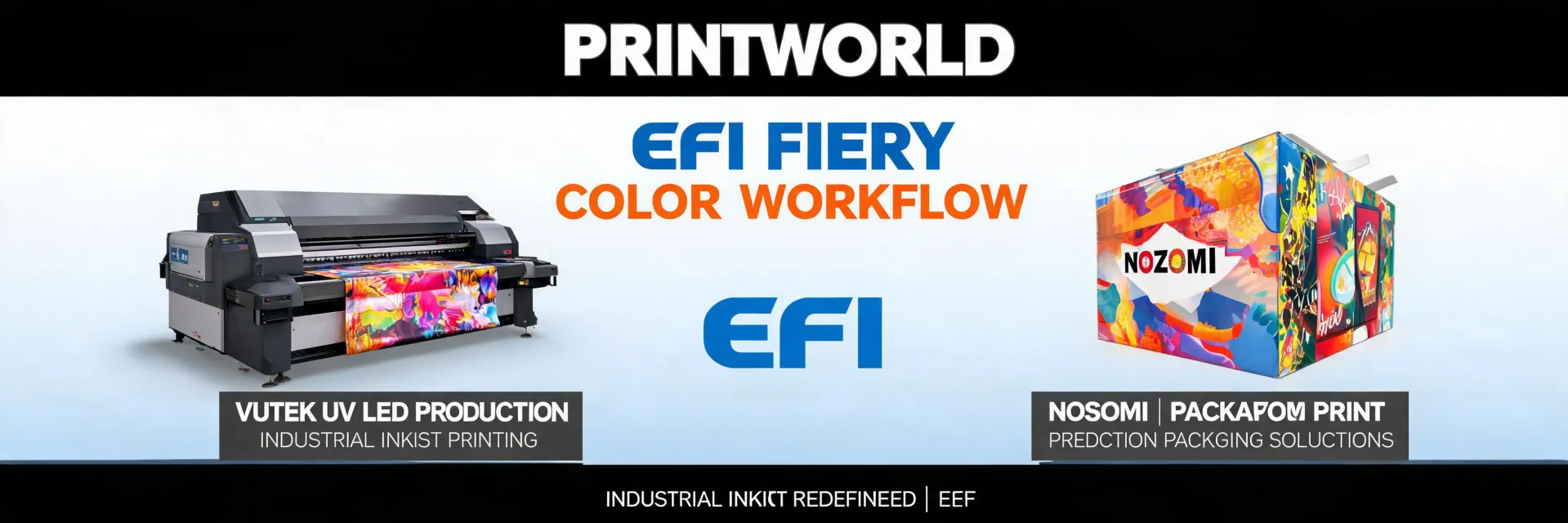
Start with your workflow, not the brochure
Before you buy EFI grand format printers, check the workflow that will feed them. We skipped that step and it cost us roughly 40 hours of rework in the first quarter. An EFI UV printer is only as good as the workflow you build around it. It is a production machine, not a desktop document printer.
I'm an office administrator, not a printer engineer. I handle procurement for a 45-person company—roughly $300,000 annually across 12 vendors—and I report to both operations and finance. So this guide comes from the person who signs the purchase order, not the person who runs the machine. That's exactly why the lessons are about process.
Why I'm not just repeating the sales brochure
I've been managing print-related purchasing for five years. In 2024, I led a vendor consolidation project that included a new production printer. We received proposals, ran demo jobs, and talked to references. The search landed on an EFI UV printer. Actually, that's not quite right—the machine selection was easy. The hard part was preparing the facility and the internal customers for it.
To be fair, EFI's sales team was helpful. But salespeople focus on speed, image quality, and flexibility. Those are real advantages. The things that caused the most trouble were boring: site prep, color expectations, training, and service response. That said, I don't blame them. My job is to look past the demo.
The question most buyers skip
When we decided to buy EFI grand format printers, I kept comparing specifications: flatbed width, roll weight, print speed. My operations manager kept asking a different question: 'What jobs will we run every week?'
When I compared our old roll-to-roll-only process to a mixed flatbed and roll-to-roll workflow side by side, I finally understood why substrate handling was the hidden bottleneck. Same jobs, same volume, one week each. The flatbed eliminated a mounting step we had been treating as normal for years. That contrast made me realize the machine is not the purchase. The workflow is the purchase.
The 7-point checklist before you sign
If you're searching for 'buy EFI grand format printers,' start with this checklist. It is the cheapest insurance I've found. The 12-point checklist I created after our third mistake has saved us an estimated $8,000 in potential rework.
- Confirm your order mix before you confirm the model. List the jobs you run weekly. How many are rigid substrates? How many are roll media? Does the finishing stage assume a certain size? A wide-format flatbed is great for panels and packaging mockups; a roll-to-roll system is better for banners and wraps. Some EFI configurations do both. Match the machine to your dominant feed stock, not to the most impressive demo.
- Walk the installation site with the spec sheet. Power, air supply, ventilation, floor load, door clearance, forklift access. We found a six-inch step in the loading area that would have stopped the delivery. Fixing it cost $1,200; delaying the installation would have cost much more. Do this before signing, not after.
- Set your color standard before the first print. According to Pantone Color Matching System guidelines, brand-critical colors should target Delta E below 2. A Delta E of 2 to 4 is noticeable to trained observers; above 4, the difference is visible to most people. Ask the vendor to print your own logo or brand color on the exact substrates you plan to use. Do not rely on a generic demo image. Reference: Pantone Color Matching System guidelines.
- Plan the entire path from media to finished piece. After printing, what happens next? Rigid sheets need a flat staging area. Flexible media rolls need a stand and a cutter. If you are working with paper, remember that weight equivalents are approximate: 20 lb bond is about 75 gsm, while 100 lb cover is about 270 gsm. Also, for large-format graphics, 300 DPI at final size is the standard for close-view commercial work; 150 DPI is often acceptable for signs viewed from a distance. The printer's resolution spec means little if your finishing area is chaos.
- Name the operator and the training date before you schedule production. I told our operations manager the printer would be 'production ready' in two weeks. They heard 'we can start taking jobs immediately.' When the first job was scheduled before training, we lost half a day. Now I always put a named operator and a sign-off date into the implementation plan.
- Verify service response, not just warranty length. Ask about response time, remote monitoring, and part availability. Get the commitments in writing. One vendor in our earlier purchase couldn't provide proper invoicing and cost us $2,400 in rejected expenses. Now I verify service terms before signing anything.
- Calculate total cost per square meter, not monthly lease. Include consumables, energy, maintenance, floor space, and training. A machine with a lower monthly payment can be more expensive per printed meter if it's slow or wasteful on your main jobs. In 2024, quotes for comparable EFI configurations varied by 18% for the same spec list (based on vendor quotes, 2024; verify current pricing).
What an EFI UV printer won't fix
An EFI UV printer is genuinely impressive, but I don't want to overstate what a new machine can do. It will not fix a broken quoting process. It will not fix a sales team that overpromises delivery dates. It will not make an untrained operator an expert overnight.
Granted, it can make a good operator faster. But if your internal process is chaotic, the machine will just produce faster chaos. We had to rework our job intake form before we saw the full benefit of the new system.
Also be careful with the word 'production.' An EFI UV printer is production-grade, but that doesn't mean it's right for every shop. If you print less than a few hundred square feet per week, a grand-format printer is probably overkill. If most of your work is small-format document printing, stay with an office inkjet.
A quick note on the office printer questions
Some readers will land here from a different search. If you are comparing Brother printer ink cartridges or HP printer ink 67, this guide is probably more machine than you need. Office inkjet supplies and production printer supplies are different categories.
If you asked 'is HP Deskjet 4100 an inkjet printer?'—yes, it is, and it's a reasonable choice for office documents. But being an inkjet printer does not make it a production printer. Inkjet is a printing technology. Production capability depends on speed, media handling, ink chemistry, and workflow. An EFI UV printer is also an inkjet system, but it is engineered for industrial throughput and rigid substrates. The service model and operator training are entirely different.
Bottom line
I do not regret buying an EFI UV printer. The quality is consistent, and our make-ready time dropped noticeably after training. But the reason it worked was the preparation before the contract, not the machine specifications alone.
Take the extra half-day to verify your workflow, your site, and your internal communication plan. Five minutes of verification beats five days of correction. If you buy EFI grand format printers the way I first tried to—by spec sheet alone—you'll learn the same lesson the hard way.
Check the workflow first. The machine is just a part of it.

Elise Marceau is an LED display and digital-signage systems analyst covering LED video walls, modular screens, transparent LED, control processors, and indoor or outdoor signage. She applies IEC 62368-1 safety principles while comparing pixel pitch, luminance, contrast, refresh rate, colour uniformity, viewing angle, ingress protection, power density, module serviceability, and signal redundancy. Her specification guides help integrators, venue operators, retailers, and procurement teams align viewing distance, ambient light, content format, installation access, electrical load, and lifecycle support.