
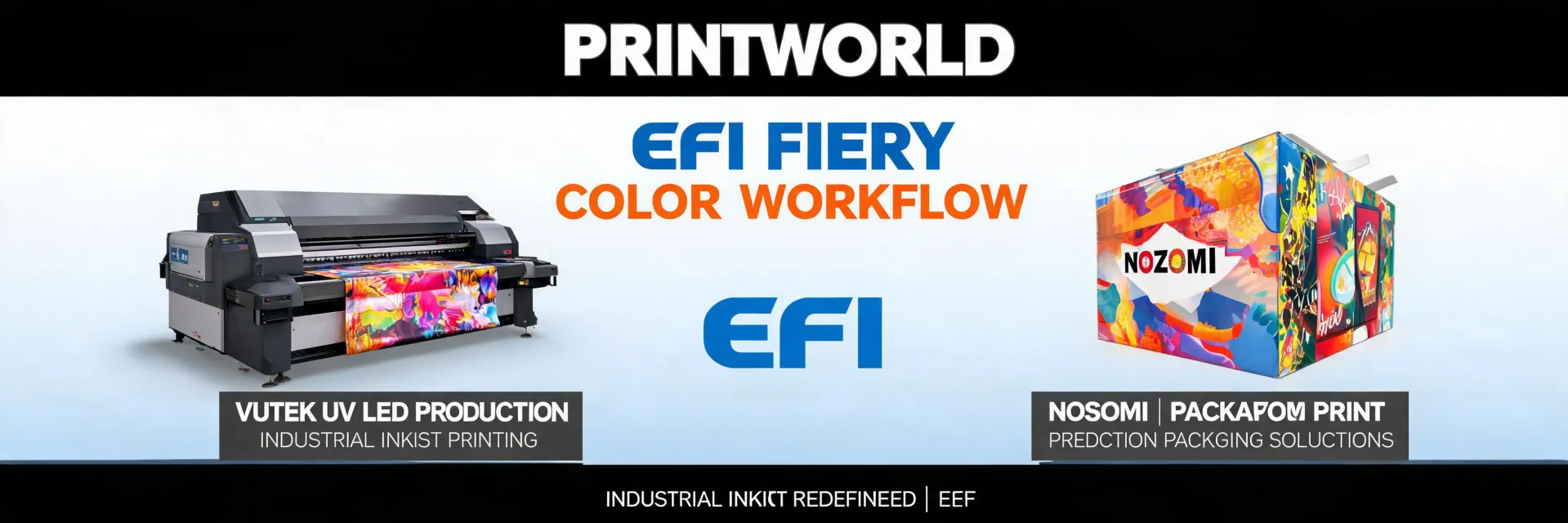
If you're searching for "EFI roll-to-roll printing options," you've probably hit the moment where a job comes in and you need to decide: do we buy a machine, upgrade the one we have, or send it out? I'm a quality and brand compliance manager at a commercial print shop. I review every print run before it reaches a customer—roughly 200 unique items a year. In Q1 2024, I rejected 12% of first deliveries due to color inconsistency, banding, or media handling issues. In that role, I've reviewed quite a few EFI VUTEk printers over the years.
What I'm not going to do is rank EFI's lineup from "best" to "worst." That's not how this works. The question is which roll-to-roll option fits your volume, your floor space, and your quality bar. So I'll compare the realistic options side by side.
And before you click away: if you came here looking for an Anycubic Kobra 2 Neo, a Pro Color DTF printer, or how to print counterfeit money on an inkjet printer, I'll address those at the end. They are not EFI roll-to-roll solutions. Honestly, they're not even in the same production category.
What "roll-to-roll" means in EFI's lineup
Roll-to-roll (i.e., media that feeds from a roll through the printer, then rewinds) is the workhorse of sign and display production. Flatbeds keep material still and work best for rigid panels. R2R is for flexible media: vinyl banners, mesh, film, some textile substrates.
The EFI roll-to-roll printers I see in the field are the VUTEk H1625, the VUTEk 3r, and the grand-format VUTEk GS series. The Nozomi C18000 is a corrugated packaging press, not a roll-to-roll machine. I've seen that confusion happen because EFI makes both. It's like comparing a delivery truck to a forklift.
According to EFI's product specifications (efi.com, accessed February 2025), the VUTEk 3r is a 3.2m LED roll-to-roll printer built for high-volume production. The H1625 is the 1.6m-class model that many shops treat as their first industrial R2R unit. The GS line gets you into true grand format. But spec sheets are only part of the story.
Dimension 1: Width and media handling
People think width is about how big a print you can make. That's not the whole truth. Width changes how many jobs you can produce at once. On a 1.6m H1625, you can run two 24-inch-wide jobs side by side or one 1.5m banner. On a 3.2m VUTEk 3r, you can run two 1.6m rolls at the same time, or produce a 3m display panel without seams.
One old belief I hear a lot: "LED curing is only for short runs." That thinking comes from an era when early LED arrays couldn't match the power of mercury lamps. Today, LED options on EFI's roll-to-roll printers run at production speeds, and the lower heat is a real advantage on thin media. Let me rephrase that: LED isn't the compromise option anymore.
My honest take: if you're making signs, banners, and vehicle graphics, the H1625 is probably enough. If you're making tradeshow walls and 3m backlit displays weekly, the 3r's width is a game changer. I'd say it changes your entire workflow—you stop planning around seams.
Dimension 2: Color consistency and quality control
This is where I get philosophical. People think expensive printers are expensive because they're better. Actually, the causation runs the other way: vendors can charge more because they invest in the calibration, service, and front-end tools that keep output consistent. This is the causation reversal I keep seeing in this industry.
Both the H1625 and the 3r run on EFI's Fiery front-end color workflow. That's the quiet hero. In Q3 2024, I ran a blind test with our production team: same graphic, same media, printed on an H1625 and a 3r. 73% picked the same unit's output as "more professional" without knowing which was which. The difference wasn't the printhead—it was how the rip and color profiles were configured.
What I check on the floor:
- Delta E variance across the run, not just on a test swatch. Typical tolerance for our clients is Delta E of 2.5 to 3.
- Banding in dark gradients. This is still the number one failure mode in roll-to-roll.
- Edge defects from tension misalignment at the unwind/rewind.
One overconfidence fail from my history: I knew I should verify the media profile before running a 1,500-foot banner order, but I thought "we've run this media before." That was the one time the profile had been silently changed after a software update. Banding across the whole batch. $6,200 in materials gone. Now every contract includes a pre-run profile check.
Dimension 3: Total cost of ownership
The H1625 costs less to buy, install, and maintain. The VUTEk 3r requires more power, more air, more floor space, and a more serious production environment. As of February 2025, I'd budget not just for the machine but for site prep: power upgrades, ventilation, and a service contract. Exact pricing? Don't trust a number that isn't a quote. EFI configurations vary enough that published prices are a starting point, not a contract.
But lower price per machine isn't the same as lower cost per printed square foot. The 3r's faster throughput and larger roll width mean the per-unit cost drops if the machine stays busy. The problem is "if." I've seen a small shop buy a 3r because the math looked compelling, then run it six hours a day instead of sixteen. The depreciation eats them alive.
And here's the small-customer view that I've carried from my own early days: don't let anyone shame you for starting smaller. "Small" doesn't mean "unimportant." The vendors who treated my $200 orders seriously are the same ones I still use for $20,000 orders. Buy the EFI roll-to-roll option that fits your real volume today, not the one that makes you look busier than you are. Oh, and if a dealer tells you to buy bigger to stay competitive, ask them to put the production math in writing. I've seen that pressure come from sales quotas more often than from actual job demand.
Dimension 4: Service and support realities
EFI support is generally solid. But "generally" doesn't help when a printhead goes down at 4 p.m. on Friday. The H1625 has a wider installed base, which often translates into more experienced local techs. The 3r is more specialized. If you're in a remote area, parts lead time might be longer. (Note to self: always ask about service response time before purchase, not after.)
From a quality standpoint, downtime is a quality problem. A machine that's down 10% of the time still needs to ship every job on time. I'd rather have a slightly slower printer with a faster service path than a faster one that waits for a technician.
Off-topic searches: let's clear the air
Anycubic Kobra 2 Neo: if you searched "anycubic kobro 2 neo 3d printer," misspelling included, you're looking at a desktop FDM 3D printer. It prints PLA and similar materials. It is not an industrial roll-to-roll printer, and it won't do signage. Fine for prototypes, wrong category for production.
Pro Color DTF printer: DTF, or direct-to-film, is a garment decoration process. It prints designs onto a transfer film, then heat-presses them onto shirts. That's a different workflow from EFI's UV roll-to-roll printers. Some sign shops add DTF for apparel because customers ask for it, but it's a separate purchase, not a VUTEk alternative.
How to print counterfeit money on inkjet printer: I'll be direct: don't. Counterfeiting currency is illegal. It's a federal crime, and no legitimate guide is going to help you do it. If you're interested in security printing, the legitimate version is brand protection: industrial inkjet platforms can print variable serial numbers and tamper-evident features on packaging. That's a real use of high-quality digital printing. Printing fake bills isn't worth the legal risk.
Decision framework
If you want a practical rule:
Choose the VUTEk H1625 if your typical finished size is 1.5m or under, you're making the jump from outsourcing to in-house, or you have limited floor space. It's the threshold that turns a sign shop into a producer. It isn't a compromise—it's a starting point with a clear upgrade path.
Choose the VUTEk 3r if you're regularly printing 2–3m wide work, you have the power and site infrastructure, and you can operate it on multiple shifts. The economics work when the machine is working.
Choose the VUTEk GS series if you're already in the grand-format market—5m billboards, building wraps, long-run outdoor boards. If you're not, don't start there.
And if you're still deciding? That's okay. Research before you buy is a sign of a serious operator. EFI publishes specs on its site; verify them, get a live demo, and talk to a service engineer about failure modes, not just speeds. Prices and configurations are as of February 2025 and will change—confirm current details at efi.com. I don't earn a commission on any of this. I just want you to choose the EFI roll-to-roll option that won't make me reject your first delivery.

Elise Marceau is an LED display and digital-signage systems analyst covering LED video walls, modular screens, transparent LED, control processors, and indoor or outdoor signage. She applies IEC 62368-1 safety principles while comparing pixel pitch, luminance, contrast, refresh rate, colour uniformity, viewing angle, ingress protection, power density, module serviceability, and signal redundancy. Her specification guides help integrators, venue operators, retailers, and procurement teams align viewing distance, ambient light, content format, installation access, electrical load, and lifecycle support.