-
1. What is an EFI digital printer, exactly?
-
2. Is the EFI H1625 LED printer worth it for a smaller shop?
-
3. What does 'collate on printer' mean—and why should I care?
-
4. Inkjet printer vs laser printer: which is better?
-
5. When is a smart label printer 650 enough, and when do you need an EFI label printer?
-
6. What's the question almost nobody asks before buying a digital printer?
I've run production printing at our shop for eight years. Before that, I was the person opening boxes and praying the colors matched. I've personally made—and documented—eleven significant mistakes, totaling roughly $40,000 in wasted budget. That's why I now maintain our team's pre-check checklist. Not because I'm naturally cautious, but because I've already paid for the lesson.
This article isn't a product brochure. It's the questions I get from shop owners looking at EFI digital printers, plus the answers I wish someone had given me before we bought our H1625 LED printer.
Here's what we'll cover:
- What an EFI digital printer actually is—and why it's not an office printer
- Whether the EFI H1625 LED printer is worth it for a smaller shop
- What 'collate on printer' means, and why I lost an afternoon to it
- Inkjet printer vs laser printer: which is better for common print jobs
- When a smart label printer 650 is enough, and when you need a production label printer
- The question almost nobody asks before buying production inkjet
1. What is an EFI digital printer, exactly?
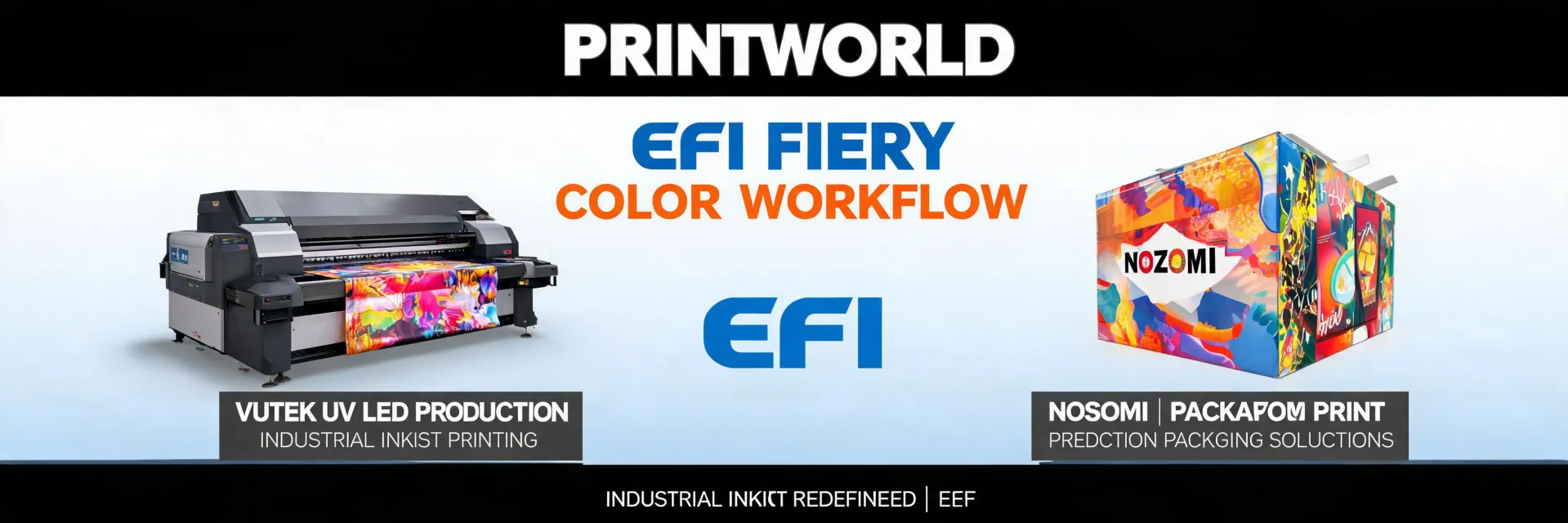
EFI—short for Electronics For Imaging—builds production-grade digital printing systems. I'm not talking about a 13-inch desktop machine. EFI digital printers cover wide-format LED flatbeds, roll-to-roll printers, label printers, and grand-format systems like the VUTEk line and the Nozomi C18000 for packaging. They are designed to run jobs all day, in a shop, with inks and media that survive the real world.
Why does this matter? Because if you're comparing an EFI digital printer to a $400 office inkjet, you're comparing a roof nail to a finishing hammer. They both hit things, but one is built for a production schedule.
According to EFI (efi.com), LED-cured inkjet systems use less energy and handle heat-sensitive media better than conventional UV lamps. That's one reason the H1625 LED printer caught my attention—not because it's the newest shiny object, but because it changed what our shop could run.
2. Is the EFI H1625 LED printer worth it for a smaller shop?
This is the question I get most. The honest answer? It depends on the work you're already doing, not the work you hope to do someday.
When we were evaluating the H1625, I kept doing the risk math. The upside was shorter turnaround on wide-format jobs. The risk was a machine payment sitting idle for weeks. I asked myself: is the convenience worth potentially losing money on a slow quarter? For us, volume was already there. We had a consistent stream of signs and POP displays. For a shop doing $1,500 a month in wide-format, a production LED printer is probably overkill.
I'm not gatekeeping. We started small. The vendors who took my $200 orders seriously in my first year are the same ones I trust with $20,000 jobs today. Small doesn't mean unimportant. It means potential. Buy the equipment that matches your actual order flow—the machine doesn't build the business, the workflow around it does.
One more honest note: we bought a mid-size configuration of the H1625, not the highest-end version. Even after signing, I kept second-guessing. What if our job mix changed? What if a print head went down? The first two months were stressful. Then it became just another machine. This worked for us because our shop had predictable volume. If you're a seasonal business with demand spikes, the calculus might be different.
3. What does 'collate on printer' mean—and why should I care?
Collate means the printer gives you complete sets in order. A 20-page document, three copies, collated: set one gets pages 1 through 20, set two gets pages 1 through 20, set three gets pages 1 through 20. Print uncollated and you get 20 copies of page 1, then 20 copies of page 2, and so on. Someone ends up sorting by hand.
Sounds simple. It is—until you forget to check the setting.
In 2021, I ran a 46-page maintenance manual with 'collate on printer' turned off. 150 sets. We noticed after the first few pages, but by then it was too late (unfortunately). Two people spent an entire afternoon sorting paper. A lesson learned the hard way.
On production printers, collating is often handled by a finishing unit. On many smaller digital printers, though, 'collate on printer' is a software setting that tells the machine to sort sets before the job reaches the output tray. If you're not sure, print one set first. It sounds obvious, but it's cheaper than a manual sort.
4. Inkjet printer vs laser printer: which is better?
I could give you a one-word answer, but it would be wrong. It depends on what you're printing.
For normal office documents, laser is usually the better tool. Toner is dry, fast, and crisp on plain paper. For wide-format signs, stickers, packaging proofs, and outdoor graphics, inkjet is the workhorse. Liquid ink can cover a wider color gamut, work on more substrates, and with UV-cured ink, hold up outside.
Why does this matter? Because the wrong technology means reprints. In our shop, we use both. I still print proofs on a laser printer when I just need to check layout. But the moment a job needs to look like a glowing sign or survive weather, it goes to our EFI LED inkjet system.
There is no universal winner. If a salesperson tells you one technology is always better, they're selling something. According to PRINTING United Alliance's 2024 industry outlook, digital print continues to gain share in short-run and customized work (Source: PRINTING United Alliance, 2024)—but that doesn't mean laser or offset is dead. It means production inkjet is becoming a smarter default for certain jobs.
5. When is a smart label printer 650 enough, and when do you need an EFI label printer?
This is another case where the name hides a big difference. A smart label printer 650—the desktop category that many offices use—is designed for shipping labels, name badges, and simple text labels. It is perfect if you need a few labels at a time.
An EFI label printer is a different animal. It's a production digital label press for full-color, short-run labels, variable data, and packaging work. It doesn't just print labels on demand; it prints thousands of them, with colors that matter, on materials that go onto products.
If you're a small brand testing the market, production digital label printing is a real advantage. In the past, you'd be forced to order thousands of labels you didn't know would sell. Now you can start with a shorter run and iterate. That fits my own bias: small doesn't mean unimportant. It means potential.
Small doesn't mean unimportant. It means potential.
But I'll add a caveat: don't buy a label press on sample colors alone. Ask about ink adhesion, lamination, and finishing. The printer is one piece. The workflow around it matters—that's true for labels just like it is for wide-format.
6. What's the question almost nobody asks before buying a digital printer?
It's not 'How fast can it print?' It's 'What's the total cost per printed square meter, including service, downtime, and reprints?'
Print speed is easy to compare. In 2022, I helped a friend buy a production printer. We compared speed, color, and price. We didn't ask about service response time. Six weeks later, the machine had a head failure. It was down for eleven days. The rework cost around $2,700 and the client waited. That wasn't the machine's fault—it was our planning failure.
The question isn't 'Can it print fast?' It's 'Can it keep printing?' Ask your vendor: what does a typical service call look like? Do you have replacement heads? What's the lead time for parts? Get those answers in writing.
Total cost includes setup fees, training, media profiles, maintenance, ink, and emergency service. The lowest quoted price often isn't the lowest total cost. This is true for EFI digital printers and every other production system I've evaluated.
It took me seven years and roughly 400 production jobs to understand that the equipment is only half the system. The other half is the process you build around it. A production printer can make great work. It won't create a great workflow for you.

Elise Marceau is an LED display and digital-signage systems analyst covering LED video walls, modular screens, transparent LED, control processors, and indoor or outdoor signage. She applies IEC 62368-1 safety principles while comparing pixel pitch, luminance, contrast, refresh rate, colour uniformity, viewing angle, ingress protection, power density, module serviceability, and signal redundancy. Her specification guides help integrators, venue operators, retailers, and procurement teams align viewing distance, ambient light, content format, installation access, electrical load, and lifecycle support.