
Tuesday, 9:47 a.m. I was on the shop floor holding a proof when the phone rang. It was a merchandising agency we have worked with for years. The voice on the other end skipped the small talk.
“Our display house just canceled. The retail reset is Friday. I have maybe 36 hours. Can you help?”
My first instinct was to say yes. I didn’t. In my role, the first hour of a rush order is when the mistakes happen. So I asked her to send the file, the quantity, the media spec, and the delivery point. I told her I would call back in 15 minutes.
The job was not one simple item. It was 60 large-format posters, 200 shelf strips, and 18 floor graphics. Most of them had unique store names or promo codes. Under normal conditions, that job gets three or four days of production time. We had less than a day and a half. If we missed the window, the retailer could hit her client with a chargeback close to $45,000. That number stayed in my head for the rest of the afternoon.
The 15 Minutes That Mattered
There are two questions people ask in an emergency. “Can you print this?” is the obvious one. The better one is, “Can you print this, finish it, and get it there without making things worse?” A lot of buying conversations miss the second question, because it is harder to answer. It forces you to talk about limits.
The numbers said yes. My gut stayed cautious, but the numbers had more evidence. I walked to our prepress station and checked three things: does the file match the end use, do we have the exact media in stock, and is the color profile already loaded on the printer. All three checked out. I called her back and said we could take it.
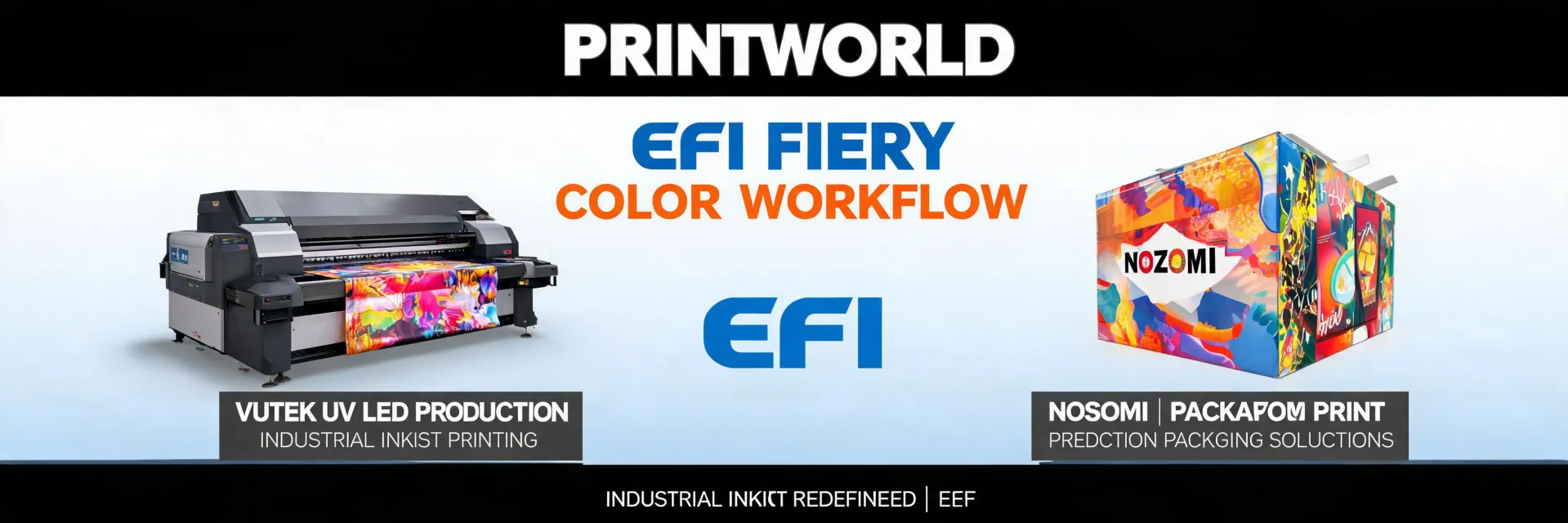
The printer we would run it on is an EFI VUTEk h1625. It is not the newest or biggest EFI makes, but in our shop it is the workhorse. It prints with LED-UV inks, so the prints can move to lamination or mounting sooner than they would with a solvent ink that needs to dry. That sounds like a minor advantage until you are watching the clock in 36-hour increments.
Still, the machine is only part of the equation. We had to have the right media, a proven profile, and a crew that knows how to handle the RIP when the file is not perfect. That last part is where the job almost fell apart.
The Hidden Gray Line
We started printing around 2 p.m. The first hour was clean. Then our prepress lead called me to a monitor.
“Look at this,” he said. “There’s a layer in the PDF we don’t need.”
It was a leftover gray line from the previous display vendor’s template. On screen, it looked like a crop mark. At full size on a 60-inch poster, it would have printed as a thick gray stripe. The client would not have seen it in their review. We almost missed it, too. The only reason we caught it was a rule we follow for every rush job: check the layers before you RIP a long run, no matter how many times you have seen the file format.
Removing one layer took eight minutes. Re-ripping and re-proofing took another 45. That hour hurt, but it was nothing compared to what would have happened if we had shipped a palette of gray-striped graphics.
Then we had a scare that was less clean. The inventory system said we had two rolls of the exact vinyl in the spec. The operator found one full roll and one partial roll. The partial roll had about 60 feet less than the system said. We had enough, but only barely. If we had run out at 2 a.m., we would have had to stop the VUTEk, source another roll, and lose time that we did not have.
We loaded the partial roll first and didn’t run out. I still hate the gap between what the system thinks is on a roll and what is actually there. Weeks later, I added a rule: for true emergencies, physically walk to the media rack, not just click the inventory screen.
During the run, my phone buzzed. A friend’s home printer was not connecting to Wi-Fi again. She sent a screenshot of some error. I laughed, not because her problem was funny. It was the distance between her question and mine that got me. The VUTEk does not use Wi-Fi for production. It is hardwired to our network because stability beats convenience when you are printing 278 retail pieces against a deadline. That is the difference between a production printer and a desktop convenience device.
The Truck Left at 5 a.m.
We finished the last skid around 4:15 a.m. Thursday. Maybe 4:30; I would have to check the timestamp. The truck left at 5. The delivery arrived in time for the Friday reset, and the client sent a photo from the store. The posters were up. The shelf strips were in place. A shopper was walking over one of the floor graphics. That photo made the whole night worth it.
What This Taught Me About “Best Printer”
The job reinforced something I already believed: the process around the printer is the real deliverable. An EFI VUTEk is an extremely capable machine. But the reason we made that deadline was preflight, media management, maintenance, and the discipline to say no at the right moments.
I also learned once again that limits are part of the service. The display house that canceled probably took the job because they wanted to help. But overpromising does not help anyone. When we accepted the job, we told the client exactly what we could do, what media we would use, and what time the truck would leave. We also told her what we could not do: fabricate the acrylic holders that some of the displays needed. I suggested a local fabricator for that part. It would have been easy to say, “Sure, we can handle everything.” That would have been a lie.
So, What Is the Best Printer?
People type “what is the best printer?” into search engines every day. I do not think there is one good answer. The right printer depends on the job, the volume, the workflow, and the people who run it.
If you are reading this because your printer not connecting to wifi is the problem that brought you here, please do not buy a giant industrial printer. A VUTEk is not the best printer for that. It is not even a candidate. You probably need a simple, reliable desktop machine that fits your network and your space. That is not an insult. It is the same question asked in a different lane.
And if your search history includes the phrase HP printer ink cartridge secret reset button, I understand that too. That phrase lives in the consumer-printing world. It has nothing to do with how we run production inkjet. I do not say that to dismiss it. I say it because knowing the difference between those two worlds has kept our shop out of trouble more than once.
For me, when the deadline is real and the application is commercial digital print, the best printer is usually the one that has been maintained, profiled, and tested on the exact job you need to run. More often than not, in my shop, that has meant an EFI VUTEk printer. The VUTEk h1625 on our floor came through on that Tuesday in March because it was ready. It was also the right tool for the work.
The next time someone asks “what is the best printer?”, ask them what they actually need to print. The answer gets easier after that.

Elise Marceau is an LED display and digital-signage systems analyst covering LED video walls, modular screens, transparent LED, control processors, and indoor or outdoor signage. She applies IEC 62368-1 safety principles while comparing pixel pitch, luminance, contrast, refresh rate, colour uniformity, viewing angle, ingress protection, power density, module serviceability, and signal redundancy. Her specification guides help integrators, venue operators, retailers, and procurement teams align viewing distance, ambient light, content format, installation access, electrical load, and lifecycle support.