
-
Start with the question: office, production, or desk-sized?
-
1. Media path tells you the machine class
-
2. One good sheet is not a successful job
-
3. Compare cost per accepted job, not cost per copy
-
4. Service and software are part of the hardware decision
-
What about 3D printers, miniatures, and design software?
-
What I would do with this comparison
Start with the question: office, production, or desk-sized?
I am a quality and compliance manager at a graphics production company. I review roughly 200 unique large-format jobs every month before they leave the shop. In 2024, I rejected about 4 percent of first production runs for color mismatch, substrate defects, or finishing problems. That sounds small until you count the reprint hours and missed deadlines.
So when someone mentions a Ricoh EFI 16H printer and an EFI H1625 LED printer in the same purchasing conversation, my first move is to slow the discussion down. Exact model names change with vendor catalogs. The bigger issue is class. An EFI H1625 LED printer is not an office printer. A Ricoh EFI 16H printer should be evaluated for the workflow it controls, not for the size of a toner cartridge or a paper tray. This comparison uses the standard I work to every day: office vs production, paper vs substrate, and one printed sample vs a delivered, repeatable run.
1. Media path tells you the machine class
An office printer is built around sheets. It handles A4 and A3 paper, card stock, labels, and maybe a roll accessory. That is enough for a document-heavy workplace. It is not enough for a shop that prints rigid display boards, acrylic panels, corrugated point-of-purchase pieces, or outdoor flexible materials.
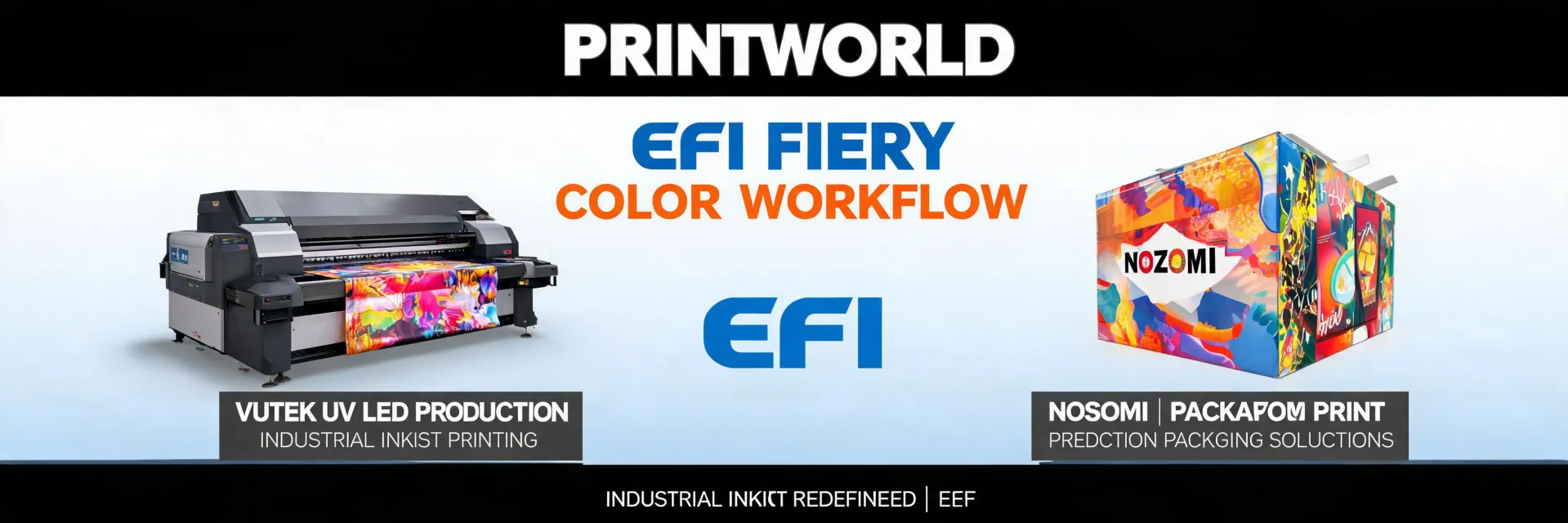
A production UV LED system like the EFI H1625 LED printer is built around a different media philosophy. UV-curable inks are cured as the material passes through the print zone, and the machine is designed to work with wide-format rigid and roll-fed materials. When I looked at the Ricoh EFI 16H printer and the EFI H1625 LED printer in the same evaluation, the first thing I checked was not the pages-per-minute number. It was the media path and the type of output the customer expected to sell.
Conclusion: if the job list is paper, reports, and standard office collateral, an office printer is the correct answer and usually the cheaper one. If the job list includes rigid media or long wide-format runs, you are no longer in the office printer category.
2. One good sheet is not a successful job
An office printer can produce a very good first page. The real production question is whether page 500 looks like page 1. For brand work, consistency is not optional.
In a Q1 2024 quality audit, I tracked a corrugated display program with more than 1,400 panels. The first 100 panels looked clean. By panel 800, small color drift became visible in the mid-tones. That kind of issue is rarely caused by one dramatic failure. It comes from media profile changes, ink curing differences, and the lack of a process control discipline.
When I compared sample output at the start of a shift with output two hours later, I finally understood why production printers and office printers are engineered for different duty cycles. An office printer is convenient because it wakes up, prints, and goes back to sleep. A production device is meant to run in a controlled workflow with color checks, head maintenance, and calibration. The machine is only part of that system.
Conclusion: if your customer needs a reproducible color over hundreds of parts, judge the printer by its daily consistency, not by one demo file.
3. Compare cost per accepted job, not cost per copy
Office printer cost-per-page models can look very tidy. The machine price is low. The click charge is known. That logic breaks down when the output cannot be shipped because the color is wrong, the media curled, or the production run was interrupted by a service issue.
The lower cost per copy on paper may become the higher cost per accepted job after you add reprints, wasted media, employee time, and a missed deadline. This is especially true for production signage and display work, where the value of one on-time delivered job is often much larger than the cost of the print itself.
In March 2024, we paid $400 extra for guaranteed delivery on a deadline-critical component. The alternative was missing a $15,000 event installation. I do not describe that $400 as a premium. I describe it as certainty. Certainty has a price, and in production work it is often the most useful part of the specification.
4. Service and software are part of the hardware decision
As a quality manager, I buy service agreements as carefully as I buy machines. A production printer is not a standalone office appliance. It sits inside a workflow that includes color management, a front end, media profiles, operator training, and maintenance planning.
If you are evaluating an EFI H1625 LED printer or a Ricoh EFI 16H printer, compare the service response schedule. Find out what happens when a printhead fails in the middle of a production week. Ask about expedited parts, remote diagnostics, and operator escalation paths. A slightly slower printer with a reliable service plan can beat a faster printer with no local support. That is not a vague opinion. It is the lesson I learned after a support gap delayed a $22,000 project for several days.
What about 3D printers, miniatures, and design software?
This article is about two-dimensional production printing. If your search was “what is the best 3d printer for miniatures,” a UV LED production printer is not the answer. For tabletop miniatures, resin-based 3D printers are usually a better fit than FDM machines because of detail level and surface finish. The best choice depends on your budget, workspace ventilation, and how much post-processing you want to do.
The phrase 3D printer design software also points to a separate workflow. In 3D printing, you need design or modeling software to create a model and slicing software to prepare it for the printer. For miniatures, many people start by downloading files and slicing them rather than designing original models from scratch. That is a completely different process from using an office printer or a production wide-format system.
What I would do with this comparison
If your real workload is office documents, buy an office-grade system. Do not let anyone convince you to buy a production UV LED machine because it is faster on one sample.
If your business sells signs, displays, packaging samples, acrylic decor, or roll-fed graphics, then compare the EFI H1625 LED printer, the Ricoh EFI 16H printer, and other production systems on media flexibility, color repeatability, service certainty, and total cost per accepted job.
And if your search is about 3D printed miniatures, skip the 2D production printer conversation. Get a resin printer suited to small parts, use the correct slicing and support workflow, and keep the wide-format production machine for the jobs it was actually built to handle.

Elise Marceau is an LED display and digital-signage systems analyst covering LED video walls, modular screens, transparent LED, control processors, and indoor or outdoor signage. She applies IEC 62368-1 safety principles while comparing pixel pitch, luminance, contrast, refresh rate, colour uniformity, viewing angle, ingress protection, power density, module serviceability, and signal redundancy. Her specification guides help integrators, venue operators, retailers, and procurement teams align viewing distance, ambient light, content format, installation access, electrical load, and lifecycle support.