When I first got into print production in 2017, I thought a digital printer was just a digital printer. That assumption cost me about $4,100 in rework, overtime, and one very awkward client apology.
So let me make something clear for anyone comparing these categories: EFI printers and employee ID card printers are both called printers, but they belong in different worlds. This article is the comparison I wish someone had forced me to do before I spent my budget.
The Comparison Framework
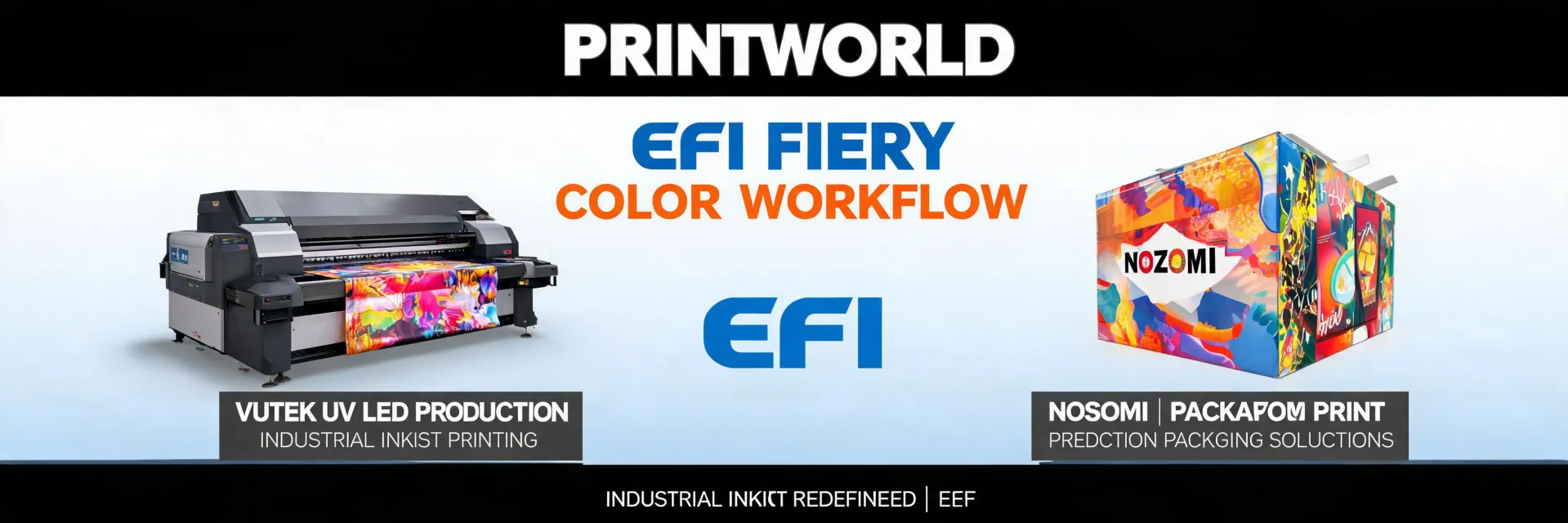
First, a definition that would have saved me from a major mistake. An EFI digital printer is production-grade inkjet equipment for work like signage, packaging, labels, and wide-format graphics. When people in the industry say EFI, they are usually talking about systems like VUTEk, Nozomi, or other large-format digital presses. Those machines are built to run for long hours on demanding commercial jobs.
An employee ID card printer, on the other hand, is a dedicated device that prints plastic cards. Zebra card printer systems are the most familiar example in that space. They produce access badges, security credentials, and other card-based identification.
Different machines. Different jobs. Period.
The four dimensions I use when comparing them
- What the printer is actually designed to output
- The typical workflow and volume it handles
- What ownership actually costs
- Who should choose which option
Dimension 1: Media And Intended Output
Here is where I made my biggest mistake.
In September 2021, a client asked whether we could produce 400 employee ID cards for a factory orientation event. Our shop had a wide-format production workflow, and I said yes without thinking it through. I assumed that if a printer can handle a 4x8-foot sheet of printable material, it could handle anything smaller with no issue.
Wrong.
An EFI digital printer is designed for large media: roll media, rigid panels, corrugated packaging, and other commercial print substrates. It prints signage and display graphics. It is not an employee ID card printer. It does not feed CR80 card blanks, encode magnetic stripes, or produce secure credentials the way a dedicated card system does. Can you technically image a large PVC sheet and then cut out card-shaped pieces? Maybe, but that is not a credential issuance workflow. That is a finishing nightmare. I learned that lesson the hard way when my team spent two days cutting and recoating cards that still looked homemade. The client rejected the whole batch. That was the $4,100 mistake.
On the other side, a Zebra card printer is designed to do one thing really well: print employee ID cards. It handles card stock reliably and can usually work with security features, encoding options, and dedicated card software. It will not print a 6-foot banner. Nobody sane would try to use a desktop card printer for production signage.
The conclusion in this dimension is not complicated: you need the machine that matches the physical output you sell. If you sell plastic badges, you need an employee ID card printer. If you sell large-format printed applications, you need an EFI digital printer. The phrase one digital printer does not mean one universal machine.
Dimension 2: Workflow And Volume
I also learned that workflow matters more than list price. A $3,200 printer that saves you from outsourcing can still be a bad purchase if your average job is eight cards a month.
An EFI digital printer is built for production shifts. When I evaluated a VUTEk class system in Q4 2022, the sales conversation was not about printing one-off ID badges. It was about square footage per hour, media handling, ink costs, and how many large-format jobs we could push through before lunch. That kind of machine earns its keep when there is constant production volume and finishing capacity around it.
An employee ID card printer, like the Zebra card printers I have used, is different. It is a batch device. You might print 50 employee badges one afternoon and nothing for the next three weeks. The operator wears many hats. The machine sits on a desk or cart. It does not need a forklift or dedicated air supply. Honestly, that flexibility is a feature for smaller companies.
Let me answer a related question that keeps appearing in our web analytics: is my HP Deskjet a inkjet printer? Yes. It is an inkjet printer. But it is a consumer office paper printer, not an industrial production printer and not an ID card printer. An HP Deskjet can print a family newsletter. It will not give you durable, professional credentials or high-volume production prints. The search phrase makes sense if someone is trying to figure out which printer category they already have, but knowing that word inkjet is only the beginning.
Back to the comparison. If your workflow is mostly large format, an EFI digital printer fits. If your workflow is mostly badge issuance and access control, a dedicated employee ID card printer is the appropriate tool. One does not replace the other.
Dimension 3: Total Cost Of Ownership
This dimension surprised me because I initially compared only purchase prices. That was the rookie mistake.
In May 2022, I got a quote for a Zebra card printer for a client project. The printer itself was a few thousand dollars. The supplies, ribbons, cleaning kits, and card stock were additional. And I had not budgeted for the learning curve. The first batch of 75 cards took us an entire afternoon because the operator had never used an employee ID card printer before. Every mistake ate material. Every material mistake counted against the project profit.
By contrast, an EFI digital printer is a much larger capital decision. The ink systems, large-scale maintenance agreements, and facility requirements are different in kind. An EFI system can be the right investment for a company with the workflow to support it, but it is not the answer for a small business that mainly needs employee badges.
This is where the small client bias hurts people. There is a temptation to buy big and grow into it. I made that mistake. When I was starting out in 2017, the vendors who took my small orders seriously were not the ones pushing me into oversized equipment. They asked questions first. The good ones helped me avoid wasting money.
So my honest conclusion on cost: a Zebra card printer can be overkill if you only need 20 badges once per year. An EFI digital printer is overkill if you are producing anything smaller than commercial signage. Small order doesn't mean small thinking. It means you find the solution that matches your actual scale.
Dimension 4: Who Should Choose What
I do not believe there is a single best category. I believe there is a best category for each situation.
Choose an employee ID card printer if you handle badges in-house regularly. That includes HR teams, security integrators, universities, and service bureaus that issue credentials. A Zebra card printer is a well-known example for this type of work. It is compact, purpose-built, and designed to be operated by someone who is not a production press operator.
Choose an EFI digital printer if your business is already producing commercial print, packaging, wide-format graphics, or display work. The EFI digital printer lineage is industrial. These machines are serious investments that require real workflow, floor space, skilled operators, and after-sale support. They exist to make large production volumes financially viable.
And if you are sitting at home asking is my HP Deskjet a inkjet printer? Do not buy an industrial machine next. Buy the right tool for the task, or hire someone who already has that tool.
What I Would Do Differently
Looking back, I should have asked one question before any purchase: what is the most expensive thing this machine will be expected to do every week?
If the answer was printed employee ID cards, I needed a dedicated employee ID card printer. If the answer was large-format work, I needed to compare actual EFI printers and other production digital printers. The mistake was treating budget as the only decision factor. It is not. Workflow, staffing, finishing capabilities, and future volume all matter just as much.
Today, I keep a simple checklist above my desk. It has saved me from repeating my earlier errors. In the past 18 months, that checklist has caught seven potential equipment mistakes before they reached the purchasing stage. That is seven projects that did not become expensive lessons.
The main lesson is this: do not let the word printer confuse you. An EFI digital printer and a Zebra card printer are both pieces of hardware, but they serve different jobs, different customers, and different production environments. Comparing them without context only produces bad decisions.
I hope this helps someone make a smarter choice than I did. And if you are still unsure whether your HP Deskjet is an inkjet printer, the answer is yes. Now just ask yourself what you actually need to print next.

Elise Marceau is an LED display and digital-signage systems analyst covering LED video walls, modular screens, transparent LED, control processors, and indoor or outdoor signage. She applies IEC 62368-1 safety principles while comparing pixel pitch, luminance, contrast, refresh rate, colour uniformity, viewing angle, ingress protection, power density, module serviceability, and signal redundancy. Her specification guides help integrators, venue operators, retailers, and procurement teams align viewing distance, ambient light, content format, installation access, electrical load, and lifecycle support.