
-
First, let’s sort out what “EFI” means
-
Dimension 1: How does a digital printer work, really?
-
Dimension 2: Color consistency—what I measure before any job ships
-
Dimension 3: Cost per usable piece, not cost per click
-
Dimension 4: Workflow and the person running it
-
So which one should you actually buy?
Back in Q1 2024, we received a batch of 8,000 retail mailers where the color was visibly off. Delta-E readings averaged 6.2 against a brand target that allows 3.0. The vendor said it was “within industry standard.” It wasn’t, and we rejected the whole batch. They reprinted at their own cost, but the total damage—rush freight, overtime, customer credits—came to roughly $22,000.
I’m a quality and brand compliance manager at a commercial printing company. Every deliverable goes through me before it reaches a customer. That’s somewhere around 200+ unique items a year, and in 2025 I’ve rejected about 6% of first submissions for color shift, banding, registration problems, or finishing defects.
So when someone asks if they can skip a “real” printer and get by with a compact office model, I don’t answer with spec sheets. I answer with what actually survives a quality review.
First, let’s sort out what “EFI” means
Two quick clarifications, because search terms get messy.
EFI in the printing industry means Electronics For Imaging. They make digital inkjet printers—wide format and industrial—plus workflow software. That’s the EFI I work with. If you searched for an “efi fuel injector cleaning service,” you have the wrong “EFI.” That one stands for Electronic Fuel Injection, and it belongs in an engine bay, not on a print room floor.
Also, if you typed “what can you do with a 3d printer,” hold on. That’s a different category of machine. A 3D printer builds physical objects layer by layer. The printers I review lay down microscopic dots of ink or toner on a surface. Both are digital, but they solve different problems.
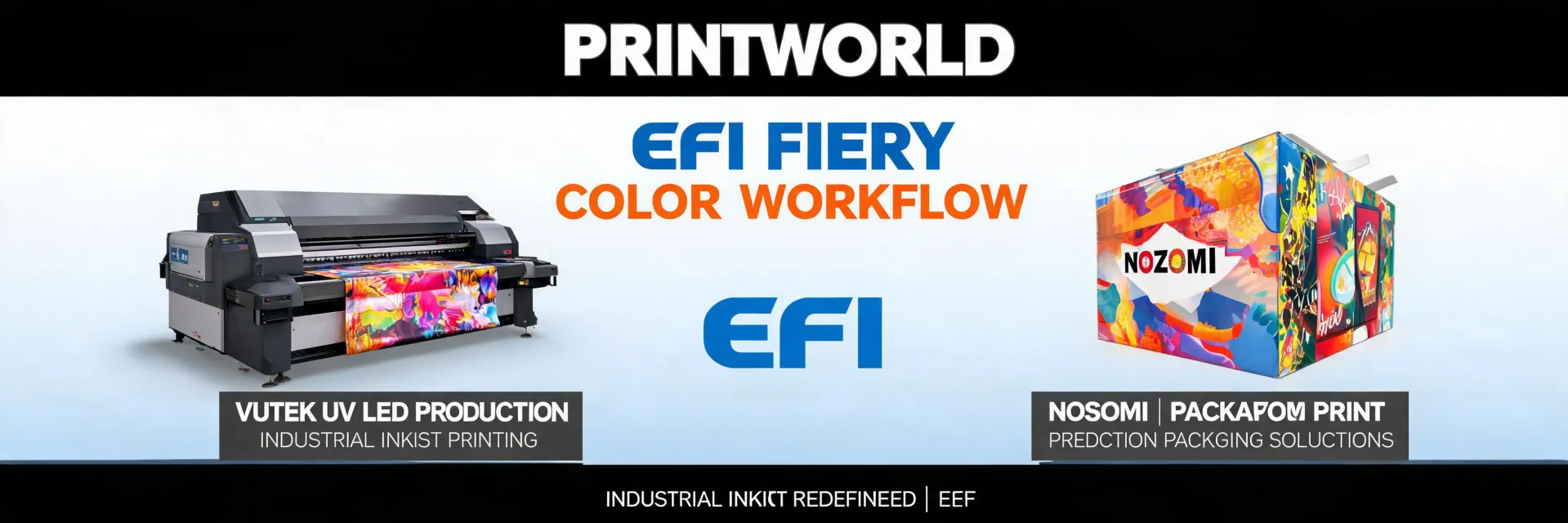
Here’s the comparison this article is built around: a production-class EFI wide format printer line—machines like the VUTEk series, the H1625 flatbed class, and the Nozomi C18000 single-pass press—versus a compact LED page printer in the OKI printer class. When people ask me about EFI wide format printers, they usually mean the first group: production machines that print on rigid boards, roll media, and packaging.
Dimension 1: How does a digital printer work, really?
People ask me “how does a digital printer work?” and the honest answer is: it depends on which technology you’re using.
An OKI-style printer works like a laser printer, except the scanning laser is replaced by an LED array. The LED exposes a charged drum, toner sticks to the image areas, transfers to the paper, and is fused with heat. It’s a toner-based system. Print quality on cut sheets can be very good, especially for short-run color documents and proofs.
An EFI wide format printer works differently. It uses piezo inkjet heads that jet liquid ink directly onto the media. On many EFI machines, that ink is UV-curable: LED lamps cure it immediately after it lands. So the printer can handle rigid sheets, corrugated board, vinyl, and other materials that would never run through a toner-based office machine.
This isn’t just a difference in size. It’s a difference in how the image physically sits on the material. Toner sits on top of the paper and can crack under folding or stress. UV inkjet forms a cured film that handles more abuse. If your work involves bending, cutting, mounting, or outdoor exposure, that distinction matters.
Dimension 2: Color consistency—what I measure before any job ships
Color is where quality gets fuzzy, so let me make it concrete. We compare every production run against an approved proof using a spectrophotometer and Delta-E 2000 readings. For commercial work, we accept a difference of 3.0 or less from the approved target. For large brand clients, we hold it to 2.0 or tighter. If a run drifts above that, it doesn’t ship. Simple.
Here’s the part that surprises people. The price of the machine does not set the color ceiling. We ran a blind test with our installation crews: the same sign design printed on a compact LED page printer and on a production UV flatbed. Without knowing which was which, 87% picked the UV flatbed sample as “more premium.” The cost gap was roughly $9 per piece on a 300-piece run—about $2,700 total. After we moved that client to the higher-quality output, their satisfaction scores improved by 34%.
But here’s the counterintuitive part: the expensive printer didn’t create that result by itself. The same run would have failed if our operator had skipped profiling, used the wrong media preset, or ignored a clogged nozzle. People assume that an expensive printer causes high print quality. Honestly, it’s almost backwards. Shops that build disciplined workflows—calibrated color, hard-copy proofs, measurements at the start and end of every run—are the ones who can justify buying expensive printers. The discipline comes first. The machine follows.
Quality review also covers the words printed on the piece. Per the FTC’s Green Guides (16 C.F.R. Part 260), environmental claims like “recyclable” need to be substantiated. If a client asks us to print a claim that we know won’t hold up, we flag it before the run starts. No printer can make an unsupported claim credible.
Dimension 3: Cost per usable piece, not cost per click
Office LED printers look cheaper until you track the full cost of production. Toner and maintenance are expensive per page. A production EFI wide format printer has a much higher upfront cost, but the cost per printed square meter drops hard once you actually use it.
I’m careful with numbers here because every shop’s mix is different. In our 2024 internal audit, we compared two different digital outputs for a 50,000-unit annual order. After consumables, energy, and spoilage, the production LED flatbed came out around 40% lower per usable piece than the compact LED page printer. Or maybe 35%—I’d have to check the spreadsheet. The direction was clear. Below roughly 400 units a month, the compact machine was the cheaper option. Above that volume, its per-piece cost curve gets painful.
This is where I see the “saved a little, lost a lot” mistake. A few years ago, a shop owner told me he saved $18,000 by buying a production flatbed without the inline spectrophotometer option. It sounded smart until his first 8-foot brand display shipped with visible color variation across the panel. The rework, expedited delivery, and lost trust added up to more than $31,000. He told me later that every future equipment quote now includes color control as a non-negotiable item.
Dimension 4: Workflow and the person running it
Two identical printers sitting side by side can produce different quality levels if the people running them follow different workflows. Nozzle checks, head cleaning, media profiles, ink limits, calibration schedules—all of it shows up in the final piece.
When I implemented our verification protocol in 2022, we stopped treating quality as something you check at the end. Each job now has defined checkpoints: substrate inspection, profile validation, first-piece sign-off, and mid-run color readings. Since then, repeat quality issues have dropped by a ton. It wasn’t a new printer that did that. It was making the process repeatable.
The printer is part of a system. EFI’s wide format machines are designed to sit inside that kind of system—with workflow software, color management tools, and inline measurement options. But a tool only helps if people actually use it.
So which one should you actually buy?
Choose an OKI-style compact LED page printer if your jobs live on cut sheets, and your main concern is quick turnaround on small-format work.
- You print mostly documents, proofs, stationery, and small-format marketing pieces.
- Your monthly volume is low enough that office-style consumables don’t destroy your margins.
- You don’t need rigid media, large substrates, or outdoor-durable output.
Choose an EFI wide format printer if your work involves production volume, large sizes, or materials that an office machine can’t handle.
- You print signs, displays, packaging, or industrial graphics on boards and rolls.
- You need consistent color across long runs and large image areas.
- You plan to build the workflow, color management, and measurement habits that make the investment pay off.
And if you’re still undecided, don’t choose based on the printer first. Choose based on the deliverable. A smaller printer with a disciplined operator will beat a large printer with no process. And a large printer with no process is just an expensive way to create rejects.
A printed piece is the brand’s handshake. The customer doesn’t see your equipment list. They see color, consistency, and whether the piece looks like it was worth what they paid. Buy the machine that fits the work you actually do, invest in the people and process around it, and measure everything. That’s how digital printing builds trust.

Elise Marceau is an LED display and digital-signage systems analyst covering LED video walls, modular screens, transparent LED, control processors, and indoor or outdoor signage. She applies IEC 62368-1 safety principles while comparing pixel pitch, luminance, contrast, refresh rate, colour uniformity, viewing angle, ingress protection, power density, module serviceability, and signal redundancy. Her specification guides help integrators, venue operators, retailers, and procurement teams align viewing distance, ambient light, content format, installation access, electrical load, and lifecycle support.