
Every few months, someone asks me, 'What is a good inkjet printer?' They want a model number. What they usually need is someone to explain why that's the wrong question.
I'm not a printer reviewer. I'm the person who signs the purchase orders. For the past six years, I've managed print production at a 40-person sign shop. I've documented every equipment order in our cost tracking system, audited our 2023 spending, and built a total cost of ownership spreadsheet after getting burned on hidden fees twice. In my opinion, the most expensive phrase in this industry isn't a brand name. It's 'good enough.'
I won't pretend our EFI flatbed printer and EFI label printer were cheap. They weren't. But the alternative that looked cheap on paper cost us more in the long run.
What People Actually Ask Me
When someone asks, 'What is a good inkjet printer?' they usually mean, 'Which device should I buy?' That sounds practical. But it skips the more important question: what's the total cost of getting that device into your workflow and keeping it productive?
That's not just semantic. I watched a buyer choose a flatbed based on print speed, then discover the media handling system couldn't handle the roll width they actually run. I saw an ID card printing machine purchased because the unit price was low, then watched the buyer spend twice that on ribbons, cleaning kits, and rejected cards in the first six months.
The device isn't the purchase. The production system around it is the purchase.
Why 'Good' Is the Wrong Filter
The word 'good' is a trap. A printer that produces a stunning test print isn't necessarily good in production. Repeatability matters more than a sample page. If a machine can't hold color and registration across a full run, it costs you in reprints, deadlines, and customer trust.
Commercial color is a good place to start. For brand-critical colors, standards like the Pantone Matching System call for color tolerance around Delta E < 2. Delta E of 2-4 is noticeable to trained observers, and above 4 is visible to most people. That's a useful benchmark when you're evaluating any EFI flatbed printer or label press. The question isn't 'Does it look nice?' It's 'Can it hold Delta E within tolerance for a whole job?'
Resolution claims are similar. Standard commercial print is roughly 300 DPI at final size. Large format work viewed from a distance can often get away with 150 DPI. But a spec sheet number like 1200 DPI doesn't tell you how the printer handles gradient banding, ink adhesion, or dot gain on your substrate. It's easy to compare specs. It's harder to compare behavior over time.
Where the Real Money Goes
The base price of a production printer is maybe 50-60% of what it actually costs to get running. The rest is hiding in plain sight.
Let me give you a boring example. One line item people forget is the large printer stand with storage. Our EFI flatbed printer didn't include one in the base quote. The stand was around $800. Shipping was $150. Installation was another $250. That's more than $1,200 before the first test print. If you're comparing quotes, that gets buried in 'accessories and options' and shows up later as a surprise.
Then there are the operational costs. Printheads are consumables. Ink coverage varies by job profile. Media waste, operator training, color management, service contracts, and downtime all hit the budget differently than the invoice does. When we audited our 2023 spending, I found that a big chunk of our budget overruns came from emergency consumable orders and rush shipping. We didn't have a formal reorder process. That cost us thousands over the year, and it wasn't the printer's fault.
I also learned to watch the fine print. One vendor's 'free setup' offer actually cost us $450 more in hidden fees once we counted the required on-site calibration. The cheaper-looking contract wasn't cheaper.
What the Wrong Question Costs
Choosing a printer without a total cost model leads to a predictable chain: the new machine arrives, it doesn't fit your workflow, the operator struggles, jobs go out late, the client asks why, and someone emails me asking if we should replace it after only two years.
I've been part of that failure before. We said 'base configuration' and the vendor heard 'entry-level.' We discovered the mismatch when the first production run came out with streaked color because the media handling wasn't matched to the roll weight we run. It wasn't their fault. It was our fault for not defining the job profile in the spec. But the redo cost us about $1,200 in materials and labor. That's the kind of cost that never shows up in a printer comparison chart.
The same reasoning applies to an ID card printing machine. The sticker price captures maybe 60% of the startup cost. Consumables, card stock, cleaning supplies, and reject rates are the rest. If you don't track those, you can't tell whether the machine is actually economical.
What I Do Now Instead
So what is a good inkjet printer? My honest answer: one that makes your operation predictable.
When I'm evaluating equipment now, I ask three things:
- Can the vendor show me sustained production results, not just sample prints? That includes color consistency, service intervals, and real downtime numbers.
- What does the total cost curve look like after year one? Ink, energy, maintenance, and operator time usually dwarf the purchase price.
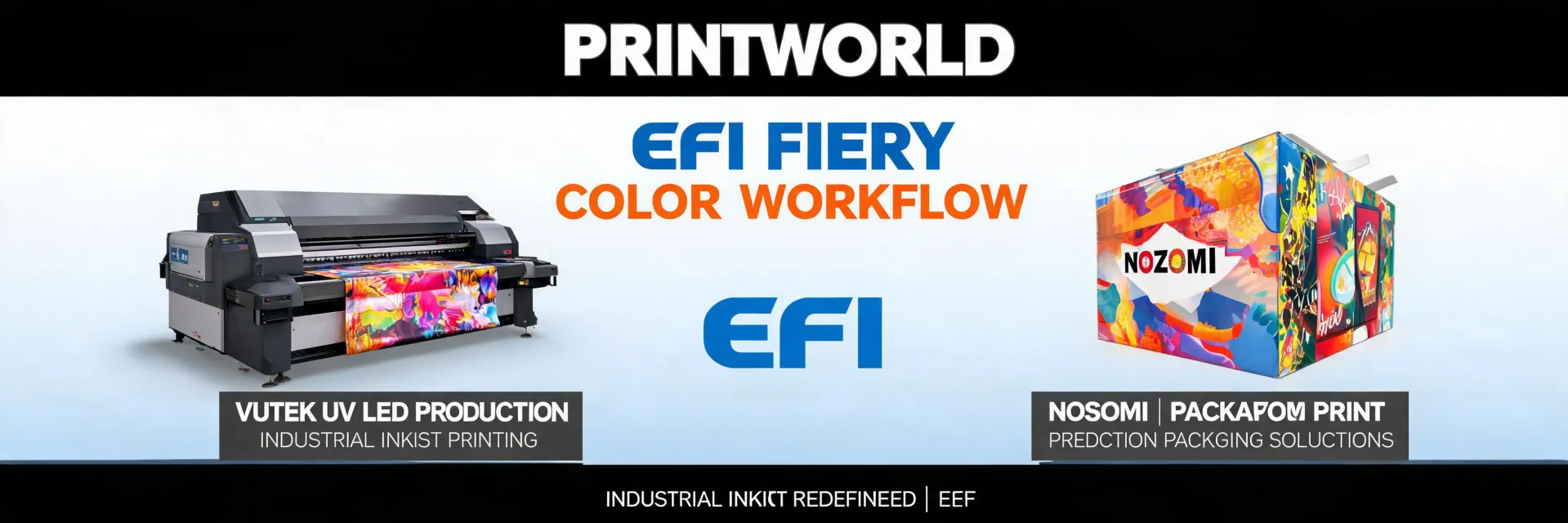
- Does it fit the way our shop already works? In our case, the EFI flatbed printer and EFI label printer share the same digital front-end. That saves us setup time and reduces the number of software packages our team needs to master.
I'm not saying EFI is the only option. But I've learned to value integration over upfront pricing. A lower quote on a standalone machine can disappear fast when you add workflow costs, training gaps, and troubleshooting time.
This is where my sample runs out. My experience is based on mid-size commercial sign work. If you're comparing industrial single-pass packaging presses like the EFI Nozomi C18000, the numbers are completely different. I can't speak to that world.
The fundamentals haven't changed—ink has to stick, colors have to match, jobs have to ship. But the execution has transformed. Five years ago, 'good' might have meant good print quality. Now, with shorter runs and tighter deadlines, good means predictable. That's the difference between a printer and a production asset.
If you're asking, 'What is a good inkjet printer?' my advice is to slow down. Look past the device and audit the system around it. The way I see it, the lowest-priced machine in the showroom rarely wins the total cost analysis.

I’m Jane Smith, a senior content writer with over 15 years of experience in the packaging and printing industry. I specialize in writing about the latest trends, technologies, and best practices in packaging design, sustainability, and printing techniques. My goal is to help businesses understand complex printing processes and design solutions that enhance both product packaging and brand visibility.