I manage purchasing for a 200-person company. When our production team asked me to research EFI printers, I didn't know much beyond the name. Months of vendor demos, site visits, and conversations with actual operators later, here's what I've learned—plus some honest answers to print-related questions I see people ask online.
What exactly is EFI?
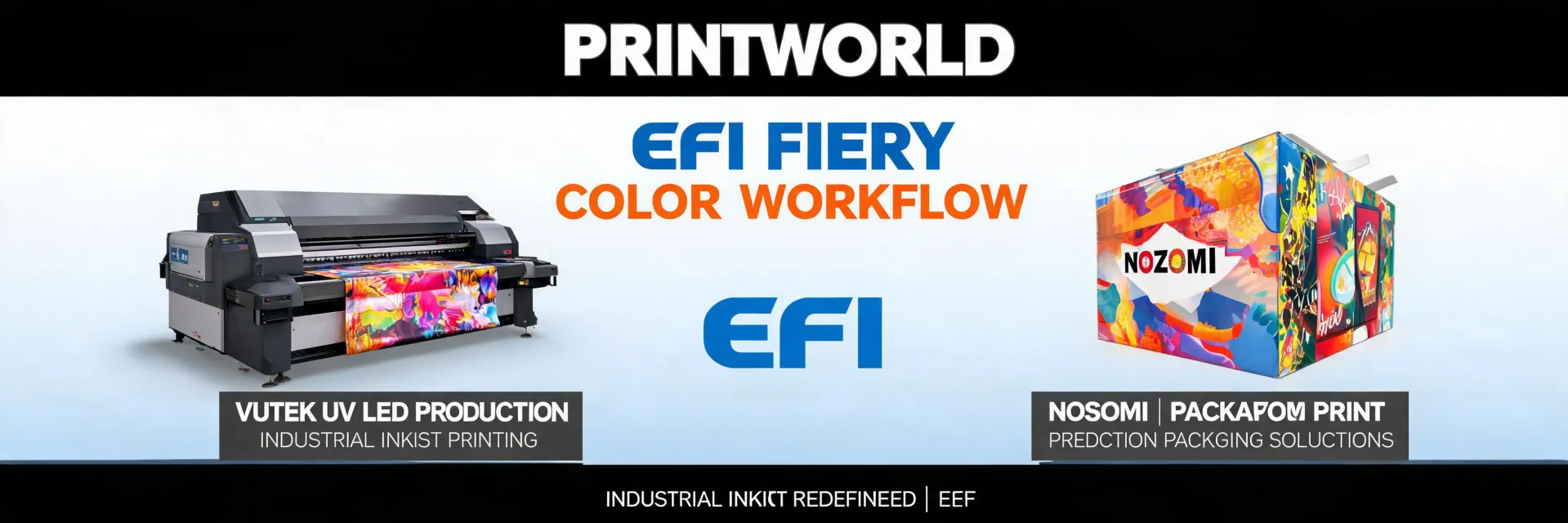
EFI (Electronics For Imaging) is a major manufacturer of industrial and commercial digital printing equipment. Unlike the office printers you'd buy at a big-box store, EFI builds large-format and production-grade machines: UV flatbeds, roll-to-roll printers, grand format printers, and industrial label presses. Their product lines include VUTEk (grand format), Nozomi (corrugated packaging), and the H1625 LED series.
If a business needs to print billboards, vehicle wraps, signage, packaging prototypes, or high-volume labels, EFI is one of the first names that comes up. They also make Fiery servers, the RIP software that drives many digital printers across the industry—but for this article, I'm focusing on the hardware.
What does "EFI inkjet" mean?
"EFI inkjet" refers to EFI's digital inkjet printing technology. Instead of plates like offset printing, inkjet printers shoot tiny droplets of ink directly onto the substrate. EFI's LED-based inkjet systems are their signature.
The LED part matters more than you'd think. Traditional UV-curing inkjet relies on mercury arc lamps—high energy draw, lots of heat. EFI's LED systems use less power and run cooler, which means you can print on heat-sensitive materials (thin plastics, PVC, some films) without warping. That was the feature that got our production manager excited during demos, and honestly, it's legitimate: it opens up substrates that older systems struggle with.
Resolution-wise, EFI machines operate well above the 300 DPI standard for commercial print. For large-format work viewed from a distance, 150 DPI is considered acceptable, so a VUTEk isn't sweating the detail. But for close-up packaging and label work, the resolution and color handling are what justify the price.
What is an EFI UV printer?
An EFI UV printer uses ultraviolet-curable inks that solidify almost instantly when exposed to UV light. Unlike water-based or solvent inks that need time to evaporate or absorb, UV inks cure on contact. The advantage: you can print on nearly any substrate—glass, metal, wood, acrylic, corrugated board, even textured surfaces—with no drying time and no smudging.
Color consistency is where UV printing really shines (or fails, if calibration is bad). A well-calibrated EFI UV printer can hold Delta E < 2 for brand-critical colors, the industry standard for color matching. For context: Delta E of 2–4 is noticeable to trained observers, and above 4 is visible to most people. If you're printing brand colors for retail clients, that precision matters.
Can I use an EFI printer for MTG proxy printing?
This question pops up in forums a lot, and I'll give you a straight answer: no. An EFI printer is not the right tool for MTG proxy cards.
The logic seems appealing—a UV flatbed can print on cardstock, images look sharp, and instant curing means no smudging. But here's why it falls apart:
- Cost: EFI UV printers are six-figure production machines. The H1625 starts around $150,000. No one buys that to print 2.5 × 3.5 inch cards.
- Efficiency: Running a grand-format flatbed for card-sized pieces is wildly inefficient. These machines are built for high-volume, large-format work—a single sheet on the VUTEk is bigger than your entire desk.
- Color matching: Trading card proxies require very specific color matching. Even with Delta E < 2 tolerance, you'd need serious color profiling to match existing card designs. It's not plug-and-play.
Honestly, for MTG proxies, a quality desktop inkjet with the right cardstock and profiles will serve you better—for 1% of the cost. There's a right tool for every job, and this is a case where the right tool is something much smaller and cheaper.
Why does my printer keep showing "offline"?
This is the question that haunts every office administrator. When your printer shows "offline" in Windows or macOS, check these first:
- The printer is asleep. Wake it by pressing a button or touching the screen.
- A loose connection. Reseat the USB cable or check the network connection.
- The spooler service stalled. Open Services (Windows) and restart "Print Spooler."
- The driver is outdated. Check the manufacturer's website (EFI's support portal for EFI machines) for the latest driver.
- "Use Printer Offline" is enabled. Go to printer properties and uncheck it.
One lesson I learned the hard way: with networked production printers (EFI's VUTEk, the H1625, the Nozomi), "offline" often means the Fiery RIP server isn't communicating with the printer. No driver reinstall fixes that. It's a network or RIP configuration issue, and our IT team had to loop in the vendor to resolve it.
My rule of thumb: about 70% of "offline" incidents are solved with the basics—wake the printer, check cables, restart the spooler. Do that before calling anyone.
What is a Dymo label printer?
A Dymo label printer is a desktop thermal label printer. They're the small machines you see at shipping desks and mailrooms, printing address labels, barcode labels, and folder labels. They're compact, relatively inexpensive, and use thermal transfer (or direct thermal) technology instead of inkjet or toner.
Here's the thing: Dymo and EFI both make "label printers," but they're different universes.
A Dymo LabelWriter is for office and light commercial use—printing a hundred address labels or bin labels at a time. An EFI label press is for industrial production—printing variable barcodes on flexible packaging film at thousands of labels per hour. The price gap mirrors the capability gap: a Dymo costs a few hundred dollars; an industrial label press is a capital expense that goes through multi-level approval.
From my purchasing seat, the key question is volume. When someone requests a "label printer," I ask: how many labels per day? The answer determines whether we're buying a $300 Dymo or a $300,000 production machine. I once saw a requisition for a "label printer" that was actually the latter—and the finance team nearly had a stroke when they saw the quote. (I should've asked about volume upfront. Now I always do.)
This was accurate as of early 2025. The printing industry evolves constantly, so verify current specs and pricing before you commit.

I’m Jane Smith, a senior content writer with over 15 years of experience in the packaging and printing industry. I specialize in writing about the latest trends, technologies, and best practices in packaging design, sustainability, and printing techniques. My goal is to help businesses understand complex printing processes and design solutions that enhance both product packaging and brand visibility.