
- The three hidden costs that decide everything
-
Why I benchmark against the EFI Pro 16H+ hybrid LED printer
-
The Brother printer app and home photo printers: a completely different universe
-
How to use DTF with an inkjet printer (and why converted machines scare me)
-
When a cheaper printer is actually the right call
-
The bill I've already paid
I've spent four years reviewing print quality for a commercial production shop — roughly 1,400 deliverables a year, checking color accuracy, banding, registration, and adhesion against customer-approved proofs. And the conclusion I keep landing on is this: the cheapest wide format printer you can buy will probably cost you more per usable square meter than an EFI Pro 16H+ hybrid LED printer. Sticker price tells you what you pay on day one. It tells you nothing about print head failures, ink coverage, reject rates, or downtime — and those are the numbers that decide whether a printer actually makes you money.
I don't have hard data on industry-wide reject rates, so I won't pretend to. But over four years and roughly 5,600 reviewed items — maybe 5,400, I'd have to check — I've watched what breaks, what drifts, and what quietly eats profitability. In our Q1 2024 quality audit alone, we rejected 11% of first deliveries. Most of those failures weren't operator error. They were the machine.
The three hidden costs that decide everything
When buyers ask me how to evaluate EFI wide format printers — or any brand, honestly — they usually start with the same specs: speed, resolution, maximum media width. Those matter. But the three numbers I actually care about aren't on the spec sheet.
Print head lifespan
A single industrial print head runs somewhere in the $800 to $3,000 range, depending on the machine, from what we've seen. On a budget flatbed we evaluated, we were replacing heads every 4,000 square meters. On the EFI Pro 16H+ we run now, the interval is noticeably longer. Machines that look like bargains often cut cost where you can't see it. Multiply head replacements over three years and a $40,000 price gap starts to close — or flip to the point where the cheap machine costs more overall.
Ink coverage and color density
Two printers can quote the same price per liter of ink. One of them needs 30% more ink to hit the same density target. I've watched this measured side by side with a spectrophotometer, and it's not the kind of detail you'll find in any brochure.
Most buyers ask, “What's your ink price?” The question they should ask is, “How much ink does it take to hit my target density consistently?”
In my experience, ink coverage is the most underrated spec in this industry. The machine that “saves” you on ink often gives it back in higher consumption.
Reject rate and downtime
On a well-maintained production printer, a 1–2% reject rate is normal. On a badly built or badly configured one, it climbs to 5–8%. Do the math on a 50,000-square-meter annual run: that's an extra 1,500 square meters of substrate, ink, and labor going into the waste bin every year. And unplanned downtime? An idle press still burns floor space, financing, and scheduled labor. One bad week of downtime can erase a purchase-price “savings” in days.
Why I benchmark against the EFI Pro 16H+ hybrid LED printer
People assume I'm loyal to a brand. I'm loyal to a standard. When our shop was evaluating hybrid LED printers, I ran the 16H+ through the same test file every manufacturer gets: 12 color patches, a gradient sweep, fine text, and a photographic image, on three different substrates at three speeds.
The 16H+ wasn't the fastest in that test. It wasn't the cheapest either. What stood out was consistency — board one and board 300 matched. Color held within tolerance across the run, and the gradient sweep stayed clean at every speed. Any printer can show you a perfect first print. Fewer can hold that on a Thursday night with a tired operator running third shift. People assume the price creates the quality. It's the other way around — consistency is why a printer can command a premium.
LED curing gets marketed as an energy-savings feature, and it is. But in my world, the bigger deal is temperature. LED cures at lower temperatures than conventional heat curing, which is the difference between a flat 3mm PVC sheet and one that warps into a potato chip. Warped media gets rejected. LED prevents that at the source.
The Brother printer app and home photo printers: a completely different universe
I get questions about the Brother printer app and home photo printers almost as often as I get questions about production equipment. Usually they come from someone who's only used consumer gear and assumes industrial printing is just a bigger version of the same thing. It isn't.
Look, I have a home photo printer in my office. I've used the Brother printer app to fire off documents from my phone. For proofs, sketches, and family photos, that gear is perfectly fine. But a $250 inkjet has almost no duty cycle, no registration tolerance across long runs, and no color management worth relying on for client work. The ink set isn't built for outdoor durability or consistent color over thousands of impressions.
It's not that consumer printers are bad. It's that they're built for a different job. Asking a home photo printer to handle production volume is like asking a sedan to haul a shipping container. It'll move. Once. Badly.
How to use DTF with an inkjet printer (and why converted machines scare me)
The most common production question I get lately is how to use DTF with an inkjet printer. DTF — direct-to-film — has a low entry point, which is why it's everywhere right now. The process, in four steps:
- Print your design in reverse onto PET film, with a layer of white ink underneath the CMYK colors.
- Apply adhesive powder to the still-wet ink.
- Cure the powder — usually with a tunnel dryer or heat press — so it bonds to the ink layer.
- Press the film onto the garment, peel, and you're done.
Technically, you can convert a desktop inkjet with a DTF kit and follow the same steps. I've tested that route. For tiny batches, it works. But I've rejected more DTF transfers from converted inkjets than I can count. The white ink layer is the whole game in DTF, and desktop print heads were never designed for heavy white pigmented ink. It settles. It clogs. Opacity drops on dark fabrics, and adhesion can fail after a few washes.
The shops that save $10,000 on a converted setup often lose that and more within a year — in reprints, ruined garments, and refunds. Whether you're printing transfers or wide format signage, the same rule applies: the cost of the machine is not the cost of production.
When a cheaper printer is actually the right call
Now the honest caveats, because the value-over-price argument has boundaries and I'd be lying if I pretended otherwise.
- Low volume. If you're printing under 500 square meters a month, a production machine's speed advantage never materializes. A simpler, cheaper printer might be the correct business decision.
- No dedicated operator. Advanced printers need someone who understands profiles, ink behavior, and maintenance. An operator who knows how to calibrate media is worth more than the machine itself.
- Single media type. If you only print adhesive vinyl, skip the hybrid and buy a dedicated roll-to-roll. Simpler, cheaper, fewer things to break.
This is the part equipment salespeople don't usually volunteer. I'm not here to sell you a machine you don't need. Every purchase I've recommended in four years passed three tests: the volume is there, the operator is there, and the cost model still works at a realistic reject rate.
The bill I've already paid
In 2022, a vendor's low bid won a critical job against my recommendation. Their samples looked fine. The production run didn't — 8,000 units with visible banding, rejected at final inspection. The redo cost us $22,000 and pushed a client's launch back two weeks.
“The output is within industry standard,” the vendor said. Another way of saying “good enough until it isn't.”
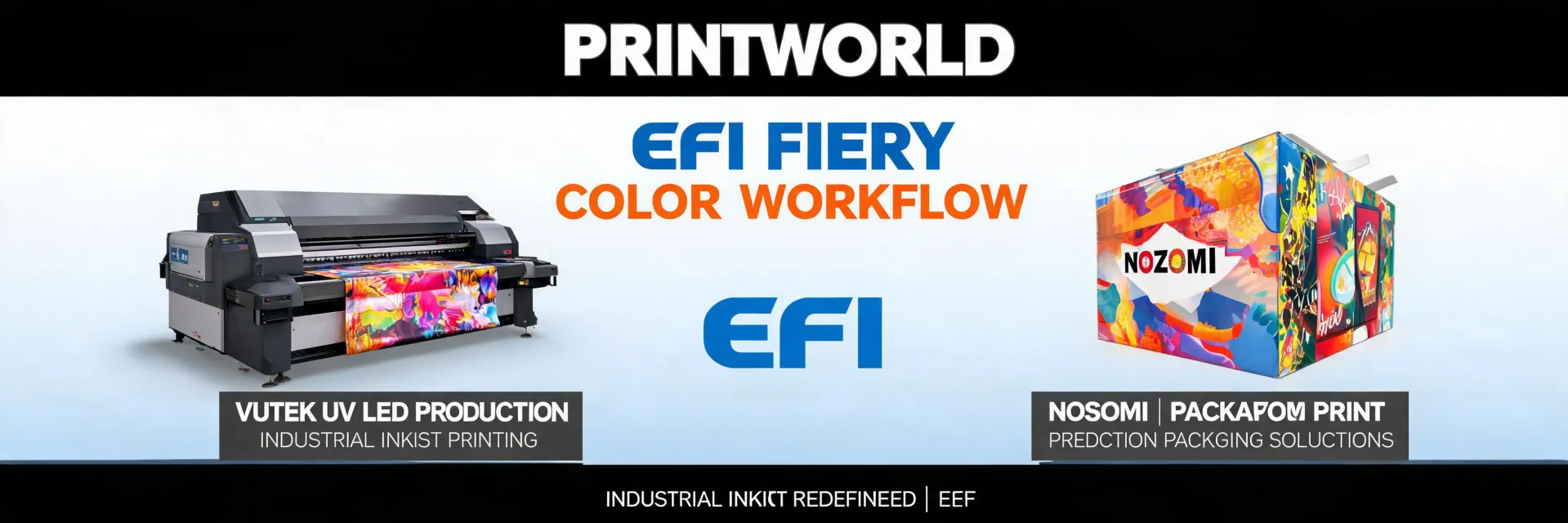
That's why the EFI wide format printers in our facility — the Pro 16H+ we run daily, the VUTEk line for superwide work, and the Nozomi we've seen at corrugated installs — have earned my respect. Not because they're flawless. Not because I'm paid to say it. Because after four years of measuring output against a standard, repeatability is the spec I get paid to protect. And that's the spec they hold.

Elise Marceau is an LED display and digital-signage systems analyst covering LED video walls, modular screens, transparent LED, control processors, and indoor or outdoor signage. She applies IEC 62368-1 safety principles while comparing pixel pitch, luminance, contrast, refresh rate, colour uniformity, viewing angle, ingress protection, power density, module serviceability, and signal redundancy. Her specification guides help integrators, venue operators, retailers, and procurement teams align viewing distance, ambient light, content format, installation access, electrical load, and lifecycle support.