
-
The old playbook is still useful, but the proof has changed
-
The EFI H1625 LED printer I check first
-
Who invented inkjet printer? A question that tells you something
-
Cricket printing machine: don't assume, ask
-
Resolution: where old rules need an update
-
Why clean test files aren't enough
-
The acquisition decision is a quality decision
-
The industry is evolving, not falling apart
Let me start with a statement that gets me in trouble at industry events: The best EFI VUTEk printer isn't the one with the highest top speed. It's the one your quality team can actually trust after the third shift.
I'm a quality/compliance manager at a mid-size digital printing operation. I review roughly 200 deliverables a year, from sign shop rush jobs to packaging prototypes. If I remember correctly, we rejected 8% of first deliveries in 2024, though I'd have to check the annual approval report to be sure. Most of those rejects weren't because the prints looked terrible to a casual observer. They were because the color and surface specs we'd agreed on weren't met. That's what this industry is moving toward: not "looks close" but "measures correct."
The old playbook is still useful, but the proof has changed
I didn't start with this opinion. Five years ago, I was the guy who printed a target, measured it, signed it off, and moved on. Then we brought in an EFI VUTEk printer and realized the print wasn't the only variable. The media, the curing temperature, the operator's tolerance for "good enough"—all of it had to be measured too.
What was best practice in 2020 may not apply in 2025. The fundamentals haven't changed, but the execution has transformed. A good substrate is still a good substrate. A calibrated file still matters. But the way I verify quality today is completely different from the way I did it five years ago.
The EFI H1625 LED printer I check first
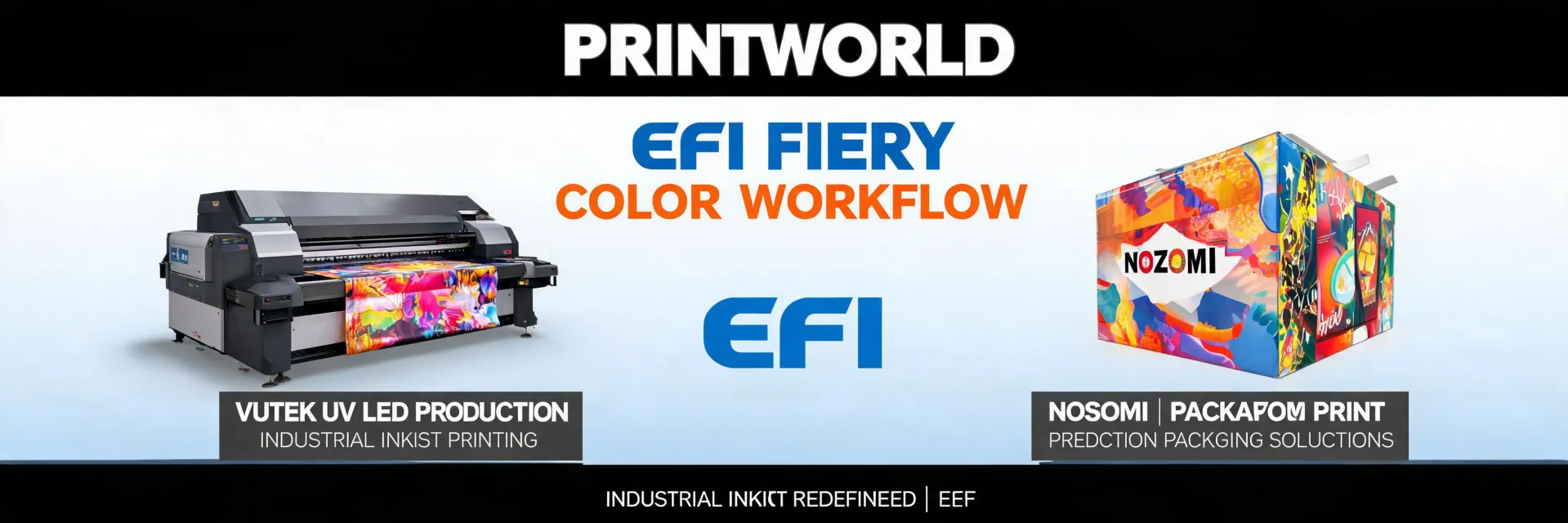
One machine that comes up often is the EFI H1625 LED printer. It's a roll-to-roll LED printer that gets attention for speed and flexibility. Both are true. But the first thing I check during an evaluation isn't a speed demo. It's a test patch printed at the left, center, and right of the bed. Then I measure Delta E. If a brand-critical color is over Delta E 2, I don't approve the install. Pantone's color matching guidelines treat Delta E below 2 as the expectation for colors that have to be exact. That's not a preference; it's a baseline.
I also ask to see prints after the machine has been running for two hours, not just after warm-up. This is where LED curing consistency shows up. Honestly, I'm not sure why some LED printers hold color across the bed better than others. My best guess is lamp stabilization and media handling play a bigger role than the marketing specs suggest, but I've seen expensive machines drift and cheaper machines stay solid. That's why I rely on measurements, not reputation.
Who invented inkjet printer? A question that tells you something
If you look at search terms for printing, you'll eventually see the question: who invented inkjet printer? The modern inkjet process was developed independently by Ichiro Endo at Canon and John Vaught at HP in the late 1970s. Endo's work used thermal bubble formation; Vaught's work followed a similar path. The result is a technology that's older than many people assume. Inkjet is not a new thing. It's a mature production process.
That matters because buying committees still get distracted by the shiny version of "new." I've seen people confuse a conveyor dryer with a 3D printer, and I've seen technical writers mix up inkjet and toner processes. The search phrase "laser powder bed fusion 3d printer" is a good example. It's an additive process where a laser fuses powdered material into a part. It sounds futuristic, and it is genuinely advanced. But it is not what an EFI VUTEk printer does, and it's not a substitute for production inkjet. That doesn't mean additive is inferior. It means the process has to match the job.
Cricket printing machine: don't assume, ask
Another search phrase that shows up in our analytics is "cricket printing machine." I'll be honest: when I first saw it, I assumed it was a typo for Cricut, the small-format cutter. Sometimes it is. One client used it to describe a compact flatbed printer for heat-transfer sheets. Another used it for a machine that prints cricket ball packaging. As a quality inspector, I've learned to ask for the substrate, the output size, and the annual volume before I assume anything.
The broader lesson is that the word "printer" covers an enormous range. A desktop label maker, a roll-to-roll EFI H1625 LED printer, and a grand-format VUTEk all sit under the same umbrella but solve completely different problems. If a buyer sends me a term that could mean five different machines, my first job is to turn that vague phrase into a measurable specification.
Resolution: where old rules need an update
Resolution is another place where old thinking creates waste. The old standard of 300 DPI is correct for close-up commercial print. But for a large-format sign viewed from ten feet away, 150 DPI is often enough. When I implemented our verification protocol in 2022, I asked the team to calculate resolution based on viewing distance instead of defaulting to 300 DPI. The first time I said we could print a 60-inch banner at 150 DPI, a senior operator looked at me like I'd suggested removing the safety guard. Then we compared the output side by side, and he couldn't see a difference. That's the kind of evolution I mean: keep the standard that protects the job, but drop the ones that only protect habits.
Why clean test files aren't enough
Let me be blunt: a clean test file hides problems. A file with perfect gradients and solid blacks is useful for a demo, but it doesn't tell you how a printer handles a production job with spot colors, thin text, and an uncoated substrate. When I evaluate an EFI VUTEk printer, I ask for a production-like file, not the marketing demo. I want to see the worst edge, the smallest type, and the brand color that's been impossible to match on every other device.
That's where the EFI VUTEk line has earned a reputation in our shop. It's not because the prints look good in the first five minutes. It's because they still look good after two hours, on a humid afternoon, with the operator managing three machines at once. I've run blind tests with our team: same file, two different print settings, no labels. Usually the sharpest result wins. But sometimes the one that wins isn't the one with the most saturated color—it's the one that holds neutral grays without shifting green.
The acquisition decision is a quality decision
Even after we chose our EFI H1625 LED printer, I kept second-guessing. What if the LED array failed after year one? The first six months were stressful. We built an internal check sheet, measured every morning, and logged everything. It took about three weeks—or rather, closer to four when you count the revision cycle—to make the check sheet feel routine. After six months, the color data was tighter than our old press. I didn't relax completely. That's not my job. But I stopped waking up at 3 a.m. with imaginary ink problems.
If you're evaluating equipment, my advice is to make quality part of the purchasing specification, not an afterthought.
- Write a color tolerance into the acceptance test. If a vendor says "close enough" during the sales process, that's a warning sign.
- Ask for test prints on the media you actually run, not the coated stock the demo team prefers.
- Ask what happens to the color after the first hour of production. A machine that drifts slowly is manageable. One that drifts on every job is a quality nightmare.
- Budget for training and media profiles. A $500,000 printer with under-trained operators is just an expensive machine that prints excuses.
The industry is evolving, not falling apart
My experience is based on production digital printing in sign and packaging environments. If you're doing fine art reproduction or flexible packaging, your mileage might differ. I can't speak to every segment, and I won't pretend to.
But the direction is clear. The industry is evolving from visual judgment to measurable proof. The operator's eye matters—I'd never dismiss that. The craft of inkjet is still a craft. But when a customer asks how you know the color is right, "the operator liked it" isn't enough. "The Delta E reading is 1.4" is a better answer. It's verifiable, repeatable, and defensible.
That's why the best EFI VUTEk printer for your shop is the one that lets you answer that question without crossing your fingers. The speed specs will change. The software will update. The search terms will keep getting weird. But the ability to prove quality? That's the skill that keeps evolving.
So if you're searching for "cricket printing machine" because a client used that phrase, or trying to understand how laser powder bed fusion 3d printer tech fits into your workflow, or just asking who invented inkjet printer because the history is interesting, start with the spec. Define the output, the substrate, the color tolerance, and the volume. Then choose the tool that meets those measurements. The fundamentals haven't changed. The execution has transformed. And in this industry, the people who document the proof will be the ones who get to keep the account.

Elise Marceau is an LED display and digital-signage systems analyst covering LED video walls, modular screens, transparent LED, control processors, and indoor or outdoor signage. She applies IEC 62368-1 safety principles while comparing pixel pitch, luminance, contrast, refresh rate, colour uniformity, viewing angle, ingress protection, power density, module serviceability, and signal redundancy. Her specification guides help integrators, venue operators, retailers, and procurement teams align viewing distance, ambient light, content format, installation access, electrical load, and lifecycle support.