I'm a quality and brand compliance manager at EFI. I review roughly 300 printer configurations a year before they get the green light for delivery. That gives me a different view of the 'which printer should I buy' question: I see the failures, the calibration drift, and the small process details that separate a smooth install from an expensive callback.
The comparison you're probably trying to make is EFI inkjet printers vs. DTF printers vs. resin 3D printers. It's not a normal head-to-head. These are three different production processes. The better question is: which one solves the work sitting on your floor? Let's compare them across output size, throughput, real cost, and safety.
The Framework: What Are You Comparing?
EFI inkjet printers are large-format production systems. They print on rigid sheets, roll media, or corrugated board using UV- or LED-curable inks. A DTF printer prints a transfer film that gets pressed onto apparel. A resin printer 3D builds small, high-detail parts from liquid photopolymer. Once you know that, you stop comparing price tags and start comparing applications.
Dimension 1: Output Size and Application
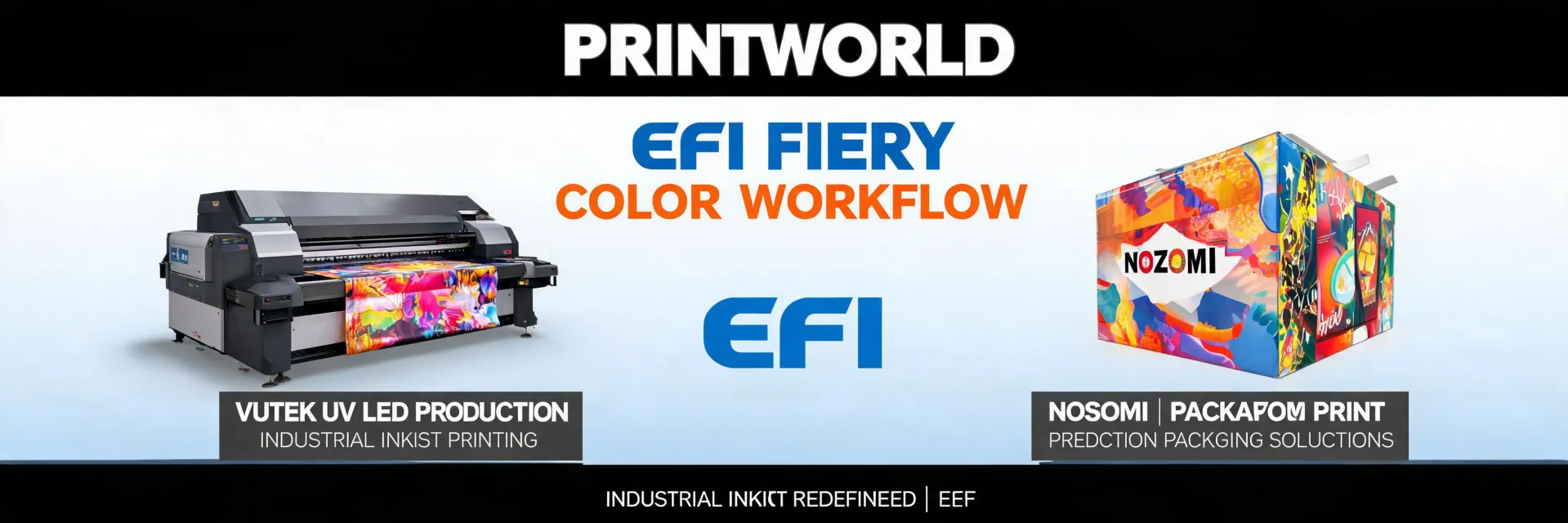
If the final product is a banner, a sign, a vehicle wrap, or a corrugated display, you're in grand-format territory. EFI's VUTEk line, the H1625, and the Nozomi C18000 are built for that world. A DTF printer can't do that. It produces a film that is then heat-pressed onto a garment. The print area is small, but the application is apparel.
A resin printer 3D produces an actual object, not a printed surface. It's for prototypes, models, dental parts, or casting patterns. The output size is usually measured in centimeters, not meters.
Conclusion: If the output needs to be large and flat, an EFI grand format printer is the relevant option. If the output needs to go onto a shirt, DTF is a better fit. If the output needs to be 3D, no inkjet printer replaces a resin printer.
Dimension 2: Throughput and Consistency
In Q1 2024, our quality audit flagged a production line where a 'production-ready' transfer printer dropped to around 60% uptime simply because the operator switched materials without reloading the correct profile. That kind of issue can happen on any equipment. The difference is what you lose when it stops.
EFI inkjet printers are designed for continuous production—or rather, they're designed to maintain high uptime when the scheduled maintenance is actually followed. LED curing, automated media handling, and repeatable color are the core value. You don't buy a 3-meter printer for one-offs. You buy it for square meters per shift. The consistency comes from the machine plus a maintained environment.
DTF is a smaller process, but the number of variables is higher: film quality, powder adhesion, curing temperature, and pressure settings. This is the part that surprises most buyers. A so-called cheap DTF printer can be harder to run with consistent quality than a more expensive grand-format system. The machine price is not the cost of process control.
A resin printer 3D is slow by comparison. It cures layer by layer, then requires washing and post-curing. If someone tells you it's production-ready for high volumes, ask for their cycle time per part and their waste rate.
Conclusion: For square meters, EFI inkjet wins. For personalized garments in low volume, DTF makes sense. For high-detail parts, resin is the only one of the three that produces the geometry.
Dimension 3: Real Cost, Not Sticker Price
The purchase price is the visible number. The real cost includes media, ink, maintenance, floor space, power, labor, and reprints. EFI grand format printers have a serious upfront cost, but the cost per square meter drops when you run them consistently. I've reviewed dozens of cost models, and the ones that work all assume high utilization.
If you're asking 'what is a good DTF printer,' the answer depends on your order volume. For low volume, a single-head machine can be fine. For everyday production, I'd want a dual-head DTF printer with an integrated powder shaker and curing tunnel. A good DTF printer is one with industrial piezo printheads, reliable white ink circulation, and a supplier who answers support calls. That matters more than the base price.
A resin printer 3D has a low machine cost, but the material cost and manual labor are high. It's a tool, not a volume business. When I see a shop buying a resin printer for production economies, I usually ask them to trace the actual cost per finished part first.
I have mixed feelings about 'multi-process' printers that try to do a little bit of everything. On one hand, flexibility sounds appealing. On the other, every changeover eats time, and every time you touch the machine you introduce a new quality variable.
Conclusion: Buy an EFI grand format printer when you have the volume to spread out the investment. Buy DTF when the per-garment margin justifies the setup. Buy resin when you need a specific 3D capability and can charge for it.
Dimension 4: Safety and Material Limits
Quality decisions don't stop at print quality. They include what the machine releases into your workspace.
EFI LED-inkjet systems cure inks with LED energy, which lowers the odor and VOC load compared to older solvent systems. Still, you need ventilation, the correct PPE, and the safety data sheets for every ink and cleaning fluid. I read those sheets more often than I want to admit.
DTF has airborne powder and adhesive concerns. Use a dust collector and make sure operators aren't eating or drinking near the powder area. Resin 3D printing is the one that gets under-estimated. Uncured resin can cause skin irritation, and the fumes accumulate in small rooms. You need a dedicated ventilated area for a resin printer 3D.
For those asking 'what 3D printer filament is food safe,' the honest answer is nuanced. PLA, PETG, and polypropylene can be labeled safe in their raw pellet form. But a printed part is not automatically food-safe. Layer gaps trap bacteria, and the nozzle can leave trace material. If you need a food-contact part, use a dedicated printer, use a food-contact-certified filament, and design out rough surfaces. For commercial food production, injection molding is usually the safer path.
Conclusion: Don't buy a machine without a safety plan. The cheapest resin printer 3D setup is not cheap if it makes your operators sick or contaminates a food-contact line.
So Which One Should You Buy?
I'm not going to claim EFI inkjet printers are right for every shop. They're not. If your business is garment decoration, a grand-format UV printer is overkill. A good DTF printer and a heat press are the right tools. If you're producing prototypes, a resin printer 3D is probably the right purchase.
But for commercial print, sign, and packaging operations that need large-format production at high speed, EFI is a good fit. That's the context I know best. I've only worked with commercial print workflows; I haven't run a DTF line daily myself, so my opinion there is based on what I see during audits and customer visits.
If you've decided to buy EFI grand format printers, here's what I'd verify first:
- Run your own files on the actual machine before signing.
- Check the scheduled maintenance plan, not just the printhead warranty.
- Make sure the color proof is part of the deliverable.
- Confirm operator training includes calibration, not just a start-up video.
According to EFI's product documentation (efi.com, viewed Feb 2025), the VUTEk line and the H1625 are engineered for continuous high-speed production. But that only matters if your operation can keep them loaded. In other words, buy the process you can actually sustain.
Dodged a bullet once when I insisted on reading the maintenance contract before approving a grand-format demo. One clause almost made us responsible for a printhead replacement that cost more than the annual service plan. Read every page of the service agreement. That's the quality control nobody markets.
At the end of the day, there is no single 'best' printer. There is only the one that matches your production, your people, and your market. If that's large-format inkjet, EFI should be on the shortlist. If it's DTF or resin, buy the one that gives you the best process support. Just don't buy a machine you'll have to apologize for.

Elise Marceau is an LED display and digital-signage systems analyst covering LED video walls, modular screens, transparent LED, control processors, and indoor or outdoor signage. She applies IEC 62368-1 safety principles while comparing pixel pitch, luminance, contrast, refresh rate, colour uniformity, viewing angle, ingress protection, power density, module serviceability, and signal redundancy. Her specification guides help integrators, venue operators, retailers, and procurement teams align viewing distance, ambient light, content format, installation access, electrical load, and lifecycle support.