
The first time I rejected a full production run of labels, it wasn't the operator's fault. It wasn't bad media either. The color was a solid 1.5 ΔE off our approved proof—visible to anyone with a trained eye. My production manager argued it was "within industry tolerance." He was probably right, by the book. But our client caught it anyway, and we ate a $22,000 redo plus a two-week schedule slip.
That's when I stopped looking at the floor and started examining how we chose the equipment in the first place.
The Problem Nobody Wants to Talk About
Here's the surface issue: too many print shops buy production equipment the way they'd buy a used car. They compare spec sheets, watch a demo, and ask "can it print what I need?"
The answer is almost always yes.
Every manufacturer claims versatility. The EFI H1625 LED handles roll-to-roll. The VUTEk line covers grand format. Roland's printer cutter combos do print-and-cut in one pass. Epson printers have a reputation for exceptional color reproduction. Nearly every brochure includes the word "versatile" somewhere.
But the real question was never "can it print it?" It's "can it print it—with acceptable quality, at your required volume, day after day?"
Those are completely different questions. Most people are asking the first one, and that's why so many equipment purchases end in quality disasters.
What I've Learned About Expertise Boundaries
I've spent 4 years as the quality and compliance manager at a mid-size packaging house. Roughly 600 jobs a year come through my review process. In 2024, I rejected 7.2% of first deliveries—most for color or curing issues. And when I trace those failures back to the root cause, they usually don't lead to the operator or the material. They lead to an equipment decision made months earlier.
My experience is based on label and packaging production, mostly mid-volume runs. If you're a sign shop producing a handful of jobs a week, your situation might differ. But the principle holds.
Here's the uncomfortable truth I've landed on: no single machine is great at everything. Every manufacturer has an expertise boundary—a zone where their technology genuinely excels. Everything outside that zone is just "good enough."
Take Roland printer cutters. There's a reason they're everywhere in the sign industry. The print-and-cut integration is genuinely strong. But if you push one into high-volume packaging because you also need the cutting function, you're crossing the boundary. It'll work. It'll just cost you in rejects, throughput, and upkeep.
Epson is the same. Their aqueous printers set the standard for photographic reproduction. But industrial UV production? That's not their core. The ink economics and throughput profile tell that story pretty quickly.
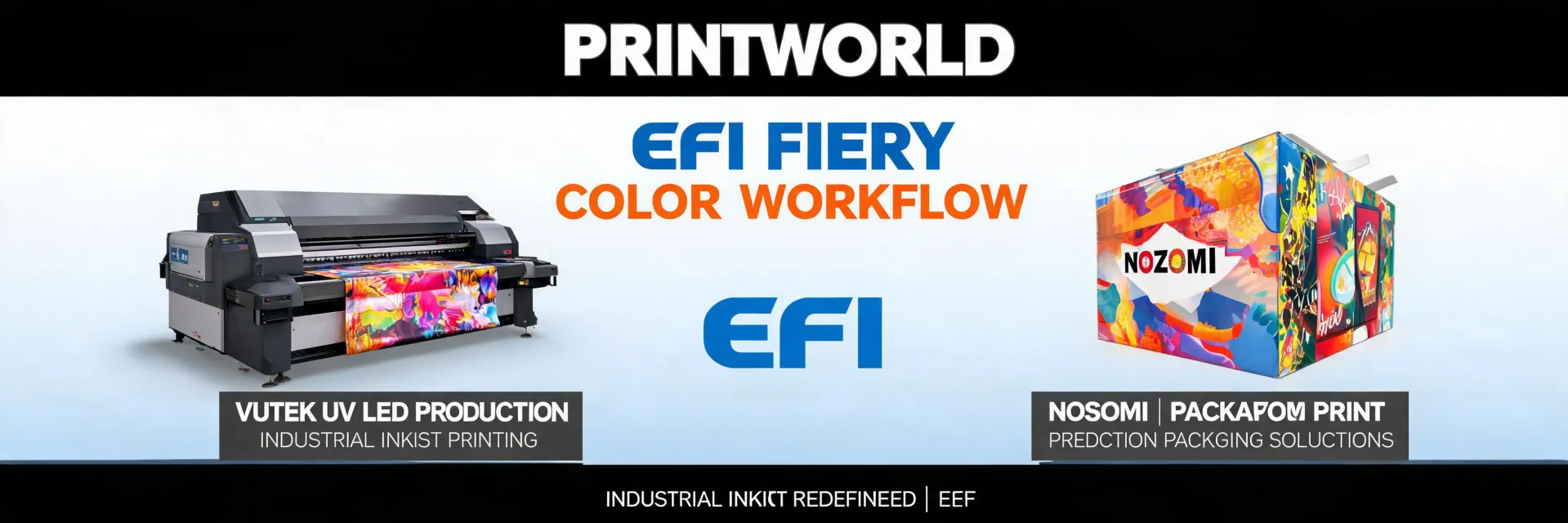
And EFI—their UV LED technology in the VUTEk and Nozomi lines is engineered for industrial production volumes. That's their boundary: high-speed, consistent UV printing at scale. The H1625 LED roll-to-roll, the Nozomi C18000 for corrugated packaging—these are tools built for continuous production, not occasional use. When people ask me about EFI printing systems, I tell them the same thing I'd tell anyone: judge the machine by what it's designed to do, not by its spec sheet width.
The point isn't that one brand is better than the other. It's that one brand will be a better match for your specific workflow. And the vendor who knows their own boundary will tell you when you'd be better off elsewhere.
What It Costs When You Ignore the Boundary
People think expensive equipment delivers better quality—that the premium price guarantees consistency. The relationship actually runs the other way. Machines that are carefully matched to your workflow produce quality, and that reliability is what justifies the premium. The price tag doesn't buy quality. The match does.
I fell into the trap myself, so I know how seductive it is.
In 2022, we expanded into can label printing. The decision came down to two options: a versatile machine that could do wide-format AND labels, and a dedicated label solution. We went with the versatile option. The price was 18% lower, and the sales rep's pitch was convincing: "Why buy two machines when one does both?"
Six weeks after installation, we ran our first big can label order. 50,000 units, four spot colors, a UV coating. The run looked great fresh off the press.
Then we checked the warehouse two days later. The edges of some stacked labels had scuffed. Storage conditions were normal. The problem? The ink hadn't fully cured. The machine's UV output wasn't consistent across the full width at production speed. The demo looked fine because we ran it at 40% speed, giving the lamps extra dwell time. At 100% production speed, the curing was marginal.
I assumed "same specifications" meant the output would hold up. Didn't verify. Turned out the versatile machine was genuinely good at wide-format and just okay at labels. And "just okay" isn't a standard to build a brand on.
That order cost us a client we'd had for three years.
The visible bill was ugly enough:
- Replaced materials: $4,800
- Re-run press time: 6 hours (~$1,200 in hourly cost)
- Overtime to hit the client's launch date: $3,400
- Next-day air shipping for the corrected order: $850
That's about $10,250 in direct costs. But here's what didn't show up on the invoice:
Two of my QC inspectors spent 18 extra hours re-inspecting the replacement batch. Our sales team had to make a humbling call to a customer who'd trusted us. The production schedule slipped for two other jobs while we prioritized the re-run. And the client started sending smaller orders afterward—testing us, slowly rebuilding trust.
Total revenue from that client over the next six months: about $60,000, down from $120,000 the previous half-year. Our margin on those orders was roughly $24,000. The equipment "savings" from choosing the versatile machine? $11,500.
That's not a savings. That's a loss of at least $36,000, probably more once you factor in lost referrals. I did the math because I wanted to know exactly how much one bad equipment decision cost. Accurate numbers are the only way to get leadership to listen.
What I Do Now: A QC Framework for Equipment Evaluation
That failure changed how we evaluate printers. The framework below cut our first-delivery reject rate from 11.3% in 2022 to 5.8% in 2024.
1. Define acceptance criteria before you test. Not "it looks good." Measurable tolerances: ΔE under a specific threshold, scuff resistance, ink adhesion, curing margin. Write them down and hand them to the vendor before the demo.
2. Test at production speed, not demo speed. That was our mistake. A machine that prints beautifully at 40% speed can fall apart at nominal capacity. Set up exactly the run you'd do in production and watch what happens when you push the button.
3. Bring your own media. Don't test on the vendor's optimized stock. Bring the actual substrates you'll run—your label stock, your corrugated board, your banner material. Media compatibility varies more than spec sheets suggest. I've seen an EFI UV printer outperform on production media where other machines looked great only on the vendor's own paper.
4. Ask what the vendor doesn't do well. This one's counterintuitive, but it works. When we evaluated a new UV flatbed in 2023, one vendor said: "If your work is mostly food-grade packaging, we're not the right fit—here are two companies who do that better." That statement didn't push us away. It made us trust every other claim they made. The vendor who respects their own limits is more credible than the one who claims total versatility. I'd rather work with a specialist who knows their boundaries than a generalist who overpromises.
5. Validate curing and durability under real conditions. Don't test a print fresh off the press. Let it sit for 24 hours. Stack it the way your warehouse stacks it. Put it through the same handling your clients use. Curing issues show up later—checking early catches them before they become expensive.
Bottom Line
There are genuinely world-class tools in this market. The Roland printer cutter is a category-defining product for print-and-cut work. Epson printers have no real competition in certain photographic niches. And when you need high-speed industrial UV printing—whether that's an EFI UV printer like the VUTEk line, roll-to-roll work on the H1625, or packaging on the Nozomi C18000—there's a machine built specifically for that.
The strength is real. The problem starts when we ask any of these machines to be something they weren't designed to be.
So when you're evaluating a can label printer, a grand-format UV machine, or a roll-to-roll system, change your question.
Don't ask: "Can it print what I need?"
Ask: "Can it print what I need, at my volume, with my quality standards, consistently—and does the manufacturer know exactly where its expertise boundary is?"
That answer will tell you more than any spec sheet ever will.
Product capabilities and specifications are for general reference only. Verify current models and configurations with manufacturers before making capital equipment decisions.

Elise Marceau is an LED display and digital-signage systems analyst covering LED video walls, modular screens, transparent LED, control processors, and indoor or outdoor signage. She applies IEC 62368-1 safety principles while comparing pixel pitch, luminance, contrast, refresh rate, colour uniformity, viewing angle, ingress protection, power density, module serviceability, and signal redundancy. Her specification guides help integrators, venue operators, retailers, and procurement teams align viewing distance, ambient light, content format, installation access, electrical load, and lifecycle support.