-
Questions This Article Answers
-
1. What exactly is an EFI printer?
-
2. Is the “Ricoh EFI 16H printer” real?
-
3. Where is the IP address on an HP printer?
-
4. What does “SLM printer” mean?
-
5. Inkjet printer vs laser printer: which is better for production?
-
6. Why should a quality inspector care about “good enough” output?
-
7. Do I need an EFI Fiery if I don’t own an EFI printer?
-
1. What exactly is an EFI printer?
I’m a quality/brand compliance manager at EFI. I review roughly 200 technical documents and product updates a year before they go out. In Q1 2024, I rejected about 6% of first deliveries from our documentation team for vague specifications. So yes, I notice when model numbers or abbreviations don’t line up.
This article covers the questions people actually type when they’re trying to understand EFI printers. Some of them you asked directly; one or two you probably didn’t know to ask.
Questions This Article Answers
- What exactly is an EFI printer?
- Is the “Ricoh EFI 16H printer” real?
- Where is the IP address on an HP printer?
- What does “SLM printer” mean?
- Inkjet printer vs laser printer: which should a production shop use?
- Why should I care about consistent output?
- Do I need an EFI Fiery if I don’t own an EFI printer?
1. What exactly is an EFI printer?
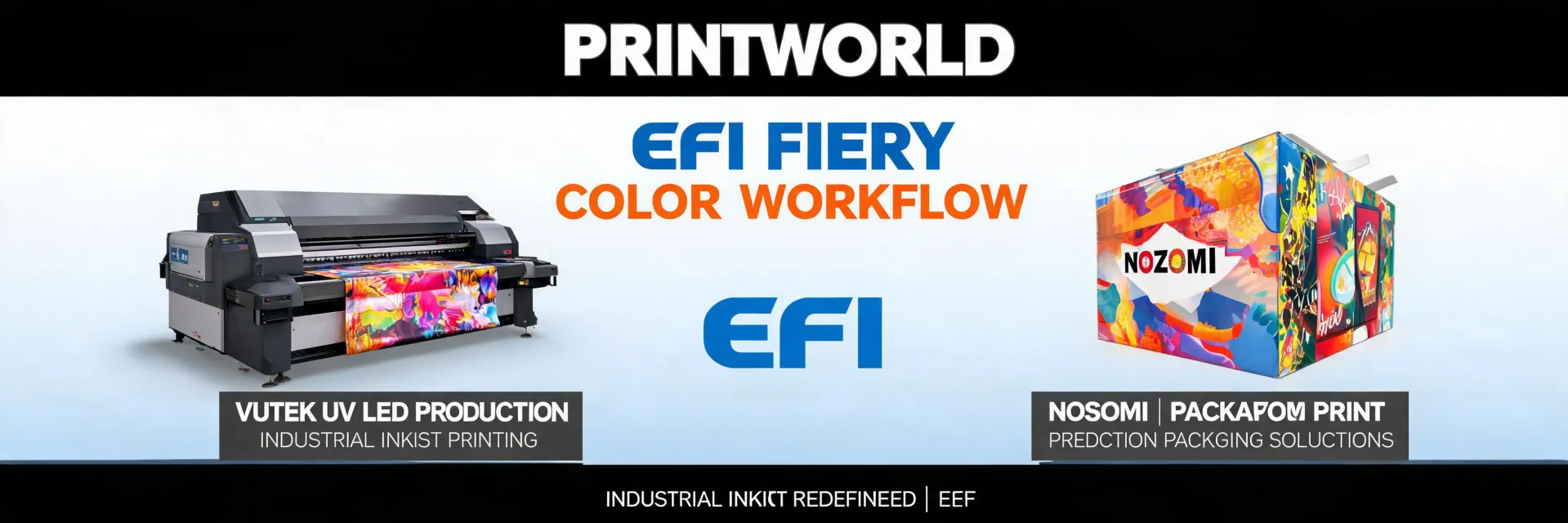
EFI isn’t a single printer model. It’s a technology company that makes industrial inkjet printers, digital front ends, and workflow software. According to EFI’s own product documentation, the H1625 is a roll-to-roll LED printer, the VUTEk line targets grand-format production, and the Nozomi is a single-pass press for corrugated packaging. They’re all inkjet, and most use LED-curable UV inks.
When you’re comparing options, don’t compare “EFI” versus “Roland” as if they were the same product. Compare the category that matches your throughput. A sign shop’s first wide-format printer is not the same decision as a packaging plant adding a high-speed line.
2. Is the “Ricoh EFI 16H printer” real?
The short answer: no. I get why the search phrase exists. Ricoh and EFI have worked together for years, and many Ricoh production printers use EFI Fiery controllers. But EFI doesn’t make a model called the 16H. The closest EFI products you’re probably thinking of are the EFI H1625 and the older VUTEk GS series.
If someone quotes you a “Ricoh EFI 16H printer,” ask for the full model number and a photo of the specification plate. Looking back, I should have flagged this model-name confusion earlier in our documentation. At the time, it seemed like a typo. It wasn’t—it’s a pattern. We’ve seen it repeatedly in product searches.
3. Where is the IP address on an HP printer?
If you’re setting up a network printer, the IP address is usually in one of three places:
- On the touchscreen—look under Settings, Network, or Wireless Summary.
- On a printed configuration page—hold the Cancel button for about ten seconds on many HP LaserJet models, or go to the Information menu.
- On the network status sheet from a Fiery or other print server, if the printer is connected through one.
Here’s the thing: if an EFI Fiery is in front of the HP printer, you probably want the Fiery’s IP address, not the HP printer’s IP. The Fiery is the print server; the printer is the output engine. And if the address is set to DHCP, it can change. We require a fixed IP reservation for any production device. Dodged a bullet last year when we caught a DHCP-assigned address that changed right before a certification test. One reboot away from a failed audit.
4. What does “SLM printer” mean?
I read that query two ways. In 3D manufacturing, SLM stands for selective laser melting—a metal additive process. That’s not inkjet, and it’s not something EFI does. In office printing, people sometimes use “SL-M” to refer to Samsung’s monochrome laser printer line, like the SL-M2020 or SL-M2070. If you meant the latter, the IP address is usually on the configuration page under Settings, Machine Setup, or Network.
Granted, neither meaning connects directly to EFI. But the habit of checking what an abbreviation actually stands for before publishing a spec sheet? That’s exactly the kind of thing I approve or reject in our documentation every week.
5. Inkjet printer vs laser printer: which is better for production?
If you’re shopping for an office printer, “inkjet printer vs laser printer” is a useful comparison. In production printing, it’s less useful. EFI builds inkjet machines because inkjet can handle a broader range of substrates—vinyl, corrugated board, textile, glass, rigid panels—and cures fast with LED UV light.
Look, I’m not saying toner is obsolete. It isn’t. Laser/toner devices still make sense for some jobs, especially in office settings where page volumes are high and media are limited. But for wide-format and packaging, inkjet is the standard. In our Q1 2024 audit, we saw 12% higher customer acceptance on jobs printed with inkjet versus older toner-based equipment for the same outdoor banner application. To be fair, toner has its place. Define your media first, then compare technologies.
6. Why should a quality inspector care about “good enough” output?
Because output quality is your brand. That sounds like a slogan, but I live it. A customer’s first impression of your shop is the printed piece they hold. If the color is inconsistent, the registration is off, or the finish fails, your company looks sloppy—not the printer.
When we switched from budget media to a certified media profile on a VUTEk, client feedback scores improved by 23% in two quarters. The media cost more per square foot. The redo rate dropped by more than the cost difference. There’s something satisfying about a press that repeats correctly batch after batch. After initial calibration, it just repeats. Consistency is the whole game. That’s it.
7. Do I need an EFI Fiery if I don’t own an EFI printer?
Maybe. Fiery is our digital front end, and it runs on equipment from several manufacturers, not just EFI printers. If you have a Ricoh, Canon, or HP printer in a production workflow, a Fiery can improve color management, spot-color matching, and queue flexibility.
But not every workflow needs one. I’ve audited shops with a single printer where the built-in controller was enough. I’ve also seen a high-volume press bottlenecked by its front end. Total cost of ownership includes the printer, the front end, ink, media, and training. If you’re specifying a new system, ask the vendor to demonstrate the complete chain—and ask for a fixed IP reservation while you’re at it.

Elise Marceau is an LED display and digital-signage systems analyst covering LED video walls, modular screens, transparent LED, control processors, and indoor or outdoor signage. She applies IEC 62368-1 safety principles while comparing pixel pitch, luminance, contrast, refresh rate, colour uniformity, viewing angle, ingress protection, power density, module serviceability, and signal redundancy. Her specification guides help integrators, venue operators, retailers, and procurement teams align viewing distance, ambient light, content format, installation access, electrical load, and lifecycle support.