
-
Quick answers before the questions
-
What is the biggest EFI printing news for production shops right now?
-
Is an EFI UV printer worth the money?
-
Can I print on glossy paper with an inkjet printer?
-
How do you print on adhesive printer paper without ruining the job?
-
When would a hand held inkjet printer be a better choice?
-
Why do my glossy inkjet prints smear hours later?
-
What is the most overlooked part of planning a rush print job?
Quick answers before the questions
I'm a production coordinator at a digital print shop. We run two EFI UV flatbeds and a VUTEk roll-to-roll. In the last four years, I've handled more than 50 rush turnarounds—trade show panels, label reruns, packaging mockups, and a few late-night saves I'd prefer not to repeat. Last quarter alone, we processed 37 rush jobs with 95% on-time delivery.
When people search for EFI printing news, most of them aren't looking for a press release. They want to know what will actually change in their production workflow. So here are the questions I get from real customers, answered the same way I would before they sign a PO.
What is the biggest EFI printing news for production shops right now?
If I had to pick one story from the past year, it's not a single product launch. It's the continuing shift to LED UV curing. On an EFI UV printer, the ink is cured by UV light instead of being absorbed into the material. That means no waiting for solvent evaporation. You can print, rack, laminate, or assemble in one flow.
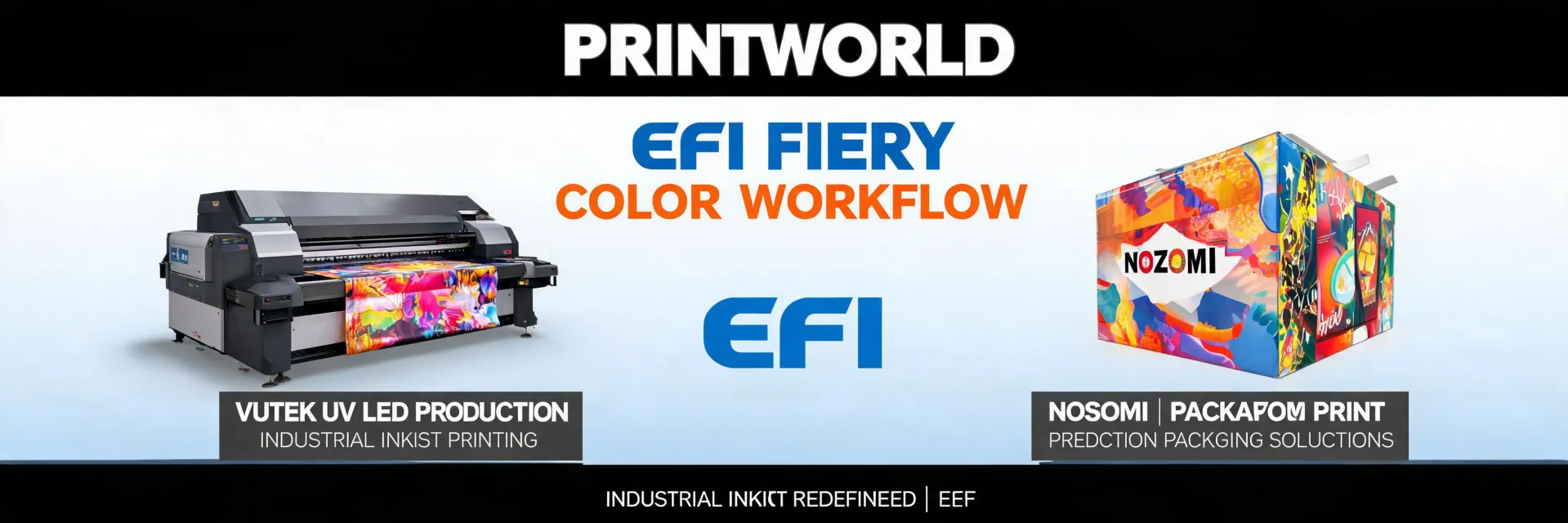
For example, the VUTEk h1625 is a grand-format LED roll-to-roll printer. The Nozomi C18000 is a single-pass inkjet press for corrugated packaging. Different machines, same core shift: speed and consistency are now the selling points, not just the ability to print on many materials.
For official product announcements, efi.com/newsroom is the right place. But the production-floor takeaway is simpler: if your growth depends on fast turnarounds, LED UV is the reason you can meet them without building a drying tunnel. Period.
Is an EFI UV printer worth the money?
I can't tell you what's worth it for your profit and loss statement. But I can tell you when it stops being a luxury.
A UV printer earns its keep when the bottleneck is material handling, not ink drying. We've printed directly onto acrylic, MDO, foam board, Dibond, adhesive-backed vinyl, and pre-cut corrugated boxes. Because UV ink cures instantly, the parts can be handled immediately. That collapses a job that used to take two days into five hours.
Color consistency is the other reason. Brand-critical colors have an industry tolerance of Delta E < 2. In my experience, a well-maintained EFI UV printer holds that with the right ICC profile. The catch: the printer is only half the equation. A high-end press with a sloppy RIP profile will still produce bad color.
Personally, I'd rather spend 10 minutes explaining profiles than deal with a mismatch later. The technology is solid; the workflow is what you have to manage.
Can I print on glossy paper with an inkjet printer?
Yes, but with a caveat: only if the paper is made for inkjet.
Glossy paper for offset or laser printers does not have the same coating as inkjet photo paper. Inkjet paper has a microporous coating that absorbs liquid ink. A sheet of standard glossy stock leaves ink sitting on the surface. The result is pooling, smearing, and prints that look fine for six seconds and then become a smudge.
If you're using a desktop inkjet, set the paper type to "glossy photo paper" and use the photo black ink tank if the printer has that option. Water-based dye and pigment inks need those coatings. If you're printing on a UV printer, the problem disappears because UV ink is cured, not dried.
So the honest answer to "Can I print on glossy paper with an inkjet printer?" is yes, if the paper says "inkjet" on the box. Otherwise, your results will probably frustrate you.
How do you print on adhesive printer paper without ruining the job?
Adhesive printer paper has a release liner, the transparent backing underneath the face stock. It isn't just paper with glue. The liner, adhesive, and face stock are three separate layers, and each one affects printing.
Here's what can go wrong: the liner can curl, the adhesive can ooze, or the face stock can be too porous and absorb ink unevenly. I remember a rush order in March 2024—a beverage client needed 500 labels in 36 hours after their usual supplier had a press failure. We printed a 10-inch test strip on the adhesive sheet, and the release liner tore when we tried to peel it. The adhesive had dried too much. It sat in storage too long.
- Specify adhesive label stock rated for inkjet or UV printing.
- Use a profile that matches the face stock, not the liner.
- Test one sheet before running the whole box.
- If the label will claim "recyclable," make sure you can substantiate it under the FTC Green Guides.
On a UV flatbed, set the platen gap for the label stock's thickness. Too large, and the image focus goes soft. Too small, and the printhead touches the liner. That's not a manufacturer defect. That's media setup.
When would a hand held inkjet printer be a better choice?
When you're printing variable codes on cartons in a warehouse. A hand held inkjet printer is a coding and marking tool: date codes, lot numbers, barcodes, simple one-color logos. It's affordable, portable, and does that one job well.
But it is not a replacement for an EFI UV printer. The print width is small. The resolution is lower. Color is limited. If a client asks for a full-color label on adhesive paper, a hand held inkjet printer isn't the answer. The surprise isn't that it looks cheap; it's that people expect more from a tool designed to mark boxes.
I'd put it this way: a hand held inkjet printer and a production UV printer both use inkjet technology. That's like saying a paper cutter and a CNC router both cut materials. Technically true, but no one uses the same blade.
If you need accurate full-color graphics, you need a production inkjet system. If you need a batch code on a moving carton, get the handheld. Don't buy one hoping it covers the other.
Why do my glossy inkjet prints smear hours later?
I think this gets asked almost as often as the "Can I print on glossy paper" question. The printer prints a beautiful sheet, you leave it to dry, and an hour later it's smeared on your thumb. It wasn't dried. It looked dry.
With water-based inkjet inks, the solvent carrier needs time to evaporate or be absorbed. On a glossy or semi-gloss media, the surface doesn't absorb ink well. So "dry" is only what the surface looks like. If the media coating is saturated, the ink is still mobile underneath.
The longer you wait before touching the print, the better. But production shops don't have time to wait. That's why UV curing matters: it turns liquid ink into a solid film in one pass. No absorption. No evaporation. No waiting. The smearing problem only exists on printers that rely on absorption and air drying.
The takeaway: if glossy prints are smearing after drying, it's not a humidity issue. It's an ink/media compatibility issue.
What is the most overlooked part of planning a rush print job?
After dozens of 48-hour turnarounds, the most frustrating part isn't missing deadlines. It's watching a job stall because the wrong print profile was picked. We once lost a $6,000 job because we assumed the adhesive paper was the same as the roll from last month. It wasn't. The coating had changed.
Now our process has a rule: before any rush run, print a 10-inch test strip no matter what the schedule says. It sounds counterintuitive. But a test strip costs two minutes; a ruined run costs the deadline.
Trust the hardware, but verify media, profile, and curing before you hit "run." Done.

Elise Marceau is an LED display and digital-signage systems analyst covering LED video walls, modular screens, transparent LED, control processors, and indoor or outdoor signage. She applies IEC 62368-1 safety principles while comparing pixel pitch, luminance, contrast, refresh rate, colour uniformity, viewing angle, ingress protection, power density, module serviceability, and signal redundancy. Her specification guides help integrators, venue operators, retailers, and procurement teams align viewing distance, ambient light, content format, installation access, electrical load, and lifecycle support.