
I'm the production manager who handles wide-format and industrial print orders for a living. I've been at it since 2017, and I've personally made and documented 23 significant mistakes that added up to about $41,000 in wasted budget. That's not a humble brag. That's the cost of learning the hard way. In my first year (2017), I made the classic mistake of trusting a PDF proof and skipping a physical proof. 1,200 business cards, $320, straight to the trash. Now I keep the checklist that keeps my team from repeating those errors.
"Which printer should I buy?" is one of the most common questions I get. The answer is: it depends on what you're actually producing. There is no universal best printer. There are only correct matches for a specific job.
I think about the decision in three branches.
- Production output: signs, panels, packaging mockups, roll graphics for retail. This is where EFI wide format printers live.
- Office work and photos: documents, snapshots, presentation materials. This is where a Deskjet inkjet and the right photo paper can be enough.
- Physical parts: prototypes, brackets, custom components you can hold in your hand. This is where a Bambu Lab style 3D printer earns its space.
I've been burned in all three branches. Honestly, the most expensive mistakes happened when I confused one branch with another.
Scenario A: You're Selling Production Output
From the outside, it looks like a commercial printer is just a bigger, faster version of an office printer. The reality is very different. A production device has to run for hours without drifting, handle rigid or roll-fed media, and match a color expectation that a client's marketing department has already signed off on.
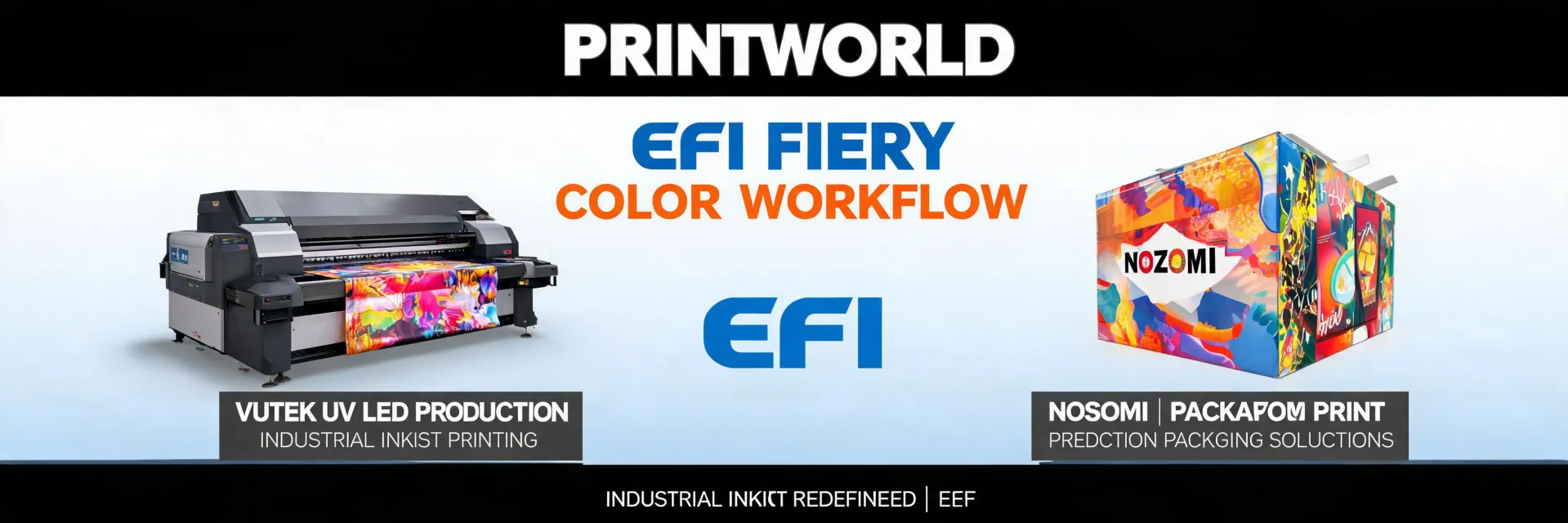
If you're producing signage, vehicle wraps, flatbed panels, or short-run packaging, the relevant category is a wide format LED printer. EFI's wide format printers, including the Pro 16h+ hybrid LED printer, sit in this branch. Hybrid means it handles both rigid sheets and roll-fed media, which basically gives you a flatbed and a roll-to-roll machine in one footprint. That flexibility is why I recommend it for shops that don't have the floor space or volume to justify two separate machines.
But the machine is only half of it. Most buyers focus on the hardware price and completely miss ink coverage, labor, and waste. The question everyone asks is "what's the square-foot price?" The question they should ask is "what's the fully loaded cost per usable panel after setup, rejected pieces, and downtime?"
I knew I should run a test print on a new media roll before the production run, but thought "what are the odds?" On a 47-piece order, every single banner had a faint banding pattern. The odds caught up with me. That one cost $890 in redo plus a week of delay.
Industry standard color tolerance is Delta E < 2 for brand-critical colors. Delta E of 2 to 4 is noticeable to trained observers; above 4 is visible to most people. Reference: Pantone Color Matching System guidelines.
If a client's logo is Pantone 286 C, don't assume the CMYK conversion will automatically be good enough on every substrate. A good LED printer plus a calibrated workflow is the difference between a repeat order and a phone call from a lawyer. For production work, the resolution benchmark is 300 DPI at final size for most commercial print. Large format, viewed from a distance, can get away with 150 DPI. Those are industry-standard minimums, not optional suggestions.
Scenario B: You're Printing Photos or Office Documents
Now the other side. Sometimes a client asks me about an HP Deskjet and whether it's an inkjet printer. Yes. A Deskjet is an HP product line and it absolutely is an inkjet printer. It uses thermal inkjet printheads. That doesn't make it a toy—for documents and occasional photos it can be completely fine. It's just not in the same branch as an EFI wide format printer.
The problems start when people treat a Deskjet as a substitute for commercial equipment. It isn't. It's a low-volume tool. If you're printing one hundred 8.5×11 photo sheets, it's fine. If you're printing a hundred 4×8 panels, it's not the right conversation.
What surprised me more than the Deskjet confusion is how many people ignore photo paper. Why does the paper matter? Because media controls how ink sits on the surface. Photo paper for printer use has a special coating that controls ink spread and color density. Print a photo on plain 20 lb bond (75 gsm), and it will look dull. Print the same file on a coated photo paper, and the difference is immediate.
Paper weight conversions are approximate, but here's a useful baseline: 20 lb bond is about 75 gsm, 24 lb bond is 90 gsm, 80 lb text is 120 gsm, and 100 lb text is 150 gsm. For photo output, use a paper designed for your ink type. If you don't know whether your Deskjet uses dye-based or pigment-based ink, check the spec sheet before buying paper. It matters.
A potential client once asked me: "Is a Deskjet good enough for printing art prints?" It depends. If you're making a proof for a client, yes. If you're selling a limited edition run, no. The question isn't whether Deskjet is an inkjet printer—it is. The question is whether the output quality and durability match the purpose. That is a scenario question, not a spec-sheet debate.
Scenario C: You're Making Physical Parts, Not Flat Graphics
Let's talk about the third branch because it trips up even smart buyers. A 3D printer like a Bambu Lab machine is not a faster, newer version of a paper printer. It's a completely different process: additive manufacturing. It builds parts layer by layer from filament or resin. It can't print a brochure, and a wide format printer can't print a bracket.
The reason Bambu Lab 3D printers get mentioned near industrial printing is that they've made good desktop 3D printing much more accessible. The workflow, however, is not plug-and-play. Orientation affects layer adhesion. Extrusion temperature affects dimensional accuracy. Supports affect surface finish. I've seen a beautiful-looking part collapse because I oriented it the wrong way on the build plate. Actually, I didn't just see it—I did it.
If your need is making prototypes, jigs, and replacement parts, a 3D printer is the right branch. If your need is producing printed graphics, it's not. "3D printer" and "wide format printer" both have "printer" in the name. From the outside, that seems like enough. The reality is that they share nothing except the ability to turn a digital file into a physical object.
How to Tell Which Branch You're On
Here's a simple way to decide. It's not a sophisticated formula, but it works.
- If you need to move 20 or more printed panels per day, or produce large-format graphics, you're in Scenario A. Look at production-oriented EFI wide format printers.
- If you need documents and occasional photos, and your daily volume is low, you're in Scenario B. A Deskjet or equivalent inkjet with decent photo paper is the right tool.
- If you need three-dimensional objects, you're in Scenario C. A Bambu Lab 3D printer or similar device solves that.
What was best practice in 2020 may not apply in 2025. The fundamentals haven't changed, but the execution has transformed. Five years ago, a hybrid LED wide format machine like the EFI Pro 16h+ was a specialty purchase. Now it's a viable option for a normal sign shop that wants to say yes to both flat rigid panels and roll-to-roll work without buying two machines.
The one thing I tell every new employee: know what you're producing before you pick the tool. That sounds obvious. It wasn't obvious to me in 2017. It cost me a lot of money to learn. That's it. That's the whole lesson.

I’m Jane Smith, a senior content writer with over 15 years of experience in the packaging and printing industry. I specialize in writing about the latest trends, technologies, and best practices in packaging design, sustainability, and printing techniques. My goal is to help businesses understand complex printing processes and design solutions that enhance both product packaging and brand visibility.