
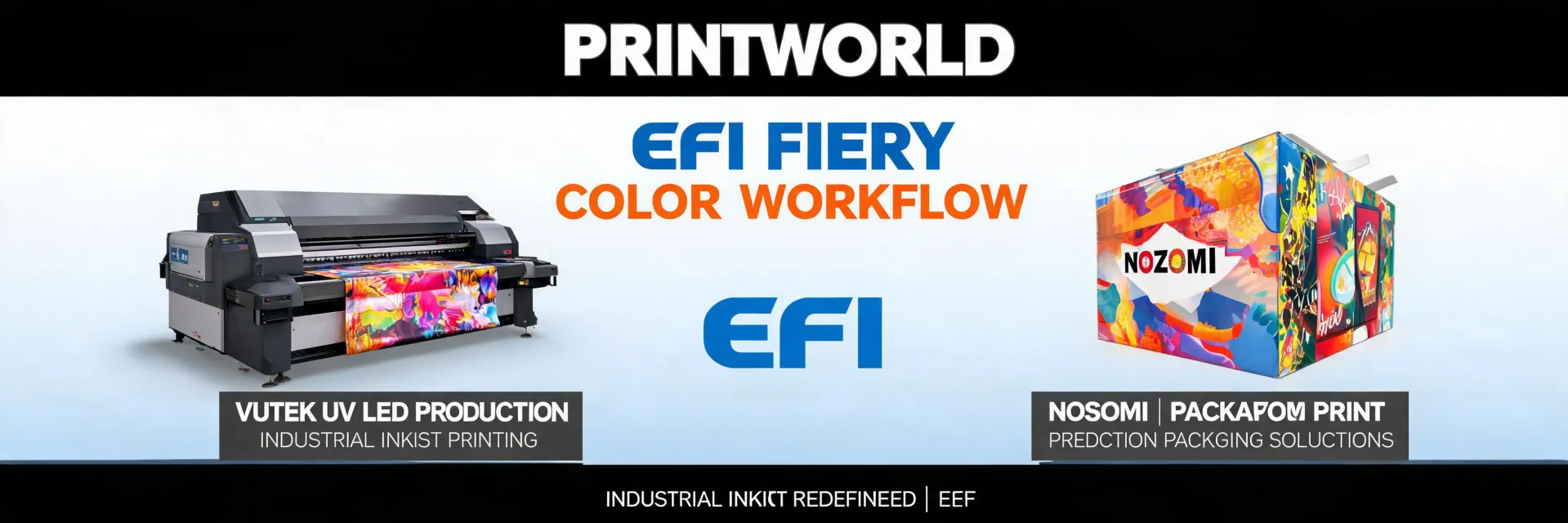
I'm not an engineer, and I don't pretend to be one. I'm an operations manager who's been handling production print orders for 12 years. I've personally made—and documented—23 significant mistakes, totaling roughly $38,000 in wasted budget. Now I maintain our team's equipment checklist. Last fall, our owner asked a question: should we buy a giant 3D printer, dip our toes into resin printing, or replace our aging roll-to-roll with an EFI H1625 LED printer? The conversation kept collapsing into the old resin printer vs filament debate. That's the wrong starting point.
This isn't about EFI inkjet printers being 'better' than 3D printers. It's about knowing what each machine is built for. A giant 3D printer builds parts, not graphics. An EFI H1625 LED printer prints on flexible roll media at a width around 1.6 meters. Those are different tools, but people keep putting them in the same budget meeting because both are 'digital printing.' Let me rephrase that: until you compare output, throughput, and workflow, you're comparing phone numbers, not equipment.
What Are We Actually Comparing?
First, clear up the 3D side. Resin printer vs filament is a question inside the additive world. Resin printers cure liquid photopolymers with light; filament printers extrude melted plastic layer by layer. A giant 3D printer is often a large-format filament printer for items that don't fit on a desktop, or in some cases a large resin machine. It is not a replacement for a roll-to-roll printer.
In 2019, I said 'we need production capacity.' They heard 'we need 3D printers.' Result: we spent about $4,700 on two filament machines and tried to use them for display pieces. It took us three failed prints to realize the order would take two weeks, not two days. That's when I learned to define output before comparing machine categories.
Dimension 1: Output Type
An EFI H1625 LED printer produces printed graphics: banners, vehicle wraps, posters, signs, and other flexible roll media. It uses UV LED inkjet technology, which means the ink is cured in-line and the machine can keep moving. A giant 3D printer produces physical objects with a build chamber big enough for, say, an automotive panel or a custom enclosure. The two never trade places.
If you're deciding between resin and filament, you're deciding between detail and strength. Resin prints can look like injection-molded plastic. Filament prints are tougher but show layer lines. That's a real difference, but it's a much smaller difference than the one between additive printing and high-speed inkjet.
Dimension 2: Cost Per Part vs Cost Per Square Meter
This is where I expected the 3D printer to win. It didn't. The proposals I evaluated in late 2024 for a 1.6-meter-class LED inkjet had a wide price range, and a serious giant 3D printer can cost less than half of an H1625. Publicly listed prices in January 2025 showed large-format 3D printers starting around $20,000 and climbing well past six figures, depending on build volume. Resin printers ran from roughly $300 to $3,000, and filament printers from about $200 to $2,000. But the sticker price isn't the real number.
Our shop's mistake was thinking 'cheaper machine equals cheaper production.' That only works if you're producing parts, not printed media. For a 500-unit banner order, the H1625 runs ahead of any additive machine. For a one-off custom bracket, a filament printer beats both. The surprising conclusion: a giant 3D printer is often the more expensive long-term tool for a print shop, even when the purchase price looks attractive. The cost per working hour adds up faster than the cost per machine.
Dimension 3: Printer Drivers and Workflow
Printer drivers are the part I didn't fully respect until it cost me real money. On an EFI inkjet printer, the driver and RIP workflow handle color profiles, media compensation, ink restrictions, and queue management. On a filament printer, the slicer acts as the driver, translating the model into G-code. On a resin printer, the slicing software controls layer exposure and supports. All of it is driver logic, just acting on different hardware.
I once lost $3,200 in media on an H1625 job because we loaded the wrong printer driver profile. The first meter looked fine, then the front panel warned a linearization was out of range. We kept going. By the time the roll was finished, the color was off and we had to throw the whole thing out. No, wait—we did throw it out, after trying and failing to sell it as a 'seconds' lot. That's the day I put software verification on our checklist.
Dimension 4: Maintenance and the Uptime Myth
Every production machine needs maintenance. A giant 3D printer can have nozzle clogs, bed adhesion issues, and part warping. Resin printers need wash-and-cure cycles and careful exposure tuning. The H1625 needs printhead cleaning, ink maintenance, and a properly controlled environment. None of these are set-and-forget, and anyone who promises guaranteed 100% uptime is not being honest.
This gets into additive manufacturing territory, which isn't my expertise. I'd recommend consulting a maintenance engineer before you buy any large format system. What I can tell you from a production manager's seat is that the machine with the strongest checklist is usually the one with the highest usable throughput.
Resin Printer vs Filament: The Trap
I want to end the resin printer vs filament question so it stops blocking the bigger budget decision. If you need small parts with fine detail, resin usually wins. If you need functional prototypes or parts that survive a little abuse, filament usually wins. But neither of those answers tells you whether to buy a 3D printer at all, let alone a giant one.
My experience is based on about 150 projects in a commercial print shop, so I can't speak to engineering labs or maker spaces. If your work is different, your mileage will vary. What I can say is this: do not let the resin versus filament argument distract you from the real question—what are you going to produce, at what quantity, and how much is a failed print going to cost you?
Which One Should You Choose?
If you print graphics for sign shops, vehicle graphics, banners, or similar roll media, an EFI H1625 LED printer is the right category. If your revenue comes from custom physical parts, a giant 3D printer makes sense. If you're a small shop doing small volume, don't let anyone make you feel that short runs are the wrong priority. When I was starting out, the vendors who treated my $200 orders seriously are the ones I still use for $20,000 orders.
Small doesn't mean unimportant—it means potential.
One more checklist item: before you choose, map the workflow. A machine without the right printer driver profiles, media settings, or operator training is just expensive stress. That lesson cost me roughly $38,000 before I started documenting it.
The Bottom Line
The real comparison is not EFI inkjet printers versus giant 3D printers as if they're rivals. It's output type and run length. The H1625 is a production printing machine. A giant 3D printer is a production fabrication machine. Resin vs filament is a side debate. Decide what you're actually selling, then choose. And make sure your printer drivers, media profiles, and maintenance plan are part of the purchase decision—because your worst equipment mistake won't be the machine. It'll be the missing checklist.

I’m Jane Smith, a senior content writer with over 15 years of experience in the packaging and printing industry. I specialize in writing about the latest trends, technologies, and best practices in packaging design, sustainability, and printing techniques. My goal is to help businesses understand complex printing processes and design solutions that enhance both product packaging and brand visibility.