
-
1. What is an EFI UV printer?
-
2. Why should you buy EFI grand format printers?
-
3. What do buyers miss when comparing EFI UV printers?
-
4. Can an EFI UV printer handle circuit printer jobs?
-
5. Can an EFI UV printer replace a Zebra card printer?
-
6. Can you use an inkjet printer for sublimation?
-
7. What does a rush order have to do with choosing an EFI UV printer?
I'm the person who coordinates production when everything is on fire. In my role at a commercial print shop, I've handled 200+ rush orders in the last five years—including same-day turnarounds for trade show and retail clients. So when people ask about printers, I answer with what I've learned from actual deadlines, not just spec sheets.
If you're searching for an EFI UV printer, thinking about grand format printers, or trying to figure out if an ordinary inkjet can do sublimation, here's what you need to know. All the questions below are ones I've actually been asked (or wish I'd been asked before signing a purchase order).
- What is an EFI UV printer?
- Why should you buy EFI grand format printers?
- What do buyers miss when comparing UV printers?
- Can an EFI UV printer handle circuit printer jobs?
- Can an EFI UV printer replace a Zebra card printer?
- Can you use an inkjet printer for sublimation?
- What does a rush order have to do with choosing one?
1. What is an EFI UV printer?
An EFI UV printer is a large-format or grand-format inkjet system that uses UV-curable inks. Instead of soaking into the substrate, the ink is exposed to UV light almost immediately after being jetted, so it cures into a solid layer. That's why EFI UV printers can print on materials that would ruin a solvent printer: rigid boards, acrylic, aluminum composite panel, foam board, and even corrugated sheet.
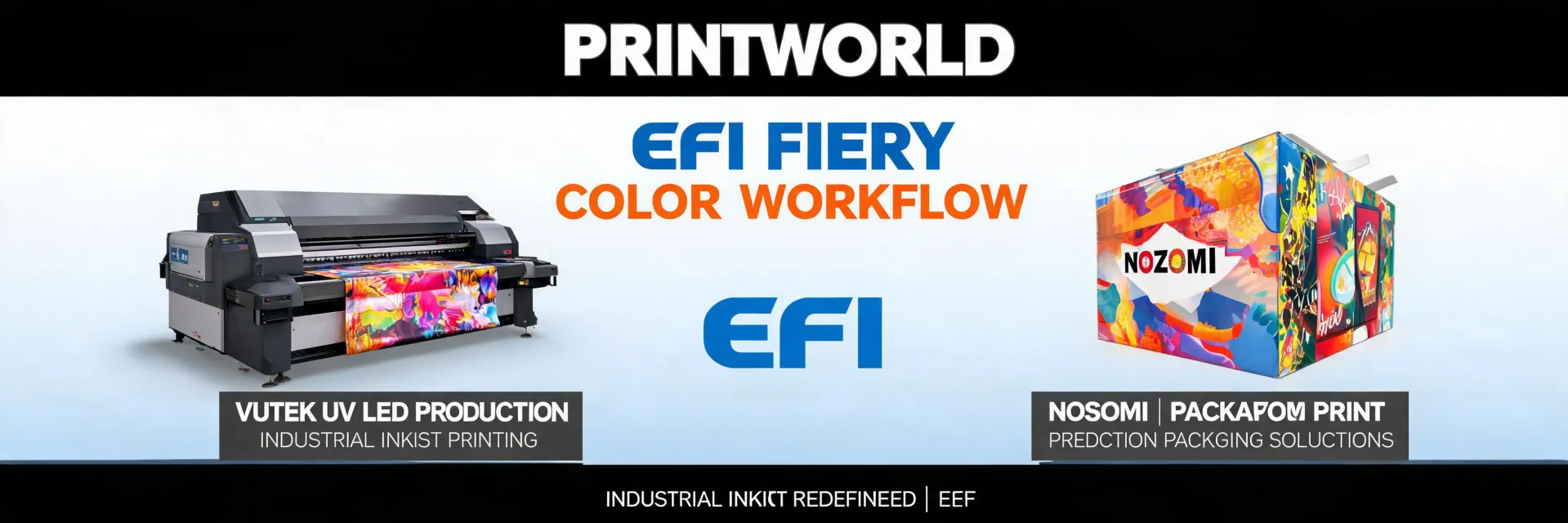
EFI's product lines span most of the production floor. VUTEk printers are superwide grand format machines. The H1625 is a roll-to-roll printer. The Nozomi C18000 is a single-pass press for corrugated packaging. They all share the LED UV approach. 'UV' isn't just a marketing word. It changes the workflow—you can print, stack, and finish immediately because the ink is dry when it hits the take-up. If you're used to waiting 24 hours for solvent ink to off-gas, that's a big deal.
2. Why should you buy EFI grand format printers?
The short answer: speed, color control, and the ability to keep production in-house. Grand format generally means 100 inches or wider. An EFI VUTEk printer can run large signage, vehicle wraps, bus wraps, and wall murals without tiling. If you're currently outsourcing those jobs, a grand format printer is a different cost structure—you're paying for ink and substrate, not a service bureau's markup and shipping.
When you buy EFI grand format printers, you're really buying consistency. We use a VUTEk for retail graphics, and the color difference between printed panels is small enough to hit a Delta E under 2 for brand colors. For context, Pantone's color matching guidance treats Delta E below 2 as the acceptable range for brand-critical color. That's not just about the machine; it's about the RIP, profiles, and LED curing behavior. But the machine has to be capable first.
3. What do buyers miss when comparing EFI UV printers?
Most buyers focus on speed and price per square foot. They completely miss setup cost, installation requirements, and the cost of keeping the machine running. A new EFI UV printer needs three-phase electrical power, enough floor space for the printer and material handling, compressed air, and a sensible workflow around it. If you don't have a dedicated operator who understands how color management and file prep work, the printer will sit idle.
The other blind spot is service. One shop in our region bought a grand format printer because the specs looked great. After two unscheduled maintenance visits, they learned that service calls get two business days to respond. In production, two days is a deadline. Ask about service contracts, response time, technician availability, and what spare parts are stocked locally before you make a decision.
Reference point: industry standard minimums for large-format viewing distances are around 150 DPI at final size. For products that'll be viewed up close, plan for more. Specs like '1200 DPI' matter less than how the system handles color on real substrates.
4. Can an EFI UV printer handle circuit printer jobs?
I get asked this more often than you'd think, usually by someone who saw 'flatbed printer' and connected it to 'printed circuit board.' The honest answer is no. A true circuit printer deposits conductive materials—silver nanoparticle ink, copper, dielectric layers—onto a substrate to create a working circuit. An EFI UV printer deposits pigmented, light-cured ink for visual graphics and protective layers.
What a UV printer can do is print membrane switches, front panels, overlays, and labels for electronic assemblies. It can even print a white base and then a graphic on a rigid board that later gets a circuit attached. But if someone needs a functioning PCB prototype, a UV printer isn't the tool. You're looking at a specialty printed-electronics system, or a PCB fabrication house.
So when you see the phrase 'circuit printer' in a product search, don't assume it's interchangeable with an EFI UV printer. The similarities end at 'inkjet.' Different ink, different heads, different result.
5. Can an EFI UV printer replace a Zebra card printer?
No. A Zebra card printer is designed to print on PVC cards—ID cards, access badges, membership cards. It can encode magnetic stripes, chips, and RFID in addition to printing. An EFI UV printer is a production machine for boards, corrugated, banners, and other large-format media. It won't feed a CR80 card, and it's not built to handle edge-to-edge card security features.
I've had clients ask if they could consolidate their ID card jobs and their signage jobs on one machine. It's a natural question, but the answer is about the media path. A card printer feeds single cards through a printhead and encoder; a grand format UV printer moves a sheet or roll through a much wider carriage. They solve different problems. If you need ID cards and signage, you need two different pieces of equipment—or an ID card service for the cards. This isn't a shortcoming of either machine; it's just what they're designed to do.
6. Can you use an inkjet printer for sublimation?
The popular answer is 'sometimes, but not safely.' A standard inkjet printer can be converted for dye-sublimation only if it uses a piezo printhead and you're willing to flush out the original inks, install sublimation ink, create a new profile, and accept the risk of permanently damaging the printer. That's a project, not a switch.
For EFI UV printers, the answer is a firm no. UV inks are a completely different chemistry. You can't drain the UV ink and add sublimation dye ink and expect it to work. The printheads, ink delivery system, and curing unit are all designed for UV-curable fluids. If your goal is sublimation on polyester fabric, mugs, or coated items, buy a dedicated sublimation printer or use a service bureau.
Also, remember sublimation isn't a direct print method. It prints onto transfer paper or fabric, then heat transfers the dye into the substrate. That extra thermal step is why a regular used inkjet printer isn't always a good candidate—you need a printhead that can handle the ink chemistry without clogging. Piezo-based machines are the standard choice because thermal printheads can overheat. So the next time someone says 'can you use an inkjet printer for sublimation,' the answer should be: only if it's designed for it or converted by someone who knows exactly what they're doing.
7. What does a rush order have to do with choosing an EFI UV printer?
Everything. In my world, the real test of a printer isn't the spec sheet—it's the 36-hours-before-the-deadline test. In March 2024, a client called on a Thursday afternoon needing 24 retail display graphics for a Monday morning store reset. Normal turnaround with outside vendors would have been five days. We ran them on a VUTEk, finished them Friday night, and delivered Sunday morning. The client's alternative was losing their placement at 14 stores.
That's the value of buying production capacity. A grand format UV printer lets you serve rush orders profitably if your workflow is efficient. But it also creates urgency in your own shop. If prepress isn't ready, the machine can't fix it. That's why I always tell people: buy the printer that can run at speed with your skillset and service support. Efficiency is competitive because time is the thing you can never get back.
Being able to say 'yes' to an emergency job is satisfying. The best part is seeing the client's relief when you hand over a job that looked impossible. That only works when the equipment, the team, and the process are all reliable. Choose the machine you'll trust when there's no time for problems.

Elise Marceau is an LED display and digital-signage systems analyst covering LED video walls, modular screens, transparent LED, control processors, and indoor or outdoor signage. She applies IEC 62368-1 safety principles while comparing pixel pitch, luminance, contrast, refresh rate, colour uniformity, viewing angle, ingress protection, power density, module serviceability, and signal redundancy. Her specification guides help integrators, venue operators, retailers, and procurement teams align viewing distance, ambient light, content format, installation access, electrical load, and lifecycle support.