
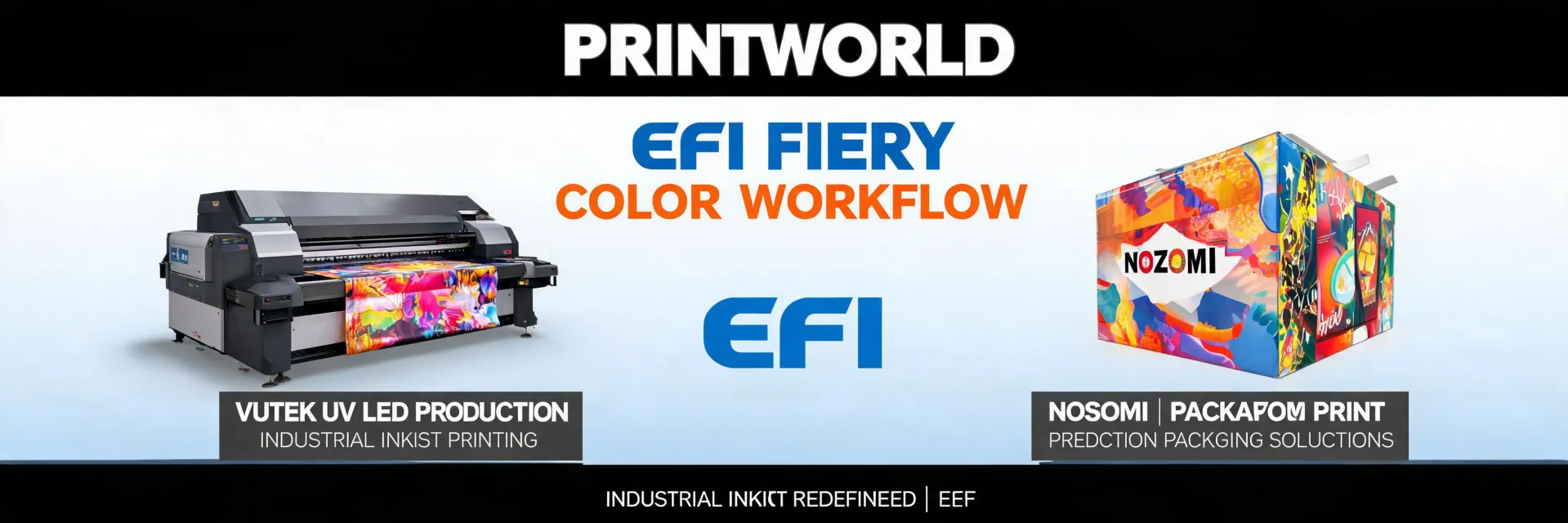
If you’re researching an “EFI digital printer” or looking into EFI digital printing for the first time, you’ll probably start with spec sheets: print speeds, ink droplet size, media handling, automation options. Spec sheets don’t tell you the one thing procurement people care about — whether the machine will earn its keep in your specific shop.
I’ve spent the last six years managing procurement for a printing operation. That means I track every purchase order, outside vendor invoice, rush charge and redo in a cost system the production team politely ignores. It also means I’ve watched print buyers make the same equipment decision three different ways: they buy too early and carry a machine that doesn’t get enough hours; they wait too long and keep paying rush premiums plus another company’s margin; or they hit what I call the volume crossover and make the jump with confidence. The difference isn’t budget. It’s scenario.
So before comparing LED curing speeds or flatbed sizes, figure out which of these three situations you’re actually in.
Scenario 1: You Outsource Most of Your Printing
This scenario is common in smaller shops and studios. You do design, project management, installation or client contact in-house, but the wide-format or production work goes to an outside trade printer. Your own printer is used mostly for proofs, small internal jobs and the occasional sample.
Here, my honest advice is to hold off on a production printer — even though telling a shop owner to wait is not the most popular answer.
An industrial printer is not a faster desktop printer. It comes with a lease or depreciation schedule, floor space, material storage, service contracts, operator training and energy costs. If that machine runs two days a week, the overhead lands on the few jobs you actually produce. Outsourcing, by contrast, doesn’t punish you for idle time. You pay only when work exists. That flexibility has real value on a balance sheet.
The counterintuitive move in this scenario is to spend money on quality control, not hardware. Start with the proofing step. If you’re showing clients proofs on plain copy paper, you’re asking them to approve something that doesn’t represent the final product. A coated photo paper for printer proofing is inexpensive, and it gives the client a much more honest preview of gloss, saturation and contrast. If you already have an HP printer set up for internal prints, calibrate it, load the correct ICC profile and make sure everyone uses the same settings. A wrong proof creates wrong expectations, and wrong expectations come back as reprints.
Your real bottleneck at this stage isn’t print speed. It’s trust. Clients don’t reorder because you own a big machine. They reorder because the last batch looked right and showed up on time.
Scenario 2: Your Volume Is Crossing the Production Threshold
This is where our shop lived, and it’s probably the situation most sign and display businesses reach before their first production printer purchase.
The signs are familiar: your outside print invoices keep growing; banners, rigid panels, window graphics and exhibition work come back at a steady rhythm; more jobs are marked “rush” or “client waiting.” On paper, outsourcing still looks reasonable. But when I audited our 2023 spending, the extras told a different story. Rush production, split shipments, special handling and redo charges added up to more than fourteen thousand dollars that year. That was money we paid to solve problems created by distance — the distance between our shop and someone else’s press.
I went back and forth on the decision for about two months. To be fair, our outside trade vendor was good. Staying with them meant no capital risk, no service contract, no training curve. Outsourcing kept our monthly expenses variable and predictable. But the cost-tracking spreadsheet kept pulling me the other way. The trade shop’s per-square-foot price was only part of the story. The full cost included our account manager’s time, proof cycles, freight, and the occasional job that arrived with a color shift we couldn’t detect until installation.
Eventually we moved production in-house with an EFI LED printer in the VUTEk class. The financial case was built on volume, not hope: we were already outsourcing enough work each month that the machine’s fixed cost made sense at roughly two-thirds of that volume. But numbers were only half of it.
Even after I signed the purchase agreement, I kept second-guessing. What if the learning curve was longer than expected? What if our shop manager hated the workflow? The first few weeks were stressful. I didn’t relax until a repeat customer called to ask whether we had changed something — because the second order matched the first order perfectly.
That moment matters more than it sounds. Brand colors are usually measured against Delta E targets. Under Delta E 2, a color difference is hard for a trained observer to see; between 2 and 4, it becomes noticeable; above 4, most people can tell something is off. Those reference points come from Pantone Color Matching System guidelines. When printing was outsourced, we had limited control over that variance. In-house, we could measure the output, adjust the profile and catch drift before it reached the client — not after.
Quality perception is a procurement issue, not just a production issue. The first thing a client experiences is the physical result: color accuracy, sharpness, consistency between one order and the next. A print that misses the brand color by Delta E 5 might still look acceptable in isolation, but it fails the client’s own standards. When quality is inconsistent, you don’t always lose the job immediately. You lose the next job quietly.
Scenario 3: You Have Repeating, High-Volume Production Runs
The third scenario is a different conversation entirely. Here, you’re not comparing a production printer to an outside trade shop. You’re comparing production models against each other — and the real question is whether your workflow justifies industrial automation.
This is the situation where EFI digital printing starts to look less like a wide-format purchase and more like a manufacturing investment. Run lengths are repetitive. Substrates are consistent. The same graphics, or close variations, come back on a predictable schedule. You might be printing corrugated packaging with the Nozomi C18000 class of machines, or running grand-format work through a VUTEk at shift-level volume. The purchase decision stops being “can we print this in-house?” and becomes “how many finished pieces do we need per shift, and what does each hour of downtime cost?”
If that description doesn’t match your shop, don’t let a vendor push you toward industrial equipment anyway. I have mixed feelings about capability demos — they’re impressive, but they show what a machine can do under perfect conditions, not what it will do with your mix of jobs, your operators and your maintenance schedule. A high-speed machine with idle hours is just an expensive way to tie up capital.
For shops in this third scenario, my advice is to compare total cost per sellable piece, not cost per square foot or linear meter. Include changeover time, ink coverage assumptions, waste on setup and the labor needed to keep the line moving. That number tells you whether the EFI digital printing investment is justified by committed production volume or only by optimism.
How to Tell Which Scenario You’re In
You don’t need a consultant to sort this out. You need twelve months of invoices.
First, total what you paid outside print vendors last year — not just the base price, but rush fees, special handling, freight, redoes and the hours your team spent chasing those jobs. If that annual total is nowhere near what a production printer would cost you to own, you’re probably in Scenario 1, and outsourcing remains the least-risk option.
Second, look at repeat rate. Do clients reorder the same type of work regularly: new versions of store graphics, updated exhibition panels, repeat packaging prototypes? Regular repetition is what feeds a production machine. Occasional one-off projects don’t.
Third, be honest about turnaround expectations. If your clients already expect five-day delivery and your trade vendor usually hits it, the urgency argument is weaker. It’s when “standard” delivery starts slipping into rush status on a regular basis that in-house production starts earning its keep.
One more version of the same question comes up when sign shops start adding dimensional work or awards. People search “where to buy a laser engraver” after a client requests engraved acrylic or personalized plaques, and they assume the machine should come before the recurring orders. I’ve seen that logic fail. An engraver is a process-specific tool, just like a production printer. If the orders are monthly, outsource them. If they’re weekly, then start comparing machines — but only after the volume shows up in your records.
The Bottom Line
The right EFI digital printer is rarely the wrong model. It’s the wrong timing that hurts.
In Scenario 1, keep your cash, improve your proofing workflow and let trade partners carry the fixed costs. In Scenario 2, the crossover is real: once your outsource bill, rush charges and quality risk exceed the cost of running production in-house, an EFI LED printer becomes a profit center rather than a showpiece. In Scenario 3, the decision is about industrial throughput and repeatable volume, not a single demo.
There is no universal answer to whether EFI digital printing is worth it. There’s only your answer — and your invoice history probably knows it already.

Elise Marceau is an LED display and digital-signage systems analyst covering LED video walls, modular screens, transparent LED, control processors, and indoor or outdoor signage. She applies IEC 62368-1 safety principles while comparing pixel pitch, luminance, contrast, refresh rate, colour uniformity, viewing angle, ingress protection, power density, module serviceability, and signal redundancy. Her specification guides help integrators, venue operators, retailers, and procurement teams align viewing distance, ambient light, content format, installation access, electrical load, and lifecycle support.