
It Started With a Jammed Envelope
Two years ago, I was standing in our print room staring at our HP OfficeJet Pro. It was flashing a cryptic error code—again. We had a rush order for 400 marketing brochures, and the machine had decided to eat the last 20 pages.
I remember thinking, “There has to be a better way to manage this volume.”
Our company isn't a print shop. We're a [small 50-person firm] that does a lot of trade shows and direct mail. As the admin who handles purchasing—including all our printing—I'm used to juggling. My annual print spend? Roughly $15,000 across 8 different vendors. I handle everything: business cards, brochures, large-format banners, you name it.
Back in 2020, when I took over purchasing, the OfficeJet was considered a workhorse. For a few years, it was. But as our marketing team got more ambitious, the cracks started to show. What I thought was a printer problem was actually a workflow problem. That's what eventually led me to an EFI H1625 LED printer, and a whole new understanding of what 'efficiency' actually means.
The Tipping Point: Why the OfficeJet Had to Go
For a while, the HP OfficeJet was fine for quick ‘run to the office and print something’ jobs. But our needs changed. We started doing more direct mail, which meant variable data printing. We wanted personalized postcards, not generic flyers.
That’s when things broke down.
First, the volume. The OfficeJet could handle maybe 100 pages before the ink started looking patchy. For a run of 2,000 postcards, I’d have to babysit the machine for hours, swapping ink cartridges and clearing paper jams. The total cost wasn't just the ink—it was my time. Processing 60–80 print orders annually, I spent probably 15% of my week just managing this one device.
Second, the quality. People assume that expensive office printers deliver the same quality as industrial ones. The reality is different. The HP OfficeJet could do a decent letter-sized document. But a wide-format banner? Forget it. We'd have to outsource that to a third party, which added lead time and shipping costs.
Then came the killer blow. In 2024, we had a vendor consolidation project. The finance team wanted to cut our number of suppliers to save on invoicing overhead. I had to prove I could bring more work in-house or justify the expense. That's when I started looking seriously at EFI printers.
I’d heard the name—EFI is big in industrial printing—but I thought it was out of our league. “We’re not a print shop,” I kept telling myself. “We just need an office machine.”
“From the outside, it looks like the only difference between an office inkjet and an industrial printer is the price tag. The reality is the difference is the entire business model.”
The Shift: Moving to an EFI H1625 LED Printer
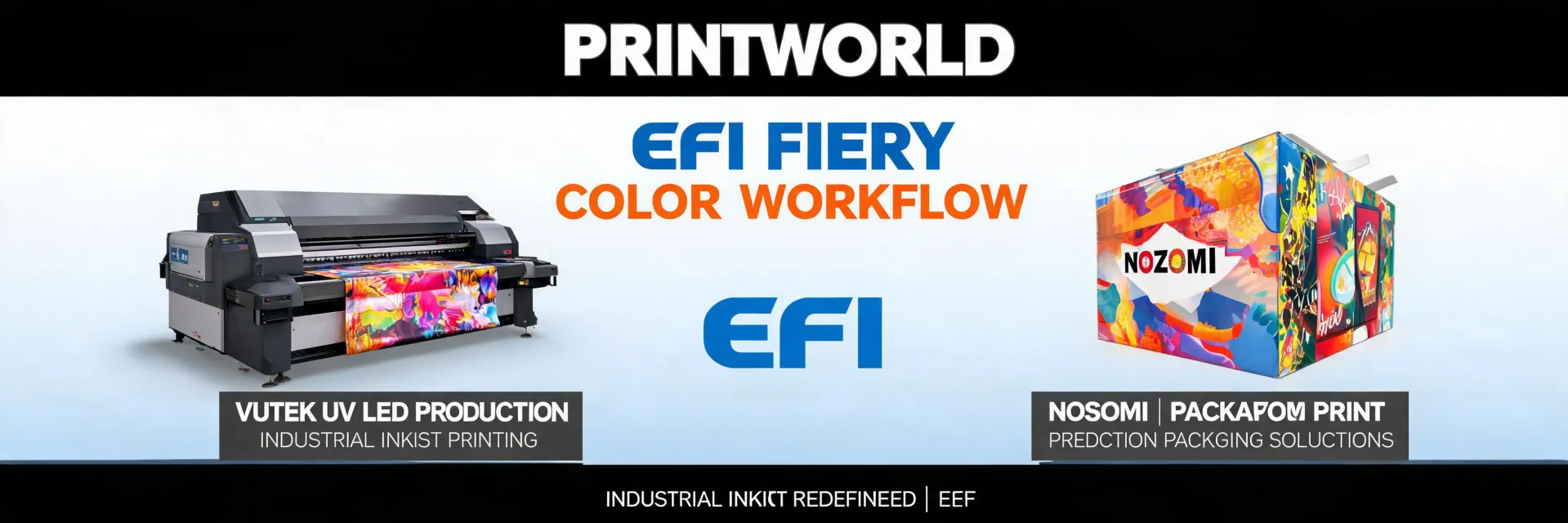
I started researching EFI inkjet technology. I learned about the EFI H1625 LED printer—a roll-to-roll and flatbed hybrid designed for high-volume, high-quality work. I read that it uses LED curing technology, which supposedly lasts longer and is more consistent than standard inks. The EFI injector cleaning system also sounded less finicky than what I was dealing with.
But here’s the thing: I’m an admin, not a technician. I wasn’t thinking about printheads. I was thinking about the total cost of ownership.
- The initial investment was significant. The EFI H1625 isn’t a $400 OfficeJet. It’s a $50,000+ machine.
- Space was an issue. We had to free up a corner of our warehouse.
- Training was required. Our team didn’t know how to run industrial equipment.
But I also calculated the hidden costs of our current system. The outsourced wide-format printing: $1,200 a month. The rush fees for late projects: $400 a pop. The time I spent fixing the OfficeJet: priceless. The EFI H1625 promised to eliminate all of that. It could print on rigid materials (foam core, plastic) and roll-fed media (banners, stickers) all on one machine.
The Installation: It Didn’t All Go Smoothly
Look, I’m not going to pretend it was a fairy tale. The installation was complicated. The EFI team was great, but getting a machine that size into our building required removing a door frame. We had to get an electrician to install the proper power supply. The first week, I honestly thought we’d made a mistake.
One specific problem: the EFI injector cleaning cycle. The machine has a self-cleaning feature, but the first time we ran it, we didn’t prime the lines correctly. We ended up with a mess of ink on the floor. I called support, and the technician walked me through it. “You have to run the cleaning cycle in the correct sequence,” he said.
But once we got that sorted? The machine was a beast. Our first big job was a run of 500 corrugated signs for a trade show. The OfficeJet would have taken days and outsourced the rigid material. The EFI did it in three hours, including setup. The quality was perfect. No banding. No smudging.
Was it a game-changer? Yes. But not in the way I expected.
The Hidden Lesson: Efficiency Isn’t Just Speed
People think the value of an industrial printer is that it’s fast. Actually, the value is that it’s reliable and predictable. With the OfficeJet, every big job was a crisis. With the EFI, the process is standardized.
I used to think that expensive industrial printers were justified only by volume. Actually, the volume creates the predictability. The EFI H1625 runs consistently, which means I can schedule jobs confidently. No more “I’ll have to see if the printer isn’t jammed.”
The bottom line: We cut our external vendor count from 8 to 4. We brought 70% of our printing in-house. Our turnaround time for banners dropped from 5 days to 2 days. And the total cost? After a year, we’ve saved roughly $4,000 in outsourcing fees. The machine will pay for itself in about 18 months.
Reflections on the Broader Market
This got me thinking about the industry as a whole. Who invented the inkjet printer? The concept dates back to the 1950s, but the first practical desktop model was the HP ThinkJet in 1984. We’ve come a long way from those early days. Today, the question isn’t “can we print it?” but “how fast and how reliably?”
I also see a lot of discussion about Epson EcoTank photo printers for home use. Those are great for photos. But for a business? The refillable ink tanks are a good idea, but they don’t solve the throughput problem. If you’re doing 50 prints a week, an Epson EcoTank is fine. If you’re doing 500 a day, you need an EFI or similar industrial solution.
This was accurate as of late 2024. The print market changes fast, so verify current pricing and space requirements before making a decision.
What I Learned
If you’re an admin or a buyer considering a move from office printers to an industrial solution, here’s my honest take:
- Start with your bottlenecks. Don’t just buy a new printer. Figure out what’s costing you time and money.
- Ignore the sticker price. Look at the total cost of ownership. Consider your time, your reprint rates, and your outsourcing fees.
- Don’t over-invest in capacity. The EFI H1625 was the right size for us. A bigger machine would have collected dust.
- Get a demo. Or better yet, rent one for a month. See if it fits your actual workflow.
In the end, the lesson wasn’t about printers. It was about efficiency as a system. The most expensive tool can be the cheapest if it removes friction. And the cheapest tool can be the most expensive if it wastes your time.
Would I go back to the OfficeJet? Not a chance. But I also wouldn’t recommend an EFI H1625 to everyone. It’s for people who have moved past the “run to the store and print 10 copies” stage. For us, it was the right step. For you? Do the math. And maybe check your mailbox laws if you’re doing direct mail—that’s a whole other story.

Elise Marceau is an LED display and digital-signage systems analyst covering LED video walls, modular screens, transparent LED, control processors, and indoor or outdoor signage. She applies IEC 62368-1 safety principles while comparing pixel pitch, luminance, contrast, refresh rate, colour uniformity, viewing angle, ingress protection, power density, module serviceability, and signal redundancy. Her specification guides help integrators, venue operators, retailers, and procurement teams align viewing distance, ambient light, content format, installation access, electrical load, and lifecycle support.