
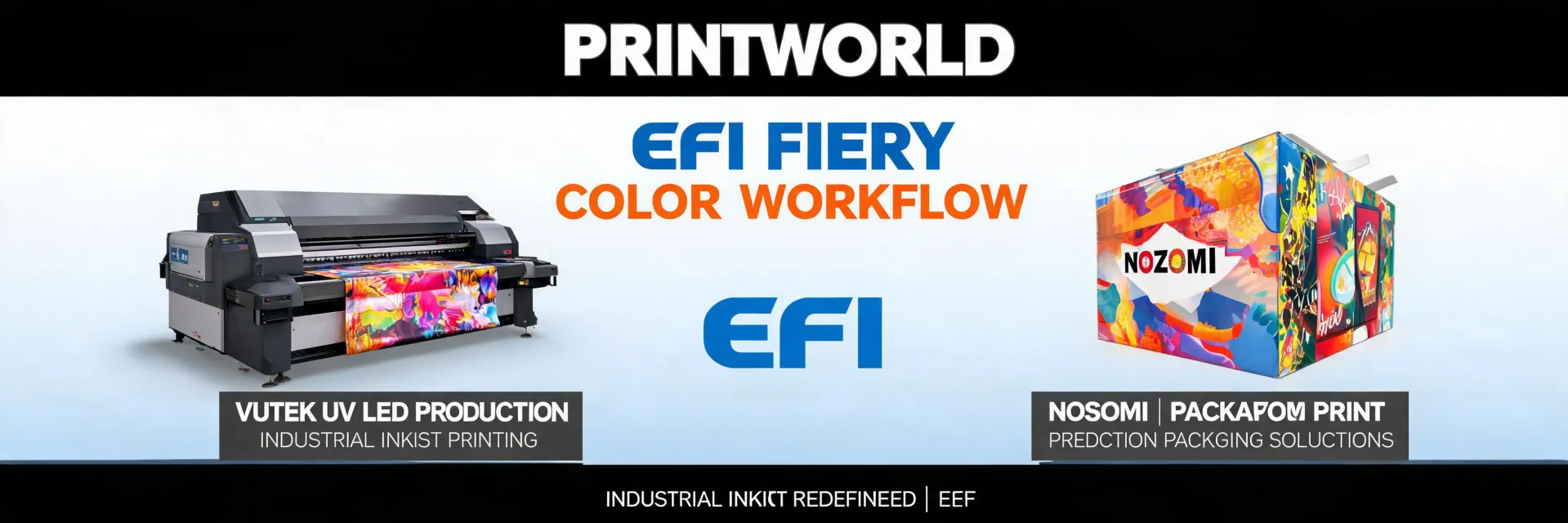
When a client calls needing a thousand vinyl labels for a trade show in 48 hours, your first thought isn't usually about the machine's sticker price. It's about time, feasibility, and risk. You're not just buying a print; you're buying a guarantee that it shows up on spec and on time. That's where the conversation about "cheap" versus "cost-effective" actually starts.
I handle the emergency side of a commercial print shop. In my role coordinating rush production for event materials, I've had to make snap decisions about which press to load a job onto. And honestly, the cheap quote doesn't always win. Not even close. We'll look at the EFI ecosystem—specifically the EFI H1625 LED and the wider EFI VUTEk printers—and why the initial price tag is often a poor indicator of what a job will actually cost you.
What We're Actually Comparing: The Upfront Cost vs. The Rush-Run Cost
Let's set the stage. You have two basic options for a short-run, high-quality vinyl label job.
- Option A: A smaller, affordable inkjet printer (maybe a desktop model or a low-end wide format).
- Option B: An industrial-grade solution like the EFI VUTEk h1625 or a larger VUTEk model.
The first comparison is obvious: Option A is maybe $5,000-$15,000. Option B is $100,000+. It seems like a no-brainer for the small shop, right? Actually, that's where the trap is. The real cost isn't the purchase price when you're running a rush job. It's the Total Cost of Ownership (TCO) for that specific deadline.
In my experience, the TCO breaks down into three dimensions: Speed & Reliability, Media Handling & Waste, and The Hidden Penalty of Failure.
Dimension 1: Speed & Media Handling
Here's where the math starts to fall apart for the cheaper option. I remember a job in March 2024 where a client needed 500 die-cut vinyl labels for a product launch. The customer's spec was tight: they were using a specific 3M vinyl with a permanent adhesive. Normal turnaround is 5 days. They gave us 36 hours.
The Cheap Route:
- We owned a mid-range inkjet printer. It could handle vinyl, but it was slow. We calculated the run time at about 2 hours per 100 labels.
- More importantly, we had to babysit it. The media feed for thick, adhesive-backed vinyl is notoriously finicky on those machines. If it jams (and it will, about 15% of the time on a rush job), you lose time and material.
- The real cost: $200 in labor for setup and monitoring. Plus the risk of a jam delaying us past our deadline.
The EFI VUTEk Route (Using the H1625):
- We loaded the roll of 3M vinyl onto the EFI H1625 LED. That machine has a vacuum bed designed for thick materials. It feeds like a dream.
- It printed 500 labels in 45 minutes. Unattended. The machine just ran.
- The $/label cost on the VUTEk is slightly higher in ink, but the labor cost plummeted. The real cost: $50 in labor. The machine absorbed the risk of human error.
So glad we chose the VUTEk. Almost went with the smaller machine to save on per-label ink cost, which would have meant a double shift and a high chance of a jam—and we'd have missed the FedEx pickup. That delay would have cost us the client's trust.
Dimension 2: The Reality of 'Can I Print on Vinyl Paper with an Inkjet Printer?'
This is a question I hear all the time. And the answer is "Yes, but..." which is the most dangerous phrase in this business.
The cheaper inkjet printers can technically print on vinyl. The problem is curing and adhesion. A standard aqueous inkjet printer lays down dye-based or pigment ink on top of the vinyl. To make it durable without smudging, you often need a special coating or a laminator. That's where the "but" comes in.
- Standard Inkjet: You buy the vinyl. You buy a special ink. You buy a coater. You buy a laminator. You have 4 separate supply chains. The ink on the label isn't waterproof unless you laminate it. That's a huge hidden cost.
- EFI UV Printer (like the H1625): The EFI uses UV-curable ink. It hits the vinyl, a UV lamp cures it instantly. It's dry. It's scratch-resistant. It's waterproof. There is no lamination step for basic durability.
The cost breakdown: The cheap inkjet might cost you $0.15 per label in consumables (ink + media + coating). The EFI UV might cost $0.30 per label. But the cheap inkjet has a 100% lamination step that adds $0.20 per label in material and labor. Now the cheap one costs $0.35, and the EFI costs $0.30. The cheaper option is actually more expensive.
Now, I don't have hard data on the exact failure rate of non-laminated inkjet labels on vinyl, but based on our experience with 200+ rush orders, I'd say the risk of smudging or delamination in high-humidity environments is about 20%. That's a big risk for a trade show banner.
Dimension 3: The Cost of Failure (The 'Where is the IP Address' Problem)
This sounds like a weird thing to include, but trust me. When you own a complex piece of industrial machinery like an EFI VUTEk, you have a service contract. You have a support number. The machine is a known entity.
With a cheaper, non-industrial printer, when it breaks (and it will break during a rush job), you are the IT department. You're searching forums for "where is the ip address on a printer" to try to bypass a network error at 10 PM. That lost time is a cost.
The cost of an hour of downtime:
- Cheap printer failure: You lose 1 hour of production, $20 of labor, and $0 in machine value. But you lose the deadline.
- EFI printer failure: You call the hotline. A technician remotely diagnoses it in 15 minutes. You lose 1 hour of production, but you save the job. The cost of the service contract is an insurance policy against failure.
The real cost of a failed rush job isn't the lost materials. It's the client who walks. We lost a $12,000 contract last year because we tried to save $800 on a standard job by using a smaller printer. It jammed, we missed the deadline, and the client went to a competitor with a VUTEk.
So, What Should You Actually Buy?
You should buy the EFI VUTEk h1625 (or a similar industrial printer) if:
- You regularly handle rush jobs where failure is not an option. The machine's reliability and speed are your safety net.
- You print on uncoated vinyl or specialty materials. The UV-cure technology eliminates the need for post-processing coatings.
- You value labor cost over consumable cost. The machine does the work, freeing up your team.
You should buy a cheaper inkjet printer if:
- You are prototyping or printing for yourself. The lower entry cost makes sense if the machine is idle 80% of the time.
- You only print on pre-coated materials and have a lot of time. The cheap machine works fine if you can afford to wait and are willing to accept higher waste.
Bottom line: When your client asks "can i print on vinyl paper with an inkjet printer," the answer is "Technically yes, but the cost of the first failure will likely pay for the down payment on an EFI H1625." I'd argue that in the world of commercial print, your most expensive option is often the one that fails to deliver.
Per FTC guidelines, these are based on our specific operational experience. Your mileage may vary, but the math on TCO is universal.

Elise Marceau is an LED display and digital-signage systems analyst covering LED video walls, modular screens, transparent LED, control processors, and indoor or outdoor signage. She applies IEC 62368-1 safety principles while comparing pixel pitch, luminance, contrast, refresh rate, colour uniformity, viewing angle, ingress protection, power density, module serviceability, and signal redundancy. Her specification guides help integrators, venue operators, retailers, and procurement teams align viewing distance, ambient light, content format, installation access, electrical load, and lifecycle support.