
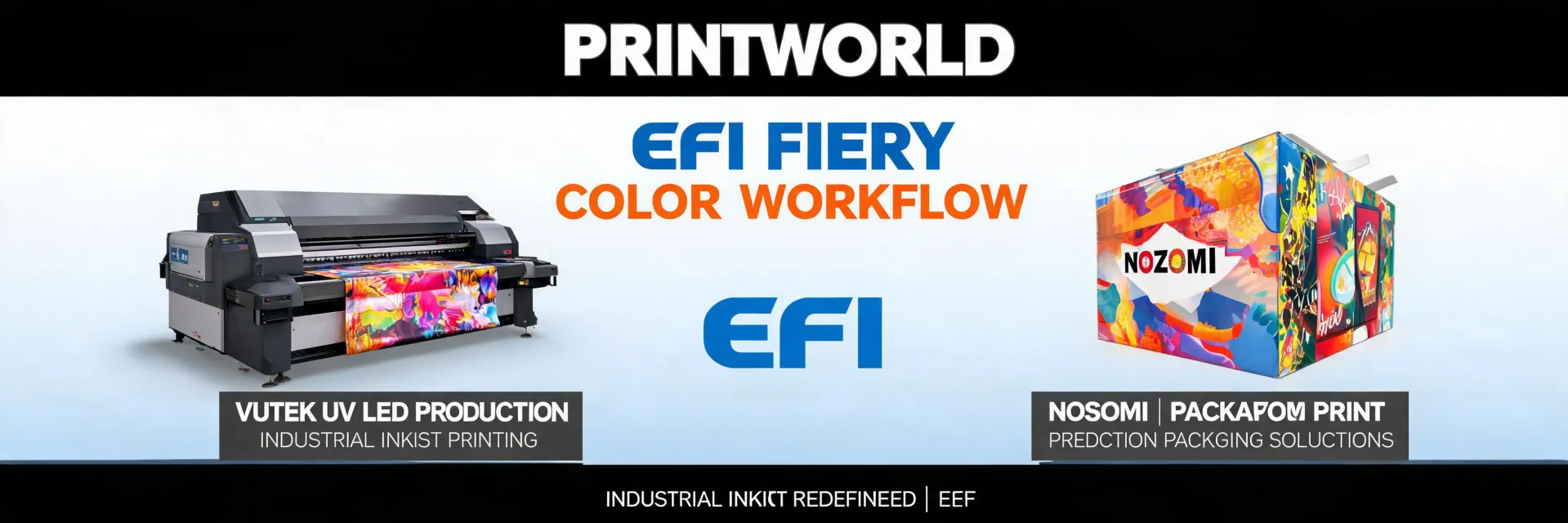
I'm the procurement manager at a 28-person commercial printing company. For the last six years, I've managed our equipment and supplies budget—roughly $1.2 million a year—and I've reviewed every major purchase through a total cost of ownership spreadsheet that borders on obsessive. So when I say the EFI H1625 LED printer is worth buying even though it isn't the cheapest wide-format option, I'm not guessing. I'm looking at the numbers.
My opinion is simple: if you produce color-critical work, the cheapest printer is usually the most expensive one you can buy. The machine on the invoice is only part of the cost. The other part is what reprints, missed deadlines, and off-brand color do to your reputation.
I know this because I got it wrong once.
I Almost Bought the Cheaper Wide-Format Printer
When we decided to upgrade our production floor in 2024, I compared eight wide-format printers over about three months. I included purchase price, ink cost per square meter, service agreements, energy consumption, floor space, and expected throughput. The EFI H1625 LED printer was not the lowest number on that spreadsheet. It wasn't the second lowest either.
I remember the moment I almost crossed it off. The budget model was $38,000 cheaper on paper, and after five years of projected operating costs, the gap narrowed to around $9,000. My CFO asked why we would pay a $9,000 premium for similar speed. I didn't have a good answer at the time. So I went back to the jobs our clients actually send us.
The answer wasn't in the machine specs. It was in the output.
What Changed My Mind: The Output Is the Sales Pitch
The EFI H1625 is a 1.6-meter hybrid printer, meaning it handles both roll material and rigid boards without changing setups. For our product mix—about 70% flexible and 30% rigid—that flexibility made the machine easier to justify. But the part that convinced me was the LED printing technology itself. It cures consistently, uses less energy than older lamps, and gives us uniform color from one panel to the next.
That consistency matters more than I initially understood. Our clients are not comparing us to another average print shop. They're comparing the proof we send to the sample their color consultant produced. If our printed color is more than 2 Delta E away from the brand standard, it gets noticed. Delta E below 2 is the industry's accepted tolerance for brand-critical colors; above 4, the difference is visible to most people.
Reference: Pantone Color Matching System guidelines.
We also print at 300 DPI for anything that will be viewed up close, even though 150 DPI is generally acceptable for large-format from a distance. A cheaper machine could probably hit those numbers in a demo. The question is whether it hits them at hour three of a long run.
I'm Not Anti-Cheap. I'm Anti-False Economy.
Let's be clear: I buy inexpensive tools all the time. We have a Bambu Mini 3D printer in the corner, and it's one of the best small purchases we've made. It prints fixture templates, replacement clips, and alignment jigs. If it dies tomorrow, I'll buy another one without a grieving period. I also keep a Bluetooth shipping label printer on the shipping desk—it cost around $50 and it's fine. These are low-stakes tools. When they fail, I lose an hour, not a client.
The same logic led me to one of my more humbling experiments. A few years ago, I watched a video on how to make your own screen printing machine for a one-time two-color job. I knew I should have outsourced it to a local shop, but I thought, 'How hard can it be?' The answer is harder than it looks. I spent $1,200 on screens, emulsion, and press parts, plus three weekends of my time. The first few prints were passable. Then the registration drifted, colors misaligned, and we had to redo the entire small run anyway. In the end, the 'save $2,000' decision cost us more than $3,400.
That experience didn't just humble me. It changed my procurement policy. Now we require a full cost-per-acceptable-print calculation for any job that touches a client's brand. If the finished piece has to look right, we use equipment and materials that can do that every shift.
The Rebuttal: 'You're Just Rationalizing an Expensive Toy'
To be fair, not every shop needs an EFI H1625 LED printer. If you print simple banners for local events and clients don't care about exact color matches, a cheaper machine may serve you well. I get why people choose the lowest bid—budgets are real. I've been the one chasing every dollar.
That said, the word 'enough' is dangerous. If your competitor's output is slightly grainy and slightly off-brand, your LED print will look better without anyone saying a word. That is not magic. It's just the output acting as your salesperson.
I can only speak to our context: a mid-size shop with 350+ orders a month, most of it color-critical work for retailers and food brands. If your product mix is different, the calculus might be different. A used machine or a lower-capex lease could be the right move for you. I would never argue otherwise.
What I do argue is this: stop comparing sticker prices. Compare the total cost per acceptable part—scrap, reprints, color callbacks, downtime, and client churn. Every time I run that analysis for our workflow, the EFI wide format option wins. And I do not say that because I love the brand. I say it because it's in our job cost report.
I'd Make the Same Call Today
As of February 2025, I'd buy the EFI H1625 again. Not because it's perfect—no printer is. We've had service calls, software hiccups, and one white ink valve failure that required a warranty visit. But I have never had a client reject the output. In a business built on first impressions, that is the only metric that pays the bills.
I don't have hard data on industry-wide defect rates, so take this with a grain of salt: based on our own orders since the installation, reprint volume is down roughly 40% compared with the previous large-format machine. That number lives in our cost tracking system, not in a brochure.
If you're shopping for a wide-format printer, don't ask which model costs the least. Ask what a failed print costs you in labor, material, and credibility. Then ask what it's worth to hand a client something that looks exactly like the proof they approved. In my opinion, that's where the real savings are.

I’m Jane Smith, a senior content writer with over 15 years of experience in the packaging and printing industry. I specialize in writing about the latest trends, technologies, and best practices in packaging design, sustainability, and printing techniques. My goal is to help businesses understand complex printing processes and design solutions that enhance both product packaging and brand visibility.