
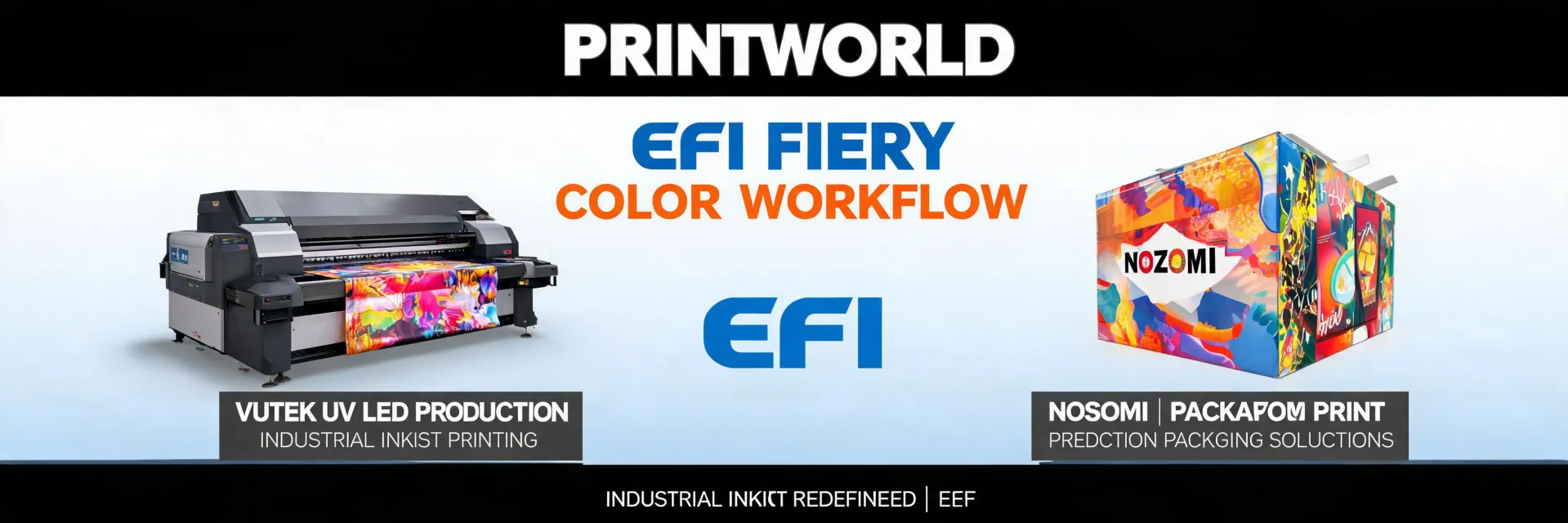
Here's the short answer, because you don't have time for me to build suspense: if your shop produces stickers and labels under deadline, an EFI wide format printer—a VUTEk roll-to-roll or an H1625 flatbed—is the workhorse that makes 48-hour turnarounds possible. But after 200+ rush orders, I can tell you with confidence that the competitive edge isn't print speed. It's maintenance. A wide format printer with a sloppy cleaning routine is just an expensive way to miss deadlines.
I'm a production coordinator at a commercial print company in the Midwest. Over the last three years, I've triaged something like 200 rush orders—sticker runs for event planners, label jobs for product launches, and one $15,000 grand-format backdrop that had to be hanging in a convention hall 48 hours after the client called. Around 95% of them made it on time, give or take a few points. The ones that didn't? Almost all were maintenance failures, not speed failures. That pattern is the whole point of this article.
What Is a Wide Format Printer, Exactly?
"Wide format" gets thrown around loosely, so let's be precise. A wide format printer is any printer that prints wider than standard commercial sheet sizes—generally anything beyond 17 inches, with true production machines running 60 inches and up. The EFI VUTEk line is a grand format roll-to-roll: it prints on continuous media wide enough to wrap a delivery truck. The H1625 is a hybrid flatbed: it handles rigid sheets up to about an inch and a half thick, which is what you need when you're printing directly onto aluminum, acrylic, or corrugated board.
But if you're looking for a printer for stickers, the width matters less than the ink system. EFI's LED-cured UV inks are the reason these machines shine on sticker stock. The ink cures the instant it's laid down, so you can print on vinyl, polyester, and other non-porous films that solvent or aqueous inks struggle with. Prints come out dry, durable, and ready to cut. No drying racks, no overnight wait. That sounds like a small thing until a client calls on Tuesday afternoon and needs 1,000 stickers in hand by Thursday morning. The dried-ink advantage is the difference between yes and no.
What Makes a Good Printer for Stickers?
Three things: color repeatability, media compatibility, and white ink. An EFI label printer configuration handles all three, but white ink is the one nobody sees coming.
White ink is how you print a vivid logo on transparent or metallic label stock—you lay down white first, then CMYK on top. It's also the most maintenance-hungry fluid in the shop. It's a pigment suspension that wants to settle, clump, and clog nozzles. If you're searching for "EFI cleaning" solutions, white ink is probably why. On a production label machine, the white channel needs attention daily. Not weekly. Daily.
Color is the other battlefield. A packaging client once gave us a Pantone reference for a limited-edition label run and told us the tolerance was Delta E < 2. For context:
Delta E of 2–4 is noticeable to trained observers; above 4, it's visible to most people. The industry standard for brand-critical color is Delta E < 2. (Reference: Pantone Color Matching System guidelines)
Their corporate blue converts to roughly C:100 M:66 Y:0 K:2 in CMYK (Source: Pantone Color Bridge guide), and on the EFI we hit it. But let me be honest: the machine only got us there because it was clean and calibrated. The hardware was capable. The process made it capable.
I'll admit the upfront cost gave me pause. The upside of going with a more budget-friendly unit was saving maybe $4,000 on the purchase. The risk was downtime at the worst possible moment. I kept asking myself: is a $4,000 savings worth potentially missing a client's launch date? One close call later, I had my answer. No.
The label printer configurations in EFI's lineup add inline finishing options and tighter registration for die-cutting, which matters if you're serious about label production. You're not just buying a print engine; you're buying a production line.
EFI Cleaning and the Maintenance That Wins Deadlines
Here's where the unglamorous stuff saves you. A wide format inkjet is a precision instrument with thousands of nozzles firing microscopic drops of ink. Those nozzles are smaller than a human hair, and when one clogs, every print that follows has a banded stripe or a missing color. On a 60-inch sheet, one bad nozzle means the whole piece is scrap.
Story I use to train operators: last March, 36 hours before a deadline, the overnight guy skipped the final nozzle check on the H1625 because it was "printing fine." The customer's penalty clause was $50,000, and they'd made clear they would enforce it. We arrived at 6 AM to a test print that looked like someone had sprinkled pepper across the nozzle pattern. Two hours of troubleshooting later, the morning production window was gone. We salvaged the job by moving it to the VUTEk and paying $180—maybe $220, don't quote me on the exact figure—for express freight. The margin on that order evaporated. A $0.50 inspection step would've prevented the whole thing.
(Should mention: the H1625 has automated cleaning cycles, and they were configured correctly. The gap wasn't the machine's cleaning—it was the verification step. Nobody had set up the protocol that says a human looks at the test print, wipes the cap plate, and confirms nozzle health before walking away. The machine did its job. The process didn't.)
That's the reality of EFI cleaning. It's not glamorous, it's not on the spec sheet, and it's the entire ballgame. A clean EFI prints like a dream. A neglected one turns into a very expensive problem.
One more angle, because people ask about "3D printer maintenance" when they see a UV flatbed. EFI isn't in the additive 3D printing business, so I'm not going to talk about filaments and build plates. But a UV flatbed is its own kind of 3D printing in a production sense: it prints directly onto dimensional objects—acrylic blocks, metal housings, injection-molded parts. The printhead assembly moves on the Z axis to clear material thickness, and that mechanical complexity adds maintenance points a roll-to-roll doesn't have. Height sensors drift. Vacuum tables clog with debris. Locating pins bend. If you maintain a flatbed like it's a desktop office printer, you'll learn the hard way what "Z-axis offset" means when it's wrong.
A realistic maintenance rhythm: daily nozzle checks and test prints; weekly cleaning of cap plates and wiper blades; monthly filter checks and calibration reviews. And every time you switch between CMYK and white ink, treat it like a separate job. It basically is.
Where a Wide Format Printer Won't Save You
I don't want to oversell this. A wide format printer isn't the right answer for every sticker job.
If you're cutting short runs of die-cut stickers—say, 500 laptop stickers for a conference—a dedicated small sticker printer with an inline contour cutter will beat a production engine on cost per piece and setup time. The big machine is for volume and speed. Starting a 60-inch production line for 500 stickers is like renting a dump truck to move a sofa.
And no printer fixes an upstream disaster. The worst rush order I ever took was a client calling at 2 PM for 2,000 labels needed at a product launch the next morning. The printer was healthy. The substrate wasn't in stock, and our supplier's warehouse wouldn't release anything without a PO that took six hours to process. The machine sat idle. The labels shipped late. We lost that client, and honestly, we deserved to. The correct move was telling them on Tuesday what we couldn't do by Wednesday.
Wide format printing gets you closer to "yes" on rush orders than any other tool I've used. But it's a tool, not a miracle. Clean the machine, verify the prints, keep the media stocked, and you'll be the shop that gets the emergency calls. Skip the boring parts, and you'll be the cautionary tale everyone else learns from.

Elise Marceau is an LED display and digital-signage systems analyst covering LED video walls, modular screens, transparent LED, control processors, and indoor or outdoor signage. She applies IEC 62368-1 safety principles while comparing pixel pitch, luminance, contrast, refresh rate, colour uniformity, viewing angle, ingress protection, power density, module serviceability, and signal redundancy. Her specification guides help integrators, venue operators, retailers, and procurement teams align viewing distance, ambient light, content format, installation access, electrical load, and lifecycle support.