
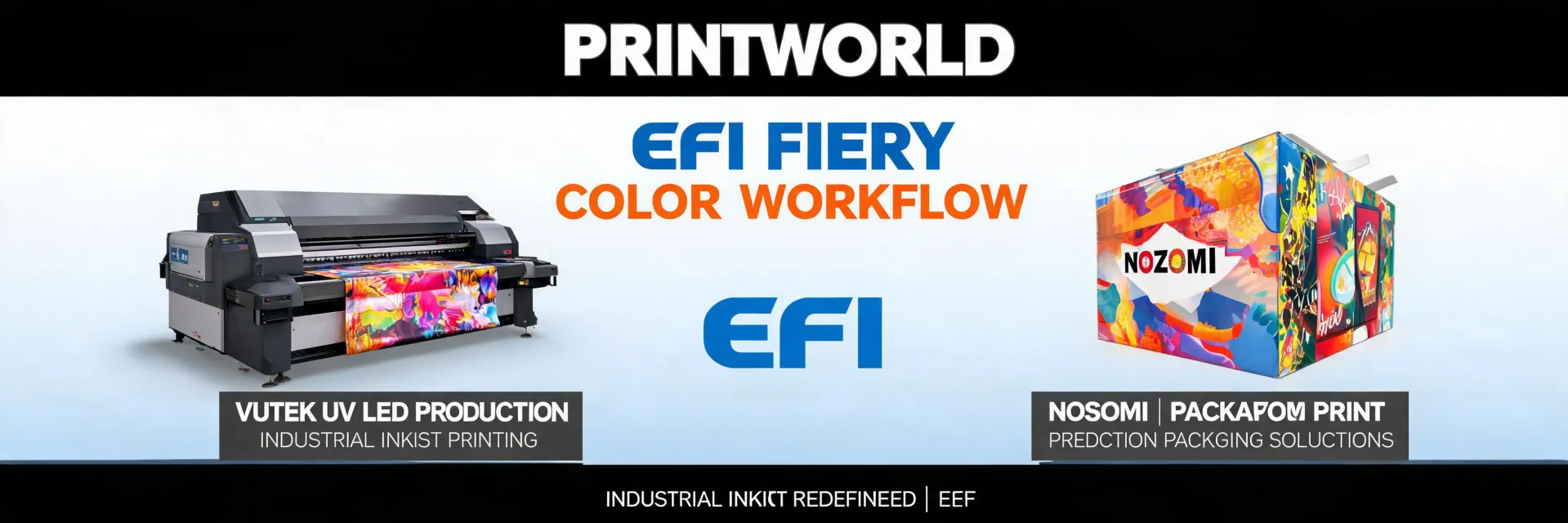
So, You're Looking at EFI VUTEk Printers
If you're an admin buyer tasked with sourcing a new industrial printer—specifically one from EFI's VUTEk line—you're probably feeling the pressure. It's a big capital expense, and the 'right' choice isn't the same for everyone. You can't just Google 'best EFI printer' and call it a day. The decision depends heavily on your specific workflow. My experience is based on managing about 200 orders for print services over the last five years, including two major printer acquisitions. If you're a massive, high-volume packaging plant, your experience might differ a lot from mine.
The core of the problem is this: EFI makes fantastic, heavy-duty machines, but their lineup is broad. You've got the massive roll-to-roll VUTEk, the hybrid flatbed, and the corrugated-focused Nozomi. Picking the wrong one for your shop is an expensive mistake. So, let's skip the generic advice and get into the three most common scenarios I've seen.
Scenario 1: The High-Volume Roll-to-Roll Specialist
Who this is for: Your business lives and breathes wide-format graphics. Think banners, vehicle wraps, and backlit displays. You're running shifts, and downtime is your biggest enemy. Your customers expect consistent quality on flexible media, and your current printer is the bottleneck.
For this shop, the classic EFI VUTEk roll-to-roll is the obvious starting point. We're talking about the workhorses like the VUTEk h-series or the 5r. In my last company, we were in this exact spot—processing orders for a regional sports team's stadium signage. We looked at the VUTEk h1625. The ROI calculation was pretty clean when we factored in labor. It wasn't just about speed; it was about the automated features. Things like the auto-roll loading and dryers that let one operator run two machines. That's where the real savings came from.
The catch: These machines are a serious capital investment. The base price is high, but the real cost is the infrastructure. A 5-meter roll-to-roll needs serious floor space. And I mean serious—you need room for the printer, the unwind, the rewind, and the finishing area. If you're in a cramped shop, this is a non-starter. Also, the training curve for operators is steeper than with a smaller flatbed.
Advice: Get a quote that includes installation, a full week of onsite training, and a maintenance contract for the first year. Don't just compare the printer price. Compare the cost per square foot of printed media over a 3-year period. One vendor we spoke to offered a lower base price, but their ink cost per square foot was 15% higher. That $10,000 savings on the machine would have been eaten up in about 18 months.
Scenario 2: The Versatile Sign Shop (The Hybrid Flatbed)
Who this is for: You're doing a mix of jobs—rigid boards for POP displays, a few small-format runs, and some roll-fed work for banners. You can't predict what will come in on Tuesday. You need one machine that does a lot of things well, even if it's not the absolute best at any one thing.
This is the sweet spot for an EFI VUTEk hybrid printer, like the EFI Pro 16h+ or similar. Honestly, this is the purchase I've seen go wrong most often. A shop will buy a massive flatbed because they think 'bigger is better,' and then they're terrified to run a 5-foot banner on it because it feels like a waste. Or they buy a fast roll-to-roll and then can't handle the rigid board jobs that walk in the door.
We almost made this mistake in 2023. We were this shop. My boss was wowed by the speed of a pure roll-to-roll. But when I mapped out our last two years of job data, 40% of our revenue came from rigid substrates. If we didn't have a flatbed option, we'd have to outsource those jobs, killing our margin. The hybrid EFI was the perfect solution. It let our operators handle everything from 1/8th-inch PVC to roll-fed banner material without switching machines. That flexibility saved our scheduling department hours a week.
The catch: You pay a premium for that flexibility. A hybrid machine can be more expensive than a comparable dedicated machine in its class. Also, because it's a compromise, the maximum print speed on rigid substrates might not match a dedicated flatbed. And you need to be disciplined about maintenance. Switching between media types means more cleaning cycles.
Advice: Don't just demo the machine. Ask the dealer to run a specific, complex job you do all the time—say, a set of 50 corrugated signs with different types of finishes. Watch the setup time. How long does it take to switch from the roll-fed banner to the rigid board? The answer to that question will tell you more about the machine than any spec sheet.
Scenario 3: The Corrugated & Packaging Uprising
Who this is for: You're a packaging converter or a fulfillment center that's drowning in short-run, customized corrugated box orders. E-commerce and direct-to-consumer brands are your clients. They want high-quality graphics, fast turnaround, and no minimum order quantities. Traditional flexo or offset is too slow and expensive for these runs.
This is where the EFI Nozomi C18000 comes in. It's a different beast entirely. It's a single-pass, industrial inkjet press built specifically for corrugated. It's not a 'printer' in the traditional sense; it's a production line. I've only seen one of these in operation at a trade show, and it's impressive. It's designed for high-speed, integrated workflows—like printing directly onto pre-cut boxes on a conveyor.
The catch: The biggest catch is that a Nozomi is a huge leap. It's not just the machine cost (which is substantial). It's the entire workflow. You need a much higher volume of consistent work to justify it. You need a dedicated area for material handling, drying, and stacking. It's a strategic shift, not just a printer upgrade. A smaller shop that tries to buy one to 'test the waters' would sink.
Advice: Before you even call EFI, do a hard analysis of your current corrugated work. How many boxes are you running per week? How many different SKUs? What's the average order quantity? If you're not doing at least 10,000+ square feet of corrugated per day, the Nozomi is probably overkill. You might be better off with a powerful VUTEk flatbed that can handle corrugated but also do other things. One mistake I see is a company buying a Nozomi because a competitor did. But if your customers are only ordering 50 boxes at a time, a flatbed with a roll feed might be more practical.
How to Know Which Scenario You're In
This is the part where you need to be brutally honest with yourself. The simplest test is to look at your last six months of job data. Not your best month, but the average. Ask these three questions:
- What's your primary substrate? If it's >70% flexible media (vinyl, mesh), you're in Scenario 1. If it's a 50/50 mix of rigid and flexible, you're in Scenario 2. If it's >50% corrugated, you're in Scenario 3.
- What's your average order size? If you're running long print runs (over 500 linear feet), a dedicated roll-to-roll makes sense. If your runs are short and varied, look at the hybrids. If your runs are short and for corrugated, you need to think about workflow, not just print speed.
- What's your growth plan? Are you trying to grow by offering more flexible media? Or are you trying to break into a new market like packaging? Your answer should point you to the specific machine category.
The bottom line? There's no single 'best' EFI printer. The best one is the one that fits your shop's current reality and your next logical growth step. A machine that looks 'cheaper' initially but doesn't fit your workflow will cost you a fortune in wasted time, labor, and lost customers. Take the time to understand your data, and you'll make a decision that looks good on your department's books for years to come.

Elise Marceau is an LED display and digital-signage systems analyst covering LED video walls, modular screens, transparent LED, control processors, and indoor or outdoor signage. She applies IEC 62368-1 safety principles while comparing pixel pitch, luminance, contrast, refresh rate, colour uniformity, viewing angle, ingress protection, power density, module serviceability, and signal redundancy. Her specification guides help integrators, venue operators, retailers, and procurement teams align viewing distance, ambient light, content format, installation access, electrical load, and lifecycle support.