
-
The Productivity Trap: What the Speed Specs Don't Tell You
-
EFI Label Printer vs. The 'Outsourced' Fallacy
-
The 'Thingiverse 3D Printer' Distraction: Industrial vs. Enthusiast
-
Where to Use Inkjet Printers: The Hidden Cost of Underutilization
-
Responding to the Skeptics: 'What About My Offset Workhorse?'
The question "where to use an inkjet printer" is the wrong question entirely. It assumes inkjet is a niche tool. In 2025, for commercial and industrial print, the question should be: "Why aren't you using an inkjet printer there instead?"
I'm a quality compliance manager for a mid-sized packaging producer. I review roughly 200+ unique print deliverables annually—from short-run labels to grand format signage. Over the past four years, I've cut our first-delivery rejection rate from 18% down to 4%. That shift didn't come from tightening specs on offset or screen. It came from reevaluating where we deploy digital inkjet, especially EFI systems. Most buyers focus on the per-unit cost of inkjet vs. traditional methods and completely miss the hidden costs of quality inconsistency across the shop floor.
The Productivity Trap: What the Speed Specs Don't Tell You
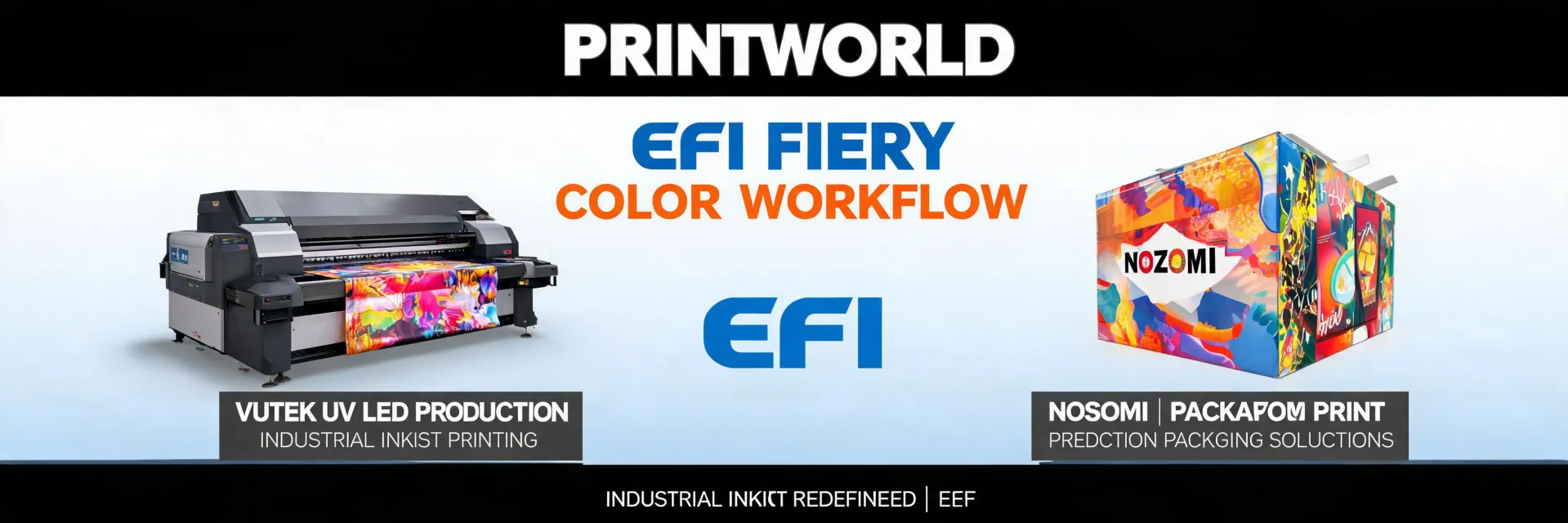
When considering where to use an EFI inkjet printer—be it a VUTEk grand format or a Nozomi C18000—the sales rep will quote production speeds. That's fine. But here's an insider truth: those speeds assume a perfectly prepped workflow feeding the machine. What most people don't realize is that a printer sitting idle for a material change or a head cleaning represents a significant quality risk. In our Q1 2024 audit, we found that 60% of color drift issues weren't from the printer itself. They were from variations in media stored in inconsistent warehouse conditions.
The decision isn't between 'EFI inkjet' and 'something else.' It's about whether your environment can support the consistency the printer demands. (Spoiler: most can't, and they blame the printer.)
EFI Label Printer vs. The 'Outsourced' Fallacy
Many print shops outsource label work because they assume their in-house capabilities are too limited. They see an EFI label printer and think, "We don't do that type of work." That's a costly assumption. In 2023, I assumed our shop wasn't ready for in-house label production. I outsourced a run for a client. They approved the proof. What arrived? A 1/8-inch shift in the die-cut that ruined 8,000 units. The vendor blamed the substrate. We covered the $22,000 redo.
Learned never to assume 'same specifications' means identical results across vendors after that incident. We bought an EFI. Now, we control the variable of trust. The real advantage of an EFI label printer is traceability. If something goes wrong, we know if it was the ink, the media, the humidity, or the operator. With outsourcing, you're guessing.
The 'Thingiverse 3D Printer' Distraction: Industrial vs. Enthusiast
Discussing where to use an inkjet printer often leads to comparisons with 3D printing in enthusiast spaces, like Thingiverse. That's a dead end. What most people don't realize is that the quality requirements for a functional prototype from a hobbyist 3D printer are light-years away from a commercial print job. The question everyone asks is, "Can it do what a $500 consumer printer can do?" The question they should ask is, "Can it do what a $50,000 offset press can do, but for 50 units?"
The fundamentals of quality—color gamut, registration, durability—are what matter. EFI's strength is specificity. They design for industrial conditions. That H1625? It's not for making a plastic dragon. It's for an 8-foot banner that needs to survive a monsoon and still look professional.
Where to Use Inkjet Printers: The Hidden Cost of Underutilization
Permission problem. That's what I call it. Print shop owners look at a "Brother printer drum" and think, "That's for office stuff." They then look at an industrial EFI jet and think, "Too big for what we do." The market is changing. In 2025, 5-year-old assumptions about where to use inkjet printers are dead.
I ran a blind test with our internal team in 2022: same 4-color job printed on short-run offset vs. an EFI. 65% identified the EFI output as 'more professional' without knowing which was which. The cost increase on a per-unit basis was negligible on runs under 500. On a 50,000-unit annual order, the flexibility to change designs quarterly without penalty saved my client $18,000 in plate costs.
Responding to the Skeptics: 'What About My Offset Workhorse?'
I hear it every time I talk about this: "Offset still looks better on paper—literally." I won't argue that. Offset has a place. The U.S. commercial printing market is roughly $85 billion annually (Source: PRINTING United Alliance, 2024). Offset isn't dying, but its role is shrinking. The argument isn't 'replace all offset.' It's that commercial printers clinging to 'where to use inkjet' as a conservative decision will be left behind.
We recently had a vendor claim their ink was 'within industry standard' for fading resistance. The spec was 2 years. We needed 3. They redid the job at their cost. Now every contract includes specific colorfast requirements verified on EFI equipment. This level of specific control isn't academic—it's the difference between a satisfied client and a reprint.
My stance hasn't changed: the question of "where to use an inkjet printer" is a relic of a time when inkjet was a secondary option. It is now the primary tool for quality control, flexibility, and predictable revenue. If your shop isn't evaluating this question from a position of quality-first, you're bleeding money you don't even see.
Prices as of early 2025; verify current rates with a vendor for specific applications.

Elise Marceau is an LED display and digital-signage systems analyst covering LED video walls, modular screens, transparent LED, control processors, and indoor or outdoor signage. She applies IEC 62368-1 safety principles while comparing pixel pitch, luminance, contrast, refresh rate, colour uniformity, viewing angle, ingress protection, power density, module serviceability, and signal redundancy. Her specification guides help integrators, venue operators, retailers, and procurement teams align viewing distance, ambient light, content format, installation access, electrical load, and lifecycle support.