
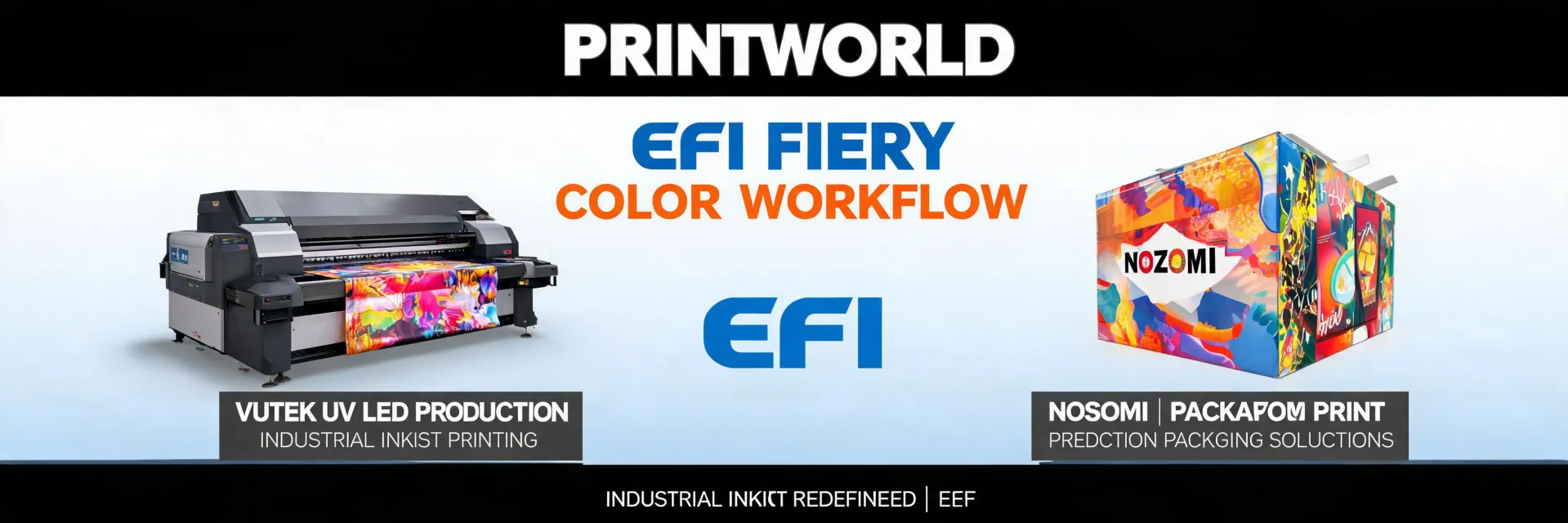
When I first started managing production for a mid-size print shop, I assumed picking the right wide format printer was just about matching specs to our most common job types. A few years and several near-disasters later, I realized there's no universal 'best' EFI printer. The right choice depends entirely on the kinds of emergencies you'll face, the margin for error in your clients' deadlines, and how much chaos you can tolerate on the shop floor.
This isn't a list of specs. It's a practical breakdown of three common scenarios I've seen play out. Here's what to ask yourself before you commit to any EFI wide format machine.
Scenario A: The High-Volume PSP with Tight Margins
This is the shop I worked at in 2022—we had 12 employees, two VUTEk Q5000r roll-to-roll printers, and a constant stream of orders from retail chains. Our clients had firm shelf dates, and delays meant chargebacks. We lost a $45,000 contract in March 2023 because we couldn't meet a 48-hour turnaround on corrugated displays. That's when we finally picked up the EFI Nozomi C18000.
The Nozomi is an investment, but it's engineered specifically for this scenario. It prints directly onto corrugated at speeds up to 75 linear meters per minute, and it eliminates the setup time of our old analog press.
What I learned: If your daily reality is high-volume runs with predictable specs (same substrate, consistent color profiles) and you need single-pass speed, the Nozomi or a VUTEk hybrid like the Q5r or H5 is your play. But don't assume that means you're safe from all disasters.
Even with the Nozomi, we had a near-miss in June 2024. A client's rush order came in with a spot color that our calibrated profile couldn't match. We had to reroute to a partner shop with a different printer. That leads to our next scenario.
Scenario B: The Generalist Shop That Has to Say 'Yes'
This is the shop I consult for now—they handle everything from retail signage to trade show graphics. Their clients don't always know what they need until 36 hours before a show opens. In this environment, I've found the EFI H1625 LED to be a lifesaver.
The H1625 is a flatbed that can handle both rigid and flexible materials, which means you can switch from printing acrylic signs to B-flute corrugated to dibond panels without a significant changeover. And since it uses LED-curable inks, you don't have to worry about the curing oven's warm-up time on a cold morning (trust me, that 30-minute delay can kill a same-day turnaround).
I'll be honest. The H1625 isn't the fastest printer if you're doing 500 identical corrugated boxes. But the ability to handle a 100-label run on aluminum, then immediately pivot to foam board, has saved me on at least a dozen occasions when a client called at 4 PM with a 'must have by 9 AM tomorrow' request.
My recommendation for this scenario: buy a printer that prioritizes media flexibility over raw speed. A VUTEk PRO 16H+ or an H-series flatbed will pay for itself in the versatility alone (which, honestly, is harder to quantify than speed, but more valuable in practice).
Scenario C: The Narrow Niche (Labels, Finishing, or Display Graphics)
This scenario is for print shops that have carved out a specific niche. If 80% of your revenue comes from short-run labels for local craft breweries, you don't need a massive wide format roll-to-roll. You need a purpose-built label printer.
I've helped two shops set up for this. One went with the EFI 8550 printer—a digital label press that handles up to 13.7 inches wide and runs at 85 feet per minute. The other went with a CD label printer from a different vendor because most of their work was on optical media.
Your scenario: If your specialty is narrow web, rigid signage, or corrugated, pick an EFI that's designed for that task. Don't try to make a single machine do everything—you'll compromise speed and end up chasing a 'good enough' result on too many job types.
How to Judge Which Scenario You're In
- Are you a high-volume plant with >70% of jobs on the same substrate? Go with Scenario A—a dedicated production-grade machine like the Nozomi or VUTEk Q5r.
- Do you field emergency and same-day orders for diverse materials? You're Scenario B—get the flexible flatbed like the H1625 or PRO 16H+.
- Is your shop focused on a specific niche, like labels or fine art prints? You're Scenario C—choose a specialized system, not a generalist machine.
One more thing: Don't ignore the total cost of ownership. I've seen shops pick a printer based on the lowest base price, only to pay 30% more in media waste and reprints within the first year. A transparent vendor will tell you the cost of the ink, service contracts, and recommended media, so you can calculate your true break-even (not just the sticker price).
According to USPS pricing effective January 2025 (usps.com/stamps), a First-Class Mail large envelope (1 oz) costs $1.50. That's a concrete number you can budget around—and the same logic applies to your printer total cost. If your vendor hides the service contract or ink pricing, walk away.
In my experience, the shops that succeed are the ones that match the tool to the scenario, not the ones that buy the flashiest machine on paper. Pick your EFI printer based on your real-world emergencies, and you'll rarely regret it.

Elise Marceau is an LED display and digital-signage systems analyst covering LED video walls, modular screens, transparent LED, control processors, and indoor or outdoor signage. She applies IEC 62368-1 safety principles while comparing pixel pitch, luminance, contrast, refresh rate, colour uniformity, viewing angle, ingress protection, power density, module serviceability, and signal redundancy. Her specification guides help integrators, venue operators, retailers, and procurement teams align viewing distance, ambient light, content format, installation access, electrical load, and lifecycle support.