
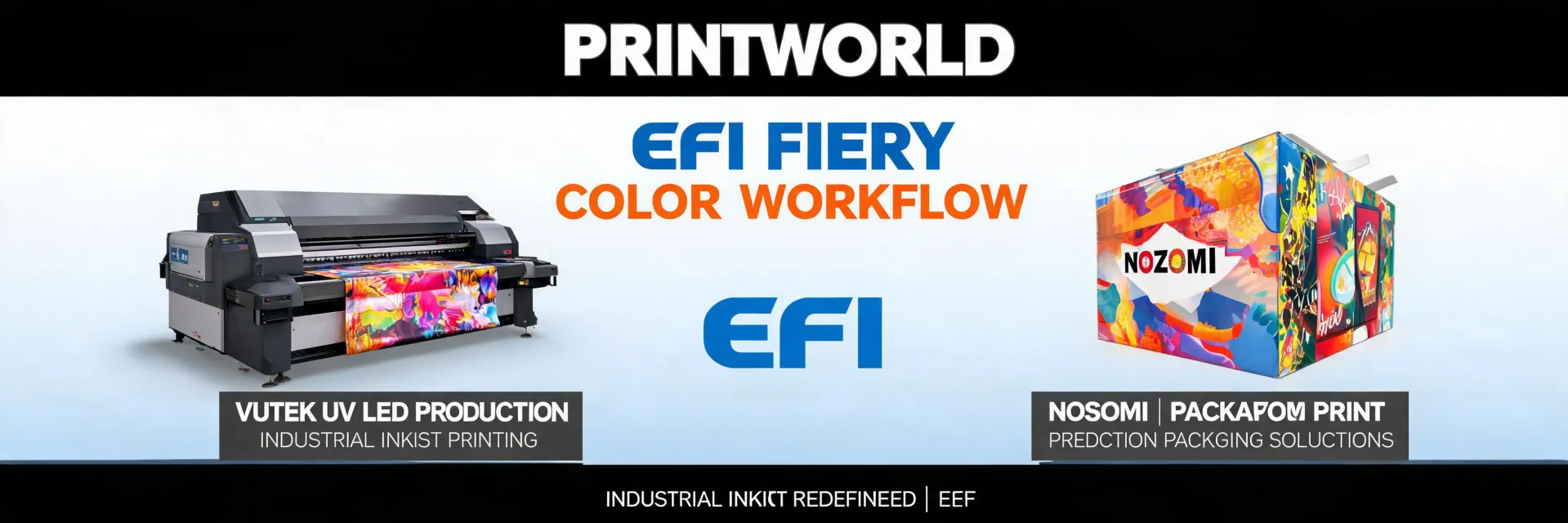
Before you buy an EFI grand format printer, here's the part the sales brochure won't put in bold: the winning model is the one whose consumables you can calculate per square foot, not the one with the largest speed spec. Ink, printheads, service. In that order. Over a machine's working life, those three line items add up to two or three times the purchase price. Most buyers never run that math. That's the mistake.
If you found this page through a 3D printing search—"what can you do with 3d printer" or "k1 printer"—I'll save you the detour: this article is about industrial inkjet, not additive manufacturing. EFI doesn't make 3D printers. But the underlying question is the same in both worlds: what does your output need to accomplish, and what does it cost to produce?
In practical terms, a grand format printer is a bet on your future job mix. You're committing to floor space, trained operators, ink inventory, and a service relationship that lasts five to seven years. The machine is the cheapest part of that commitment. So before you scroll further: buy the EFI model whose per-square-foot cost and color repeatability match your real work, not the one with the fastest brochure number.
Why I get to be opinionated about this
I'm a quality compliance manager at a commercial printing company. I review every deliverable before it reaches a customer—roughly 200 unique jobs a year, from fleet graphics to backlit panels in galleries. In our Q1 2024 quality audit, 6% of first deliveries failed on color tolerance or visible banding. We rejected them, and the vendors redid the work at their cost. That quarter's rework still cost us around $22,000 and delayed three client launches.
That experience changes how you buy equipment. When I sit through a grand format printer demo, I'm not admiring the test image. I'm thinking about what breaks, what gets consumed, and who's responsible when colors drift at hour 400.
What an EFI grand format printer is (and isn't)
An EFI grand format printer—the VUTEk line, and for corrugated packaging, the Nozomi—is industrial output equipment. We're talking widths from 72 inches up to 126 inches and beyond. EFI's portfolio in this space also includes smaller roll-to-roll systems like the H1625, which is where many shops start before they move up to grand format. These are the machines behind billboards, vehicle wraps, rigid signage, and corrugated display graphics. Most use LED-cured or UV-cured ink, which solidifies almost instantly, so you can print on vinyl, board, metal, even plastic without long drying queues.
"EFI printing" shows up in search mainly for that capability: big images, fast turnaround, repeatable quality across long runs. And to be fair, the EFI units I've audited hold color well when they're calibrated. The key word is "when." That's not an EFI-specific caveat. I'd say it about any industrial inkjet at this scale.
Thermal inkjet, explained without brochure language
One of the most common search phrases we intercept is "what is thermal inkjet printer." Fair question, so here's the mechanic's version.
A thermal inkjet printhead contains microscopic heating elements. An electrical pulse heats one, vaporizing a tiny amount of ink into a bubble. The bubble expands, pushes a droplet through the nozzle, and collapses. This repeats thousands of times per second across thousands of nozzles. The result is an image assembled from drops smaller than a human hair. That's it. Elegantly simple, and it powers a huge share of the inkjet industry.
Here's what matters if you're investing in industrial equipment: the printhead is a consumable, not a permanent part. I want to say typical production life is in the range of tens of thousands of milliliters of ink per channel—but don't quote me on that exact number; it varies with ink, media, and maintenance discipline. What I can tell you from the quality side is that printhead wear shows up as banding. Banding is the number one reason I reject first-run jobs.
(Should mention: ask for printhead replacement costs in writing before you sign. Whether the head is thermal or some other drop-on-demand system matters less than knowing what a head costs and how long it lasts at your volume.)
The 3D printer and K1 detour
Let me quickly handle the other searches that land here, because I'd rather point you to the right tool than have you read the wrong article.
"What can you do with 3d printer?" A lot. Functional prototypes, jigs, tooling, custom fixtures, short-run end-use parts. It's additive—material laid down layer by layer—and it's genuinely useful. But it's not what EFI does. The two worlds share the word "printer" and little else. If you're shopping for a 3D printer, you're in the wrong aisle.
The "k1 printer" search is even more of a mixed bag. Depending on the year and the marketplace, it can mean a compact 3D printer, a desktop laser engraver, or a small-format document device. One of my teammates bought a Creality K1 last year for engineering prototypes—that's the desktop 3D printer interpretation, and it's the one I see most often. It's a capable little machine for its price class. It is not, in any way, a substitute for a grand format production printer. Different budget. Different output size. Different goal.
If that's what you actually need, buy that. This checklist won't serve you.
The pre-purchase checklist I wish more buyers used
If you're still with me and you're genuinely evaluating an EFI grand format purchase, run through this list. Each of these mistakes cost someone real money.
1. Calculate the true cost per square foot. Most buyers focus on the purchase price and completely miss the consumables line, which can be a third or more of total cost of ownership over five years. Ask for ink price per liter, your typical coverage percentage, and expected square footage per printhead set. Lay that over your real monthly volume. If the math fails at your utilization rate, no speed spec can rescue it.
2. Ask what's NOT included in the quote.
"I've learned to ask 'what's not included' before I ask 'what's the price.'"
Installation, training, a spare printhead kit, media profiles, network racks—the quote sheet can read like a starting bid instead of a final price. Each line item is defensible on its own. Together, they turn a "competitive" quote into an unexpected wire transfer.
3. Test on your substrate, not theirs. The demo printed on glossy coated stock tells you nothing about how the machine will treat the corrugated, the textured vinyl, or the low-cost film you actually run. So glad we insisted on running our own board before committing. We were one demo away from signing for a machine that visibly struggled on our daily media. The sales rep didn't love the request. Finance loved not buying the wrong printer.
4. Set your color tolerance in advance. Brand-conscious clients expect Delta E below 2 for critical colors—above that, trained observers can see the difference, and above 4, most people will. That's a Pantone matching system standard and the metric I use in every audit. The printer you choose must hold that number across a full workday, not just for the first five minutes after a calibration.
5. Do the resolution math before you fall in love with the width. 300 DPI at final size is the standard for close-viewing commercial print. For a billboard seen from 20 feet, 150 DPI is usually acceptable. If your sharpest final file is 4000 pixels wide, a 126-inch printer doesn't make it a high-resolution poster. It just makes it very big. Know that before you choose your model.
When an EFI grand format printer is the wrong answer
Now the honest part. Every good purchase decision comes with boundary conditions.
If your shop runs less than a few hundred square feet per week, a grand format machine is overkill. It will sit idle while its printheads age. If your floor space can't handle the machine footprint plus service access clearances, the maintenance contract will be miserable from day one. If most of your work is small format—labels, business cards, stationery—you're in the wrong category entirely, and I'd tell you the same about any comparable brand.
And if you came in thinking a K1 or another 3D printer could do one thing and a grand format inkjet another—now you know the difference. Buy the tool for the job.
On price: I'm not quoting figures here because pricing changes, and any number I give you as of January 2025 will be stale by the time you read this. Verify current pricing on EFI's official channels.
One last thing. I'm not here to convince you that EFI is the only brand worth your money. I'd respect a buyer who picks a different manufacturer for a sound reason. What I won't respect is a buyer who chooses by the biggest speed number in the brochure. Speed is vanity. Cost per square foot and repeatable color are sanity.

Elise Marceau is an LED display and digital-signage systems analyst covering LED video walls, modular screens, transparent LED, control processors, and indoor or outdoor signage. She applies IEC 62368-1 safety principles while comparing pixel pitch, luminance, contrast, refresh rate, colour uniformity, viewing angle, ingress protection, power density, module serviceability, and signal redundancy. Her specification guides help integrators, venue operators, retailers, and procurement teams align viewing distance, ambient light, content format, installation access, electrical load, and lifecycle support.