
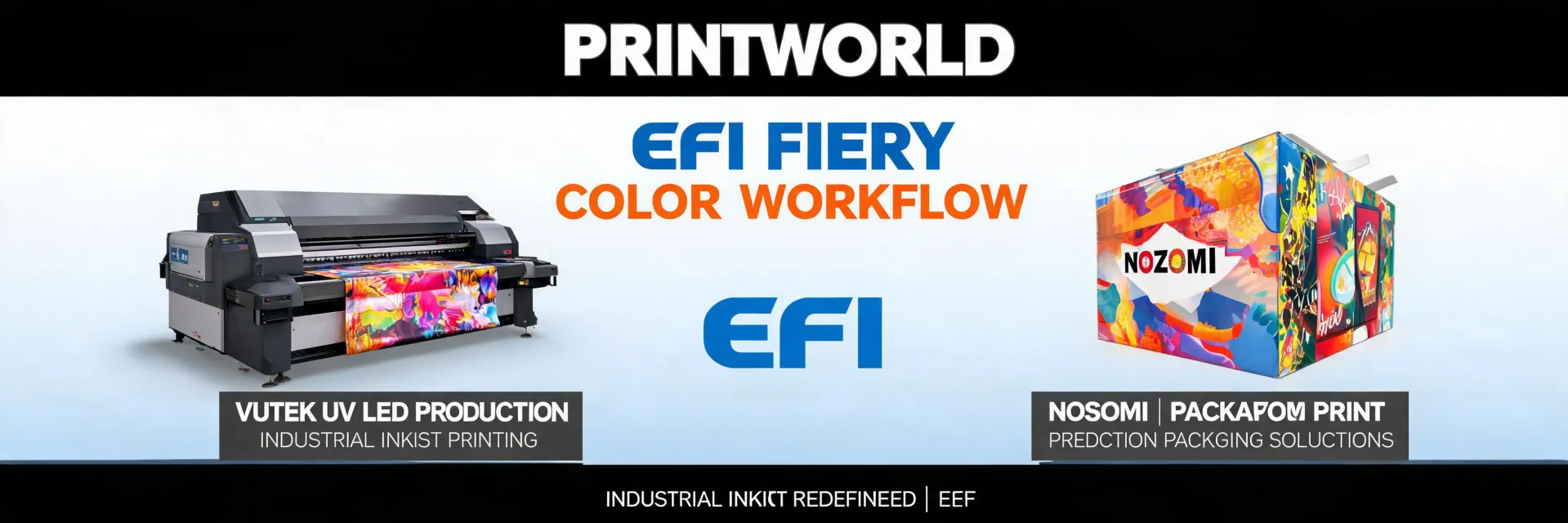
Let's start with the obvious question. When I hear someone searching for "EFI fuel injector cleaning service" alongside "EFI Vutek printers," I know exactly what kind of week they've had. The search query feels like a cry for help. You're staring at a $200,000 Vutek Q5r Pro that's decided today is the day it won't lay down ink correctly. You're not looking for a car part; you're looking for a way to unclog a printhead without losing a 48-hour deadline.
I'm a production manager at a large-format printing house in the Midwest. I've coordinated over 450 rush jobs in the last six years, including same-day turnarounds for Fortune 500 trade show displays. When a client calls at 4 PM on a Friday needing 50 corrugated displays for a Tuesday launch, I'm the person who finds the solution. And I've learned that the 'printer not printing correctly' problem is rarely about a dirty printhead. It's almost always about a flawed decision made three months ago.
Surface Problem: The Unreliable Output
You see a band. You see a nozzle out. You run a nozzle check. Maybe you run a cleaning cycle. Maybe two. The status light is flashing amber—wait, no, it's solid red now. The job is paused. You've got 40 sheets of $12 corrugated board that are now scrap.
The immediate urge is to blame the hardware. 'The EFI Vutek is down again,' you say. Or, 'The H1625 is acting up.' But here's the thing: in my experience, a well-maintained industrial EFI printer doesn't just 'act up' on a critical job unless something was ignored or undervalued beforehand.
I don't have hard data on industry-wide printhead failure rates, but based on our fleet of three Vutek printers and one Nozomi, I'd say about 70% of emergency service calls are preventable. They're the result of deferred maintenance pushed by a 'cost-per-click' mindset instead of a 'total cost of ownership' mindset.
Deep Cause: The Hidden Cost of Cheap Consumables
Let's get specific. You're running a DTF printer for a rush order of custom apparel. Your standard supplier quoted $120 for a liter of ink. You found a 'compatible' ink for $60. You saved $60. Good for you. Except now the printer isn't printing correctly. The head is clogged. You've lost a day of production on a machine that costs you $80 an hour in labor and overhead. That $60 'savings' just cost you $640.
This is where the total cost thinking comes in. The cheapest initial price is almost always the most expensive long-term option. That $500 quote for a third-party controller board for your 3D printer? It might work for a week. But when it fails, you're not just replacing the board—you're replacing the printhead it shorted out. That's a $2,000 mistake to save $300 on the original Fiery DFE component.
I learned this the hard way in 2022. We tried to cut costs by using a generic cleaning solution on our EFI flatbed. It worked fine for two weeks. Then we started seeing micro-corrosion in the ink lines. The service technician literally said, 'You saved $200 on cleaner. You're now looking at a $3,000 repair and a week of downtime.' That week cost us a contract worth $15,000. We now have a strict 'OEM or approved equivalent' policy. Period.
What I mean is that the 'printer not printing correctly' isn't a technical glitch—it's a symptom of a procurement philosophy. You've optimized for the wrong variable.
The Real Price of Downtime
You're looking for 'efi fuel injector cleaning service' because you're desperate. You've tried the automated clean cycle three times. You've power-cycled. You've even looked at the manual—or rather, you've looked at where you think you left the manual.
Let's put a number on this. According to general industry metrics shared at the 2024 PRINTING United show, a mid-sized label or corrugated facility loses an average of $2,500 per hour of unscheduled downtime. That's not just lost production; that's late penalties, re-ship costs, and lost future business.
In Q3 of last year, a client needed 1,200 EFI Nozomi printed boxes for a product launch. The job was scheduled for Monday. The printer threw an error on Sunday morning—a head strike caused by a warped board we didn't catch. Normal turnaround was 24 hours for that service. We had 12. We paid $400 extra in emergency service fees to a third-party tech to get it running by 8 PM. The client's alternative was a $12,000 penalty clause for missing the launch. We saved the contract, but it was a close call. That $400 was nothing compared to the $12,000 risk.
That's the cost you don't see when you're just Googling 'printer not printing correctly.' You see the symptom. You don't see the $12,000 bomb ticking in the background.
The Solution: A Pause for Triage
So, your EFI printer is down. The problem is deep. You have 24 hours before your client needs those wide-format prints for a store opening. What do you do?
First, stop Googling 'DTF printer cleaning service' or 'how to fix EFI inkjet.' The internet is full of general advice. You need specific triage.
1. Isolate the mechanical issue.
Is it a nozzle clog (cleaning cycle might fix it) or is it a damaged head (needs replacement)? Run a test print. If the banding is in the same place every time, it's a nozzle. If it's random or there's a physical mark on the print, it's mechanical damage. Know the difference. I've spent 45 minutes running cleaning cycles on a head that was physically cracked. I don't do that anymore.
2. Call your service partner. Not your sales rep.
If you have an EFI Vutek or a Nozomi, you should have a relationship with a local service technician who stocks common parts. If you don't have that number saved—well, that's a TCO lesson for next month. Right now, find the number. Tell them: 'I have a machine down, this is the error code, this is what I've tried, and I need a technician here within 4 hours or a loaner head shipped overnight.'
3. Calculate your alternative.
If you can't fix the machine in 12 hours, do you have a backup? Can you outsource the job to a partner shop? This is the 'feasibility' check. It might cost you 20% more, but it saves the $12,000 contract. This isn't a failure of your shop; it's a risk management decision. I've done it three times this year. We paid more, but we kept the client.
The bottom line? A printer error is not a technical failure. It's a signal that your operational strategy—your total cost thinking—has a gap. Fix the printer. But then, audit your consumables, your maintenance schedule, and your 'cheaper quote' habits. Because the next emergency is already coming.
Pricing as of January 2025; verify current rates with your supplier. Diagnostic advice based on 6 years of operational experience with EFI equipment.

Elise Marceau is an LED display and digital-signage systems analyst covering LED video walls, modular screens, transparent LED, control processors, and indoor or outdoor signage. She applies IEC 62368-1 safety principles while comparing pixel pitch, luminance, contrast, refresh rate, colour uniformity, viewing angle, ingress protection, power density, module serviceability, and signal redundancy. Her specification guides help integrators, venue operators, retailers, and procurement teams align viewing distance, ambient light, content format, installation access, electrical load, and lifecycle support.